Define data quality standards for the application inventory - Application Portfolio Management (APM) Best Practices
Define data quality standards for the application inventory
(Chapter 36 of Application Portfolio Management (APM) Best Practices)
Executive Summary: Chapter Overview
IF4ITThe Bottom Line
Core Concepts
| Concept | Definition & Strategic Role |
|---|---|
| Data Quality Dimensions | The explicit measures of inventory quality — completeness (which records exist), accuracy (whether the values are correct), currency (whether the values are up to date), and consistency (whether the values align across inventories) — each with defined targets. |
| Data Quality Reporting | The regular measurement and reporting of inventory quality against the defined standards, so quality problems surface as inventory quality issues before they surface as analysis errors. |
Quick Q&A
Question: Why must data quality standards be explicit rather than implicit?
Question: What are the typical quality targets for the Applications Inventory?
Read More Below
Overview
An application inventory without defined quality standards is an inventory whose quality cannot be measured, enforced, or improved systematically. Different Application Owners contribute data at different levels of completeness and accuracy. The same attribute means different things in different records because there are no controlled vocabularies or format standards. The inventory’s reliability as a foundation for portfolio decisions is unknown, and neither leadership nor practitioners can know whether to trust the analyses built on top of it.
Best Practice
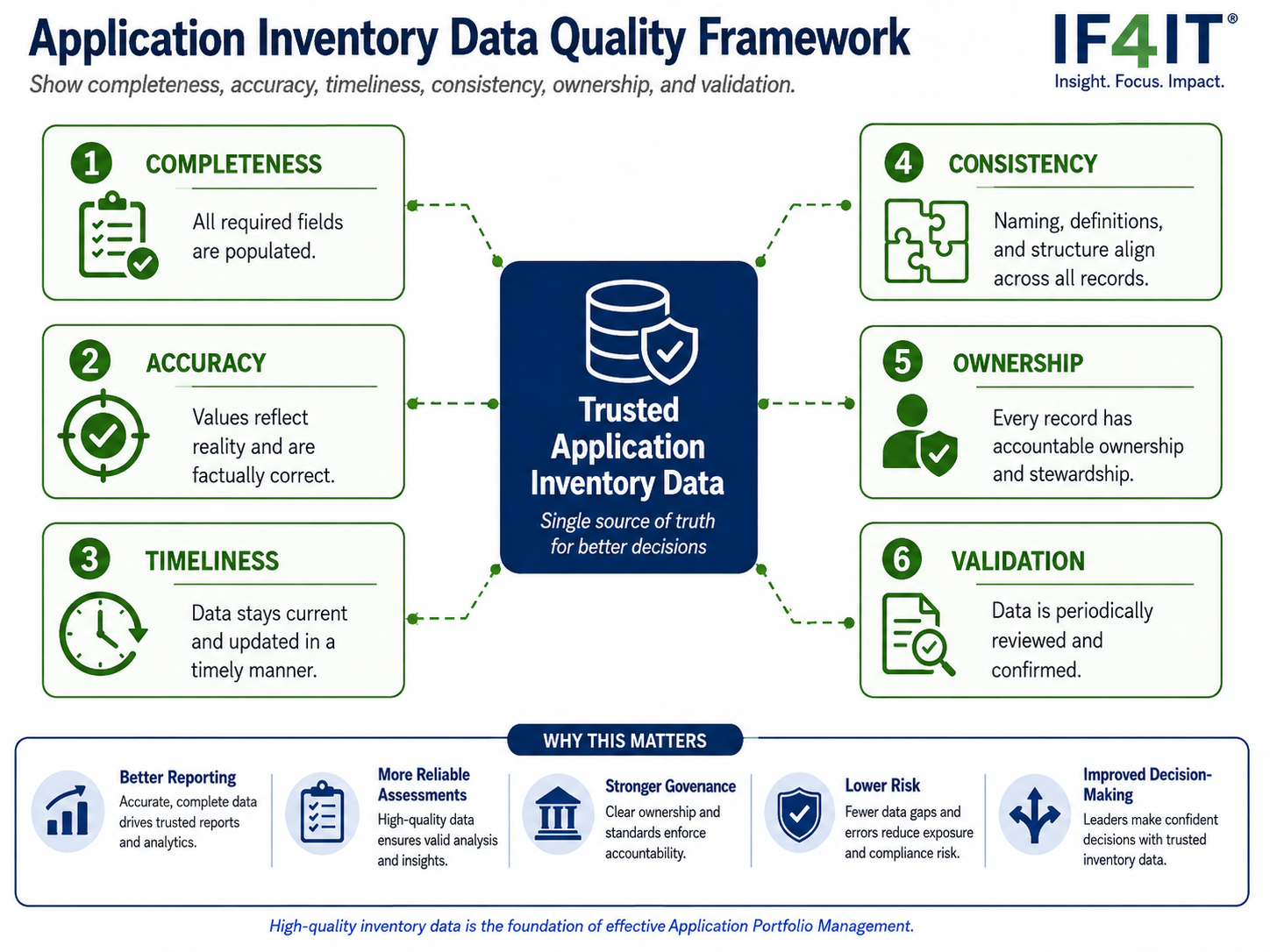
Define formal data quality standards for the application inventory covering at minimum four dimensions. Completeness measures the percentage of required attributes that have values across all records. Accuracy measures the percentage of attribute values that correctly represent the current state of the application they describe. Currency measures the percentage of records that have been validated within the required review period. Consistency measures the percentage of records that comply with defined naming conventions, controlled vocabularies, and formatting standards. Set minimum acceptable thresholds for each dimension, measure quality on a defined cadence, and report quality scores as a standard element of portfolio health reporting.
Consistent, standardized data is the foundation that makes reliable application portfolio management possible - without a defined data quality standard, portfolio-wide analysis and comparison across applications breaks down.
Benefit(s)
Defined data quality standards transform the application inventory from a collection of records of unknown reliability into a governed data asset with measurable trustworthiness. Portfolio analyses are qualified by the quality of the data underlying them - leaders know the confidence level of the data they are using for decisions. Improvement investments are directed toward the quality dimensions with the greatest gaps. Over time, consistent quality standards produce a portfolio database that leadership treats as an authoritative source of organizational intelligence rather than a best-effort IT tool of uncertain reliability.
How to cite this page
When referencing this page in academic work, internal standards, or external publications, include the page title, IF4IT as author and publisher (The International Foundation for Information Technology (IF4IT), LLC), the URL, and your access date.
Example (informal web citation):
The International Foundation for Information Technology (IF4IT), LLC. Define data quality standards for the application inventory | Application Portfolio Management (APM) Best Practices. https://if4it.org/best-practices/application-portfolio-management-apm/define-data-quality-standards-for-the-application-inventory/ (accessed 2026-10-22).
See About Us for content governance and site-wide citation guidance.
Copyright for The International Foundation for Information Technology (IF4IT), LLC: 2008 - Present
Legal Disclaimers