Define what C-level leaders need from APM dashboards and reports to make them genuinely valuable - Application Portfolio Management (APM) Best Practices
Define what C-level leaders need from APM dashboards and reports to make them genuinely valuable
(Chapter 149 of Application Portfolio Management (APM) Best Practices)
Executive Summary: Chapter Overview
IF4ITThe Bottom Line
Core Concepts
| Concept | Definition & Strategic Role |
|---|---|
| C-Level Reporting Requirements | The specific reporting content C-level leaders need — portfolio state at a glance, exceptions requiring their attention, trends that inform strategic conversations, and decisions requiring their approval — presented at the level of aggregation appropriate to C-level attention. |
| Decision-Relevant Reporting | Reporting content selected and structured to support specific decisions leaders make — not reporting that presents all available data without selection, which places the burden of identifying decision-relevant content on the reader. |
Quick Q&A
Question: Why do C-level APM dashboards fail more often than they succeed?
Question: What does C-level APM reporting look like when it works?
Read More Below
Overview
APM dashboards and reports that present technical data in technical formats do not serve the C-level leadership audience that is the most important consumer of portfolio intelligence for strategic decision-making. A dashboard showing application count by technology stack, or a report listing applications by technical fitness score, provides information that technology teams find useful but that CIOs, CTOs, CFOs, COOs, and CEOs cannot readily translate into the strategic and financial decisions they are responsible for making. APM reporting that is not designed explicitly for its executive audience produces reporting that leaders receive, acknowledge, and do not act on - failing the primary purpose of making portfolio intelligence available to the people with the authority and the accountability to use it.
Best Practice
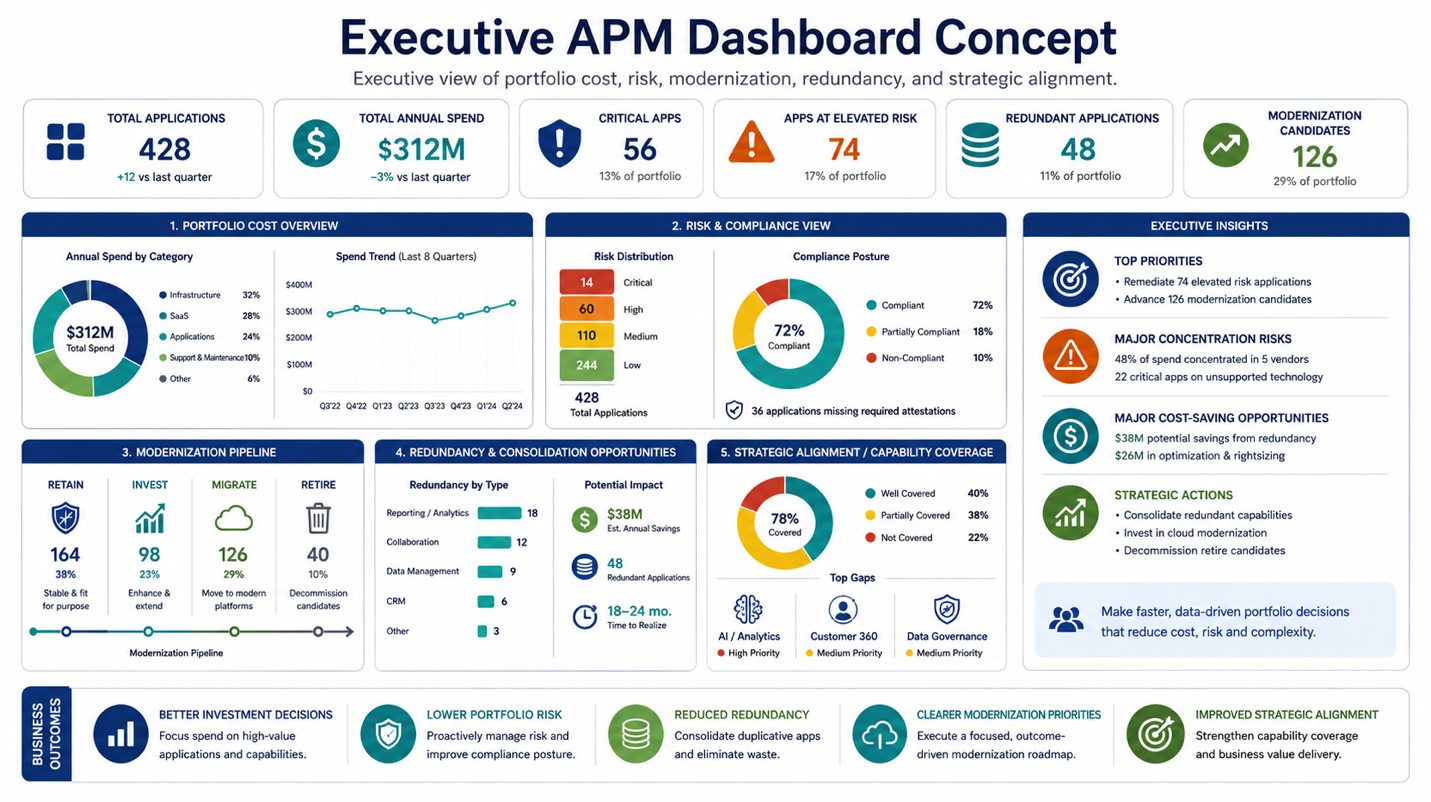
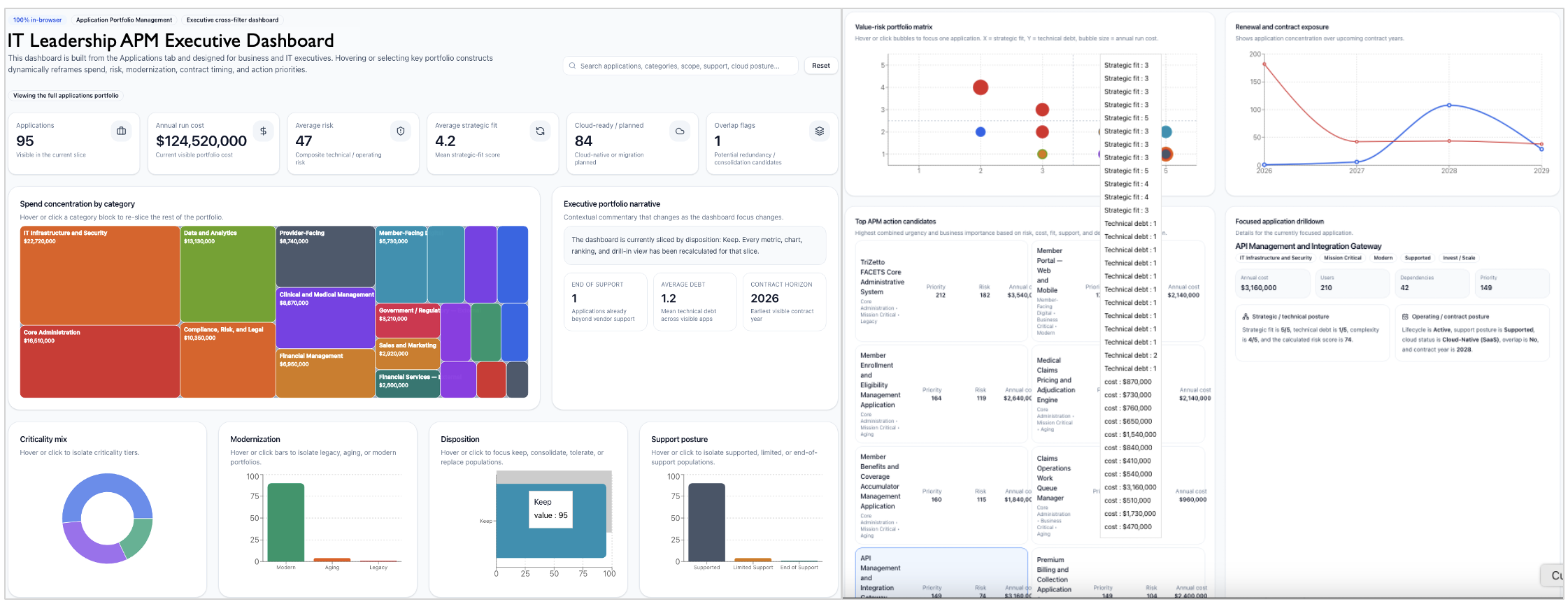
Design APM dashboards and reports for the C-level audience by starting with the decisions those leaders make and working backward to the information those decisions require. C-level leaders need from APM reporting: the total financial picture of the application portfolio with year-over-year trend and clear identification of the largest cost drivers and the largest waste opportunities; the portfolio’s risk profile expressed in business impact terms - how many critical business capabilities are at risk from EOL technology, vendor instability, or security exposure; the alignment of the portfolio with current business strategy - what percentage of applications support active strategic priorities and what is the investment trajectory toward closing capability gaps; and the rationalization progress and its financial impact - what has been accomplished, what has been saved, and what is planned. Present all of this in natural language narrative alongside visual summaries, not in technical dashboards that require interpretation.
Benefit(s)
C-level-appropriate APM reporting produces portfolio intelligence that organizational leaders can act on directly rather than requiring technical translation before use. Leaders who receive portfolio intelligence in their natural decision-making language engage with portfolio decisions more actively, more frequently, and more specifically than leaders who receive technical reports they cannot readily interpret. APM earns its place as a strategic management tool rather than a technology management artifact by consistently delivering intelligence in the form and language that strategic decision-making requires.
How to cite this page
When referencing this page in academic work, internal standards, or external publications, include the page title, IF4IT as author and publisher (The International Foundation for Information Technology (IF4IT), LLC), the URL, and your access date.
Example (informal web citation):
The International Foundation for Information Technology (IF4IT), LLC. Define what C-level leaders need from APM dashboards and reports to make them genuinely valuable | Application Portfolio Management (APM) Best Practices. https://if4it.org/best-practices/application-portfolio-management-apm/define-what-c-level-leaders-need-from-apm-dashboards-and-reports-to-make-them-genuinely-valuable/ (accessed 2026-10-22).
See About Us for content governance and site-wide citation guidance.
Copyright for The International Foundation for Information Technology (IF4IT), LLC: 2008 - Present
Legal Disclaimers