Define what practitioners need from APM tools to support day-to-day portfolio management - Application Portfolio Management (APM) Best Practices
Define what practitioners need from APM tools to support day-to-day portfolio management
(Chapter 150 of Application Portfolio Management (APM) Best Practices)
Executive Summary: Chapter Overview
IF4ITThe Bottom Line
Core Concepts
| Concept | Definition & Strategic Role |
|---|---|
| Practitioner Tool Requirements | The specific tool capabilities practitioners need — efficient data entry and update, workflow support for common activities (assessment, review, disposition assignment), analytical capabilities for portfolio investigation, and integration with adjacent systems (procurement, finance, security). |
| Practice-Enabling Tools | Tools designed to make the practice of portfolio management efficient and repeatable — distinct from reporting tools designed to communicate portfolio state to leadership. Both capabilities matter; neither serves the other’s purpose. |
Quick Q&A
Question: What happens when APM tools serve only leadership needs?
Question: What practitioner capabilities are typically most important?
Read More Below
Overview
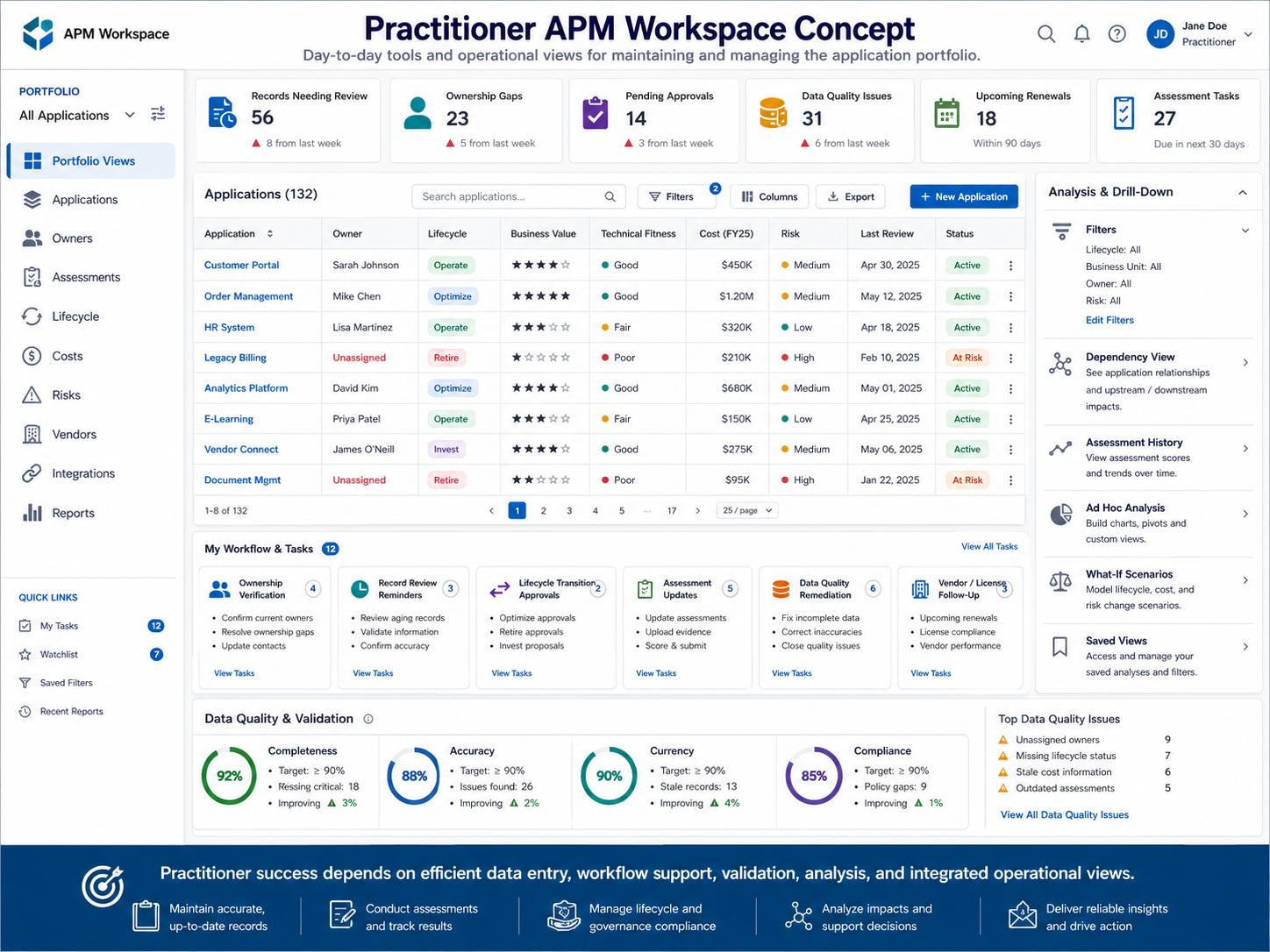
APM practitioners - portfolio analysts, Application Owners, Technology Stewards, and Finance Partners - have very different tool requirements from the C-level leaders who consume portfolio reporting. Practitioners need tools that make the day-to-day work of maintaining portfolio data, conducting assessments, tracking governance compliance, and producing analysis efficient and consistent. Tools designed only for executive reporting fail practitioners by making data entry, validation, and analysis burdensome. Tools designed only for data management fail executives by producing technical outputs that require significant effort to translate into strategic intelligence. Effective APM tooling serves both audiences from the same underlying data without requiring parallel systems or manual reporting translation.
Best Practice
Define practitioner requirements for APM tooling alongside executive requirements, and evaluate tools against both. Practitioners need: efficient data entry mechanisms that minimize the burden on Application Owners and contributing teams while enforcing the data standards that governance requires; workflow automation for recurring governance activities including ownership verification, record review reminders, and lifecycle transition approvals; data quality monitoring that surfaces completeness, accuracy, and currency gaps without requiring manual audit effort; assessment tools that apply the standard assessment framework consistently and produce comparable outputs across the portfolio; and analytical capabilities that enable portfolio analysts to answer ad hoc questions from the portfolio data without requiring custom development or data engineering for each new analysis.
Benefit(s)
Practitioner-appropriate APM tooling reduces the operational burden of portfolio management, increases data quality by making compliance with data standards easier than non-compliance, and enables the analytical work that produces portfolio intelligence at scale. When portfolio management tools are well-designed for practitioners, Application Owners maintain their records more reliably because the tool makes compliance convenient. Portfolio Analysts produce more analysis more quickly because the tool provides the analytical capabilities they need without requiring custom development. The quality and currency of the portfolio data that leadership consumes in executive reporting improves because the operational tools that produce that data serve their users effectively.
How to cite this page
When referencing this page in academic work, internal standards, or external publications, include the page title, IF4IT as author and publisher (The International Foundation for Information Technology (IF4IT), LLC), the URL, and your access date.
Example (informal web citation):
The International Foundation for Information Technology (IF4IT), LLC. Define what practitioners need from APM tools to support day-to-day portfolio management | Application Portfolio Management (APM) Best Practices. https://if4it.org/best-practices/application-portfolio-management-apm/define-what-practitioners-need-from-apm-tools-to-support-day-to-day-portfolio-management/ (accessed 2026-10-22).
See About Us for content governance and site-wide citation guidance.
Copyright for The International Foundation for Information Technology (IF4IT), LLC: 2008 - Present
Legal Disclaimers