Design for federated APM - centralize ownership of cross-enterprise inventories, federate ownership of operationally-homed inventories - Application Portfolio Management (APM) Best Practices
Design for federated APM - centralize ownership of cross-enterprise inventories, federate ownership of operationally-homed inventories
(Chapter 24 of Application Portfolio Management (APM) Best Practices)
Executive Summary: Chapter Overview
IF4ITThe Bottom Line
Core Concepts
| Concept | Definition & Strategic Role |
|---|---|
| Centralized Cross-Enterprise Inventories | Inventories whose scope spans the whole enterprise and whose value comes from consistency across delivery teams — Applications, Integrations, Capabilities — that must be centrally owned by APM to produce enterprise-scoped analysis. |
| Federated Operationally-Homed Inventories | Inventories that are inherently produced and consumed by operational teams — incidents, changes, defects, performance data — that APM consumes but does not own, with the owning teams responsible for quality and currency. |
Quick Q&A
Question: Why not centralize every inventory APM depends on?
Question: How does APM enforce quality on federated inventories it does not own?
Read More Below
Overview
APM governance must resolve a fundamental tension: the application portfolio spans the entire enterprise, but the knowledge required to maintain it is distributed across the teams that build, operate, and depend on those applications. Any governance model that ignores this tension will fail to scale.
A purely centralized model—where a single team owns and maintains all portfolio data—creates bottlenecks, limits responsiveness, and separates data maintenance from operational reality. A purely distributed model—where each organizational unit manages its own data independently—produces inconsistency, weak governance, and an enterprise view that cannot be trusted.
Effective APM design resolves this tension by deliberately combining centralization and federation. The goal is not to choose one model over the other, but to apply each where it is most appropriate.

Best Practice
Design APM using a federated operating model that clearly defines what is centrally governed and what remains distributed to operational owners.
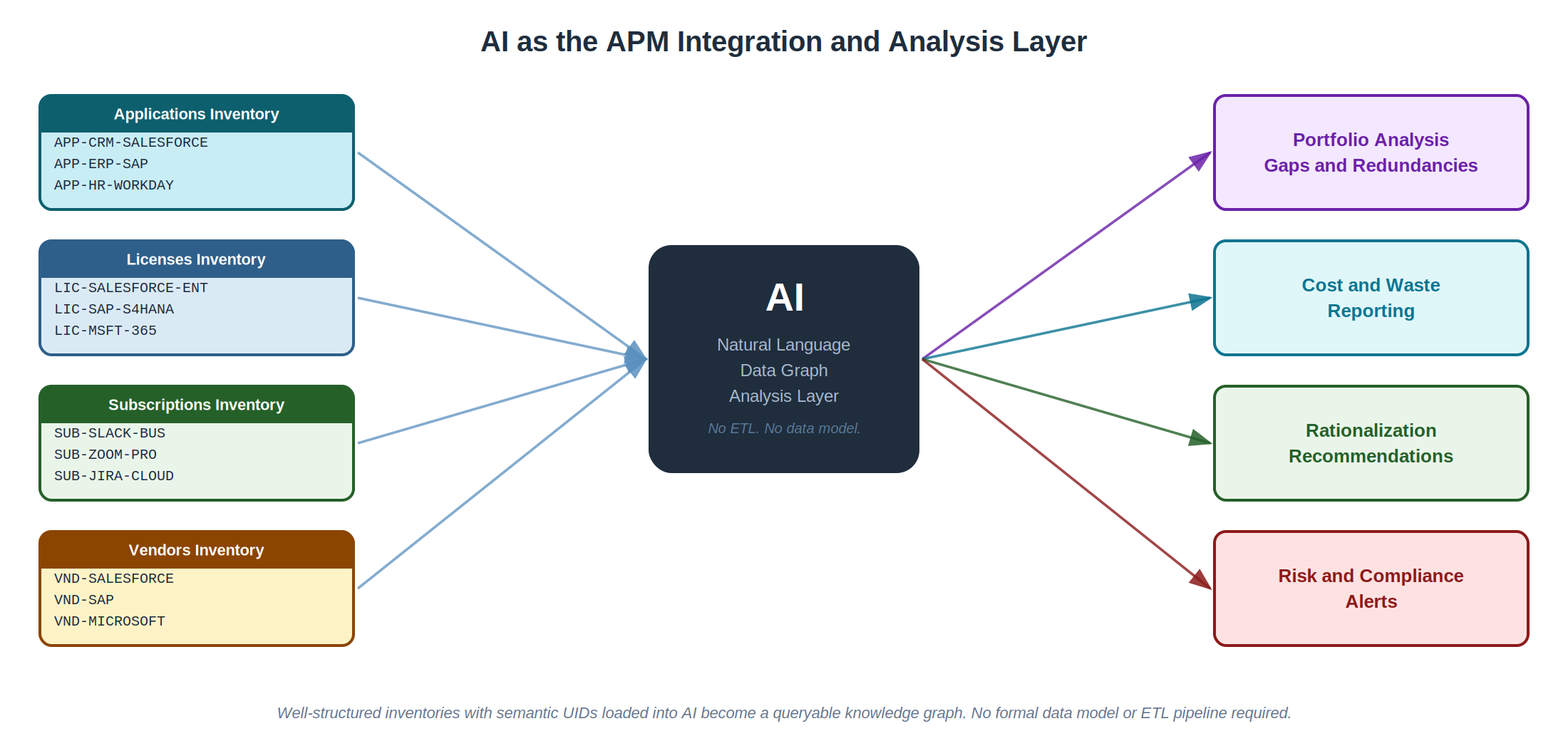
Cross-enterprise inventories—such as the Applications Inventory, Software Licenses Inventory, Software Subscriptions Inventory, Data Integrations Inventory, and Vendors and Suppliers Inventory—should be centrally owned and governed by Enterprise Architecture or an equivalent enterprise-level function. These inventories span organizational boundaries, require consistent standards, and must support enterprise-wide analysis and decision-making.
Operationally-homed data—such as defect records from Engineering, incident records from IT Operations, change records from Change Management, and performance data from monitoring platforms—should remain owned and maintained by the teams closest to the work. These teams have the context and expertise required to keep the data accurate and current.
APM should be positioned as the integrator of these domains. It consumes and connects operational data but does not attempt to own or govern it. The federated model must be explicitly defined, documented, and reinforced through governance so that ownership boundaries are clear and consistently applied.
Benefit(s)
A federated APM model captures the strengths of both centralization and distribution without inheriting their respective weaknesses. Cross-enterprise data remains consistent, authoritative, and aligned to enterprise standards because it is centrally governed. Operational data remains accurate and current because it is maintained by the teams with direct knowledge and accountability.
The resulting portfolio view is both coherent and trustworthy. Leaders can rely on the data because it reflects both enterprise-level consistency and operational reality. At the same time, the APM capability scales effectively because responsibility for data maintenance is distributed to the appropriate owners rather than concentrated in a central team that cannot keep pace with enterprise complexity.
How to cite this page
When referencing this page in academic work, internal standards, or external publications, include the page title, IF4IT as author and publisher (The International Foundation for Information Technology (IF4IT), LLC), the URL, and your access date.
Example (informal web citation):
The International Foundation for Information Technology (IF4IT), LLC. Design for federated APM - centralize ownership of cross-enterprise inventories, federate ownership of operationally-homed inventories | Application Portfolio Management (APM) Best Practices. https://if4it.org/best-practices/application-portfolio-management-apm/design-for-federated-apm-centralize-ownership-of-cross-enterprise-inventories-federate-ownership-of-operationally-homed-inventories/ (accessed 2026-09-08).
See About Us for content governance and site-wide citation guidance.
Copyright for The International Foundation for Information Technology (IF4IT), LLC: 2008 - Present
Legal Disclaimers