Distinguish between the active portfolio and the application pipeline - Application Portfolio Management (APM) Best Practices
Distinguish between the active portfolio and the application pipeline
(Chapter 124 of Application Portfolio Management (APM) Best Practices)
Executive Summary: Chapter Overview
IF4ITThe Bottom Line
Core Concepts
| Concept | Definition & Strategic Role |
|---|---|
| Active Portfolio vs. Pipeline | Two distinct application populations: the active portfolio (governance-approved, operational, consuming budget, requiring ongoing management) and the application pipeline (in development or evaluation, not yet operational, requiring entry planning) — each with distinct governance treatment. |
| Population-Specific Governance | The application of governance treatment appropriate to each population — active portfolio governance focuses on operational and lifecycle decisions; pipeline governance focuses on evaluation, entry preparation, and go/no-go decisions. |
Quick Q&A
Question: What breaks when the two are conflated?
Question: How is the distinction typically operationalized?
Read More Below
Overview
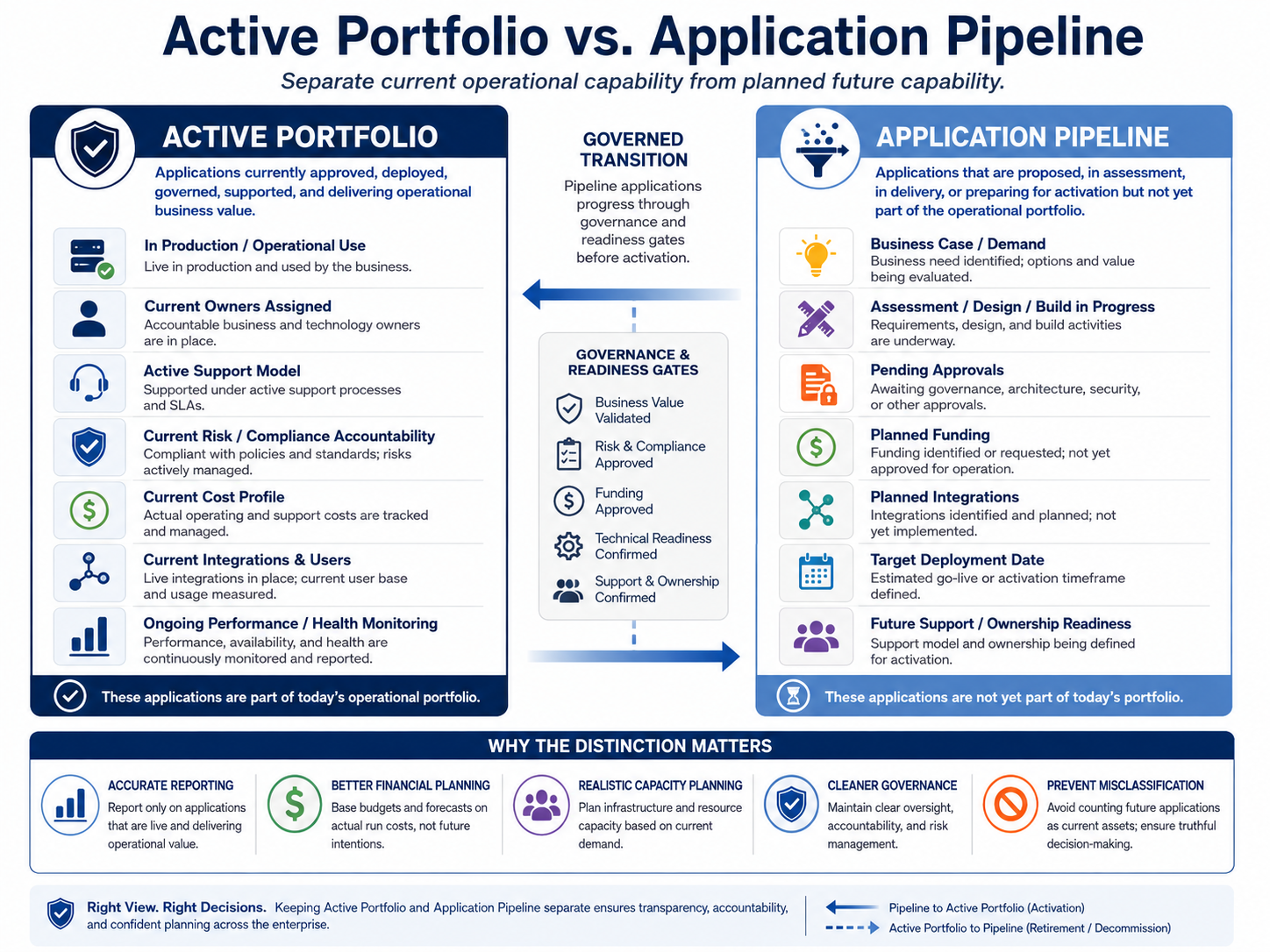
Applications under development, in evaluation, or in pilot are not yet Active applications. They have not been validated against production requirements, have not completed governance review required for Active status, and may change significantly or not proceed to Active status at all. When Proposed applications are listed alongside Active applications without clear distinction, the portfolio presents a misleading picture of current operational capability. Decision-makers may assess the portfolio’s capability coverage based on planned rather than actual capability, leading to investment decisions that duplicate what is already in progress.
Best Practice
Maintain a strict, visible boundary between the Active portfolio and the application pipeline in all portfolio reporting, communication, and governance documentation. The Active portfolio contains only applications fully deployed, validated, and available to their intended users under the governance of the lifecycle model. The application pipeline is reported separately, with explicit labeling indicating it represents planned and in-progress capability rather than current operational capability. Never represent pipeline applications as portfolio applications in capability maps, service catalogs, or operational planning documents without clearly indicating their development or evaluation status and the governance conditions required for Active status.
Benefit(s)
A strict Active-pipeline boundary preserves the accuracy and trustworthiness of the portfolio as a representation of current organizational capability. Users and business leaders can rely on the Active portfolio as an accurate representation of what is currently available for operational use. Pipeline reporting informs future planning without inflating the current capability picture or creating premature expectations. The organization develops portfolio communication practices that build stakeholder trust in the accuracy and reliability of portfolio data.
How to cite this page
When referencing this page in academic work, internal standards, or external publications, include the page title, IF4IT as author and publisher (The International Foundation for Information Technology (IF4IT), LLC), the URL, and your access date.
Example (informal web citation):
The International Foundation for Information Technology (IF4IT), LLC. Distinguish between the active portfolio and the application pipeline | Application Portfolio Management (APM) Best Practices. https://if4it.org/best-practices/application-portfolio-management-apm/distinguish-between-the-active-portfolio-and-the-application-pipeline/ (accessed 2026-10-22).
See About Us for content governance and site-wide citation guidance.
Copyright for The International Foundation for Information Technology (IF4IT), LLC: 2008 - Present
Legal Disclaimers