Establish a FinOps practice with defined roles spanning Finance, Engineering, and Business - Application Portfolio Management (APM) Best Practices
Establish a FinOps practice with defined roles spanning Finance, Engineering, and Business
(Chapter 100 of Application Portfolio Management (APM) Best Practices)
Executive Summary: Chapter Overview
IF4ITThe Bottom Line
Core Concepts
| Concept | Definition & Strategic Role |
|---|---|
| Cross-Functional FinOps Practice | The structured collaboration across Finance (owns budget and financial visibility), Engineering (controls the consumption decisions that produce cost), and Business (owns the business demand that justifies the consumption) — with named roles and defined interfaces across the three. |
| FinOps Role Definition | The specific role definitions — FinOps practitioners, engineering champions, finance liaisons, business owners — that collectively operate the practice, with defined accountabilities that prevent decision hand-offs from becoming decision voids. |
Quick Q&A
Question: Why does FinOps fail without cross-functional structure?
Question: What are the typical roles in the FinOps practice?
Read More Below
Overview
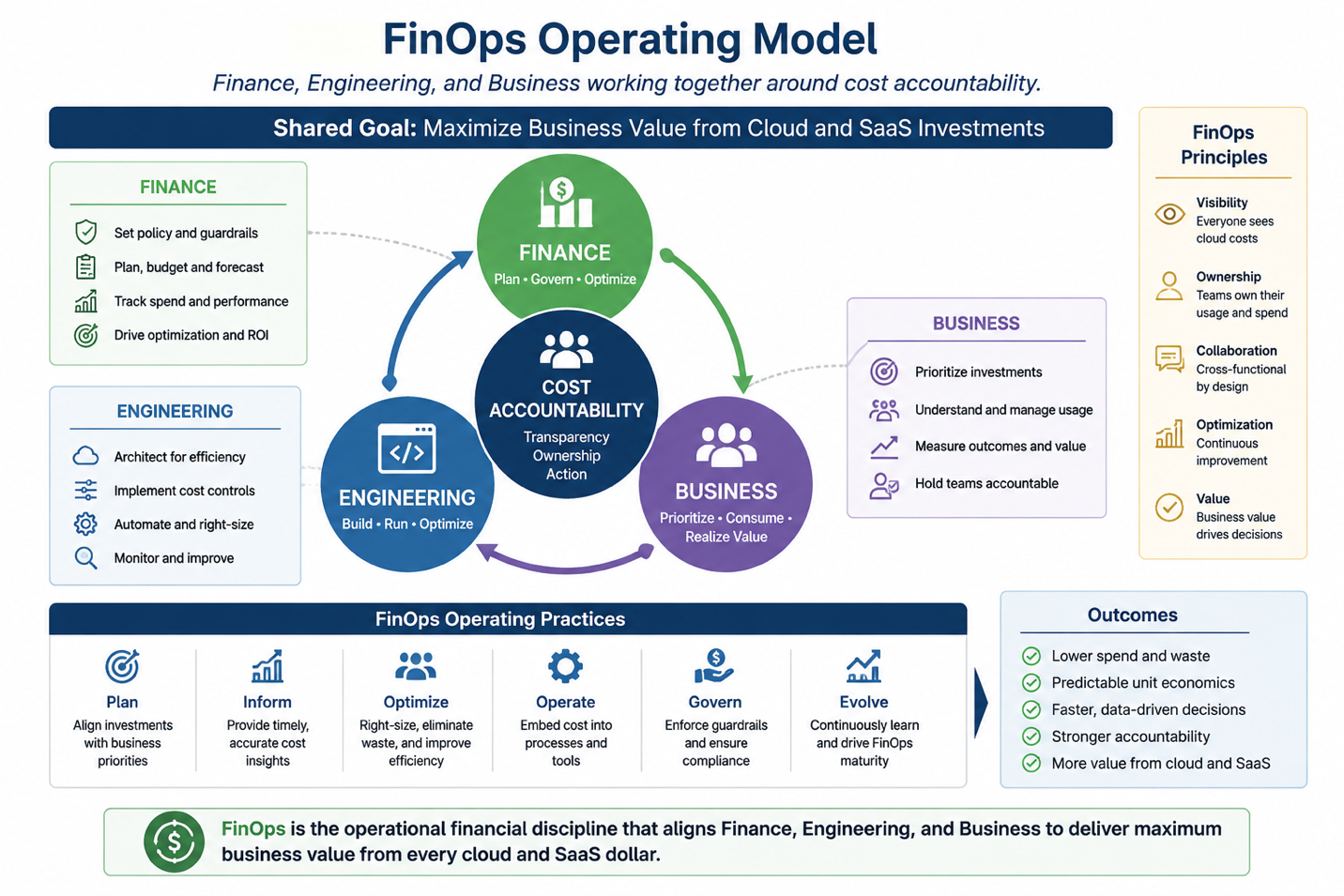
FinOps is fundamentally a cross-functional discipline that fails when it is treated as solely a Finance function, solely an Engineering function, or solely a Business demand management function. Finance brings the financial accountability frameworks, budget governance mechanisms, and reporting capabilities that cloud spending requires. Engineering brings the technical knowledge needed to understand what cloud resources are doing, why they are consuming what they consume, and what optimization actions are technically feasible and safe to implement. Business teams bring the demand context - the understanding of which spending supports current priorities and which is supporting stale or deprecated activities that have already concluded. None of these three perspectives alone is sufficient for effective cloud financial management.
Best Practice
Define a formal FinOps operating model with explicit roles and responsibilities for Finance, Engineering, and Business stakeholders. The Finance role is responsible for budget governance, chargeback and showback reporting, variance analysis against budget, and financial forecasting of cloud and SaaS spend. The Engineering role is responsible for resource tagging and labeling compliance, technical implementation of cost-optimization actions, architecture decisions that affect cost, and technical feasibility assessment of optimization opportunities identified by Finance or Business. The Business role is responsible for demand management, utilization accountability for tools and resources allocated to their functions, and business justification for spending decisions. Establish a regular cross-functional FinOps review meeting at which all three perspectives contribute to optimization prioritization and decision-making.
Benefit(s)
A cross-functional FinOps operating model produces optimization decisions that are financially sound, technically feasible, and operationally appropriate simultaneously rather than optimizing one dimension at the expense of the others. Finance governance prevents budget overruns without blocking the engineering work that delivers business value. Engineering expertise enables the technical optimization actions that reduce spending without degrading performance or availability. Business accountability creates the demand discipline that prevents unnecessary consumption from accumulating undetected. The cross-functional model also builds mutual understanding - Finance understands the technical drivers of cloud cost, Engineering understands the financial implications of architectural decisions, and Business understands the cost of its technology consumption.
How to cite this page
When referencing this page in academic work, internal standards, or external publications, include the page title, IF4IT as author and publisher (The International Foundation for Information Technology (IF4IT), LLC), the URL, and your access date.
Example (informal web citation):
The International Foundation for Information Technology (IF4IT), LLC. Establish a FinOps practice with defined roles spanning Finance, Engineering, and Business | Application Portfolio Management (APM) Best Practices. https://if4it.org/best-practices/application-portfolio-management-apm/establish-a-finops-practice-with-defined-roles-spanning-finance-engineering-and-business/ (accessed 2026-10-22).
See About Us for content governance and site-wide citation guidance.
Copyright for The International Foundation for Information Technology (IF4IT), LLC: 2008 - Present
Legal Disclaimers