Establish APM as a due diligence requirement in every M&A transaction - Application Portfolio Management (APM) Best Practices
Establish APM as a due diligence requirement in every M&A transaction
(Chapter 140 of Application Portfolio Management (APM) Best Practices)
Executive Summary: Chapter Overview
IF4ITThe Bottom Line
Core Concepts
| Concept | Definition & Strategic Role |
|---|---|
| APM in Due Diligence | The application of APM discipline during M&A due diligence — assessing the target’s application portfolio, its cost, its integration complexity, and its portfolio-level risk before deal close so these realities inform deal terms and post-close planning. |
| Portfolio-Aware Deal Structure | The structuring of M&A deals with awareness of portfolio realities — accounting for vendor commitment carry-over, integration cost, rationalization potential, and specific portfolio risks in the deal structure rather than assuming a generic ‘integrate portfolios’ approach. |
Quick Q&A
Question: What portfolio realities typically surface only after M&A close?
Question: What should APM due diligence produce for deal decision-making?
Read More Below
Overview
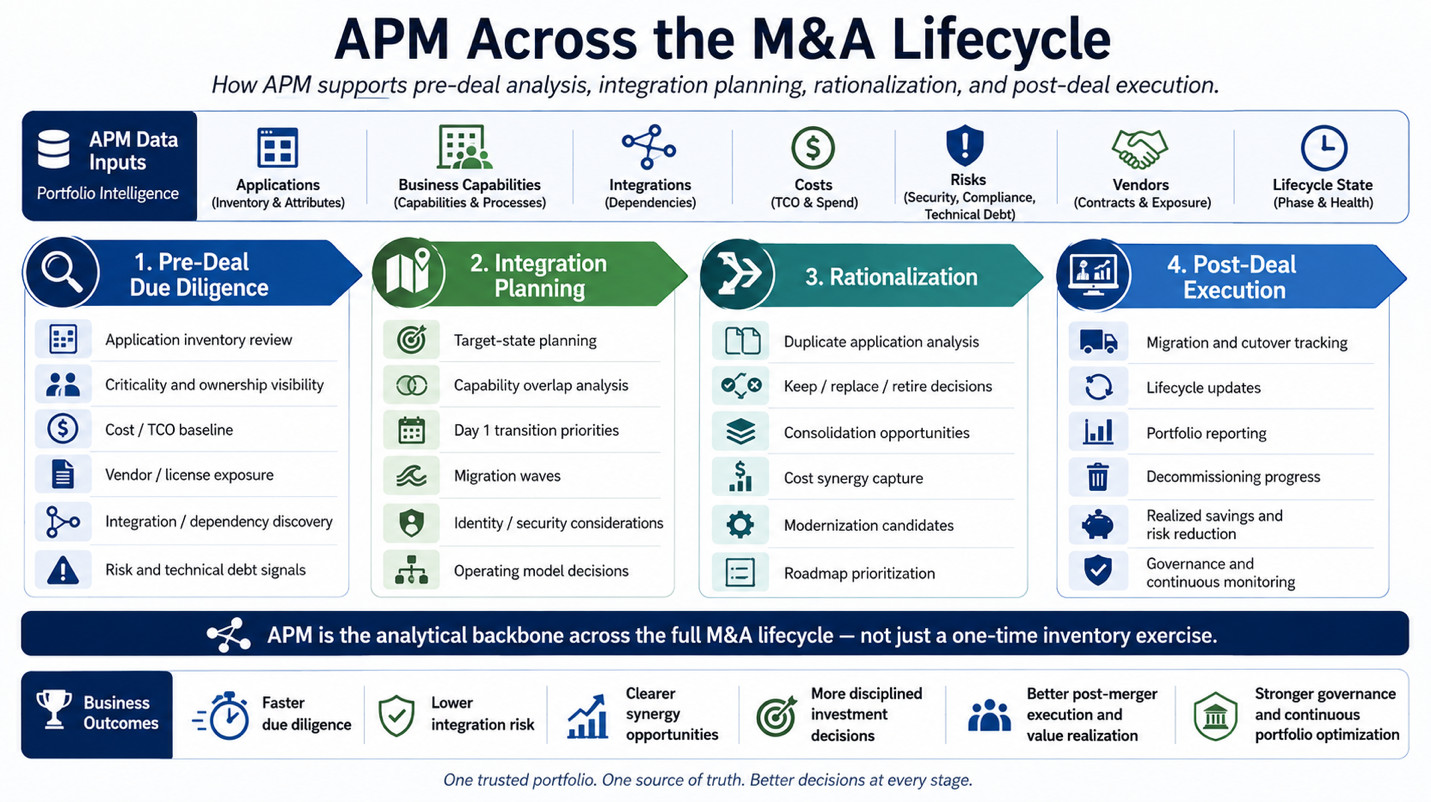
Application portfolio assessment is one of the most consistently underestimated components of technology due diligence in mergers and acquisitions. Organizations invest significant effort in financial, legal, and commercial due diligence, while conducting only superficial technology reviews that miss the application portfolio realities that will most directly affect the integration’s cost, timeline, and organizational impact. The application portfolio of an acquisition target contains information that is essential to accurate integration cost estimation, risk assessment, and deal valuation - information that is only available through structured APM-informed due diligence conducted before the deal is closed and while the organization still has the leverage to adjust deal terms or structure based on what is discovered.
Best Practice
Establish APM-informed application portfolio assessment as a standard, non-negotiable component of the technology due diligence process for every material M&A transaction. The portfolio assessment should be completed before deal close and its findings should directly inform deal valuation, integration cost estimation, and post-close integration planning. Define a standard due diligence portfolio assessment framework that addresses the questions most consequential for deal decision-making: what is the total cost of the target’s application portfolio including full TCO; what technical debt and EOL risk does it carry and what will remediation cost; what integration complexity will the combined portfolio create and what will that integration cost; and what rationalization opportunities and associated costs will the combination generate.
Benefit(s)
APM-informed M&A due diligence prevents the most common and most costly M&A integration failure: discovering post-close that the target’s application portfolio carries technical debt, integration complexity, and rationalization requirements that were not accounted for in deal valuation or integration planning. Deals are valued and structured with full awareness of the application portfolio implications rather than with hidden liabilities that emerge after the deal closes. Integration budgets are realistic rather than optimistic. The organization enters the post-close integration with a clear understanding of the portfolio challenge it is undertaking rather than an optimistic picture that will be revised upward under crisis conditions.
How to cite this page
When referencing this page in academic work, internal standards, or external publications, include the page title, IF4IT as author and publisher (The International Foundation for Information Technology (IF4IT), LLC), the URL, and your access date.
Example (informal web citation):
The International Foundation for Information Technology (IF4IT), LLC. Establish APM as a due diligence requirement in every M&A transaction | Application Portfolio Management (APM) Best Practices. https://if4it.org/best-practices/application-portfolio-management-apm/establish-apm-as-a-due-diligence-requirement-in-every-m-a-transaction/ (accessed 2026-10-22).
See About Us for content governance and site-wide citation guidance.
Copyright for The International Foundation for Information Technology (IF4IT), LLC: 2008 - Present
Legal Disclaimers