Application Portfolio Management (APM) Best Practices - Govern the application portfolio across all environments - not only Production
Application Portfolio Management (APM) Best Practices
Chapter 24. Govern the application portfolio across all environments - not only Production
Executive Summary: Chapter Overview
IF4ITThe Bottom Line
Core Concepts
| Concept | Definition & Strategic Role |
|---|---|
| Multi-Environment Governance | The extension of APM governance across all environments — development, test, staging, disaster recovery, and Production — so cost, risk, and compliance analysis reflect the full portfolio footprint. |
| Environment as Portfolio Attribute | The recognition that a single application typically exists across multiple environments and that each environment carries distinct cost, risk, and compliance implications requiring inventory representation. |
Quick Q&A
Question: Why does Production-only governance produce a distorted portfolio picture?
Question: How should non-Production environments be represented in the inventory?
Read More Below
Overview
Most APM programs are scoped to the Production environment by default - the reasoning being that Production is where applications deliver business value, incur operational cost, and create organizational risk. This reasoning is sound but incomplete. Applications that are installed and actively maintained across multiple environments - Development, Systems Integration Testing, User Acceptance Testing, Staging, and others - incur costs, carry risks, and require governance attention in each environment they occupy. An APM program that treats the Production portfolio as the complete picture of the organization’s application estate is systematically underestimating the total cost of its portfolio, misunderstanding the full complexity of its environment topology, and missing a category of risks that non-Production environments distinctively create.
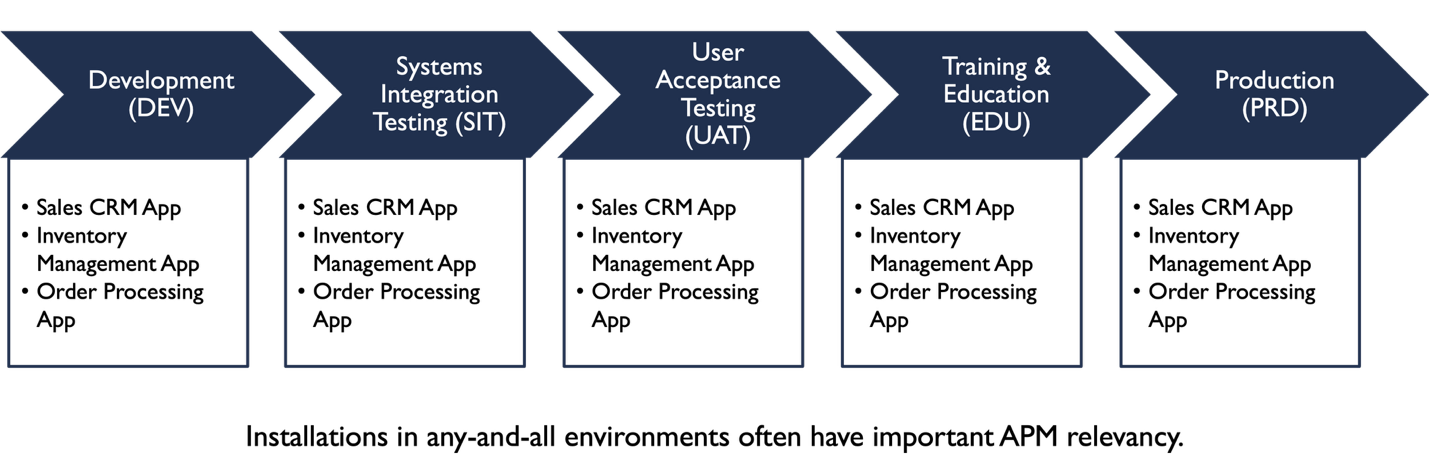
Non-Production environments are not merely technical infrastructure. They represent significant and frequently untracked organizational investment: the licensing costs of software installed across multiple environments, the infrastructure costs of maintaining separate environment tiers, the operational staffing costs of managing application configuration and data across environments, and the security and compliance risks created by non-Production environments that handle copies of Production data or that are accessible to a broader and less carefully governed population of users than Production systems. As APM maturity develops, governing the portfolio across all environments is not an advanced capability - it is a necessary component of understanding what the organization actually spends on and is exposed to through its application estate.
Common Environment Types
While organizations define their own environment structures based on their development practices, regulatory requirements, and organizational scale, the most commonly encountered environment types in enterprise application portfolios include the following:
Development (Dev) - the environment in which application code is written, integrated, and initially tested by engineering teams. Development environments are typically the least formal in their governance but may host significant infrastructure and tooling that carries real cost.
Systems Integration Testing (SIT) - the environment in which integrations between applications and external systems are validated. SIT environments often require full copies of integration middleware, API configurations, and connected system stubs, creating infrastructure costs and integration complexity that parallel Production.
User Acceptance Testing (UAT) - the environment in which business users validate that the application meets their requirements before it is promoted to Production. UAT environments frequently require data that is representative of Production data, creating data governance and compliance obligations that are often underestimated.
Staging or Pre-Production - an environment that closely mirrors Production configuration and is used to validate deployment packages before Production promotion. Staging environments carry costs and risks approaching those of Production itself and are often the least carefully governed of the standard environment tiers.
Disaster Recovery (DR) - a replicated environment maintained in a geographically separate location or separate infrastructure tier for business continuity purposes. DR environments carry significant infrastructure cost and require active governance to ensure they remain synchronized with Production.
Sandbox or Experimental - environments provisioned for exploratory development, proof-of-concept work, or vendor evaluation. Sandbox environments are among the most common sources of ungoverned cloud cost accumulation and the least likely to be included in standard APM scope.
Best Practice
Establish the scope of APM environment coverage as an explicit governance decision, documented in the APM Governance Policy, rather than an implicit default that limits APM to Production without deliberate consideration of the cost and risk implications of that limitation. At a minimum, the governance decision should address which environment types are in scope for APM, what data is collected and governed for each in-scope environment type, and how environment-level data is connected to the application’s primary portfolio record.
For organizations in the Crawl maturity stage, beginning APM scope with Production is a pragmatic starting point. The Production environment contains the applications that are actively delivering value, incurring the largest share of operational cost, and creating the most significant organizational risk. Establishing a high-quality Production portfolio is the highest-priority foundation for all subsequent APM capability development.
As the organization advances through the Walk and Run maturity stages, expand APM scope deliberately to include additional environment types in the following recommended sequence. First, add Staging or Pre-Production environments, which closely mirror Production in cost and configuration and where governance gaps most directly affect Production risk. Second, add UAT environments, where data governance obligations are most frequently underestimated and where compliance exposure from Production-representative data is most significant. Third, add SIT environments, where integration complexity and its associated cost are most clearly visible. Finally, evaluate the inclusion of Development and Sandbox environments based on the scale of their cost footprint, the degree of ungoverned cloud resource accumulation they contain, and the organizational capacity to govern them effectively alongside the higher-priority environment tiers.
For each environment type brought into APM scope, capture at minimum the following data for every application instance in that environment: the environment type and its relationship to the Production instance of the same application; the infrastructure cost of the environment instance, including compute, storage, and network; the licensing cost attributable to the environment instance where the license terms require separate licensing for non-Production use; the data classification of any data present in the environment, with particular attention to environments that contain copies or subsets of Production data; and the ownership and access governance applicable to the environment instance, including who has access and under what controls.
Use the environment topology of each application as an input to rationalization analysis, retirement planning, and cost optimization. An application with a complex, multi-environment footprint carries higher total lifecycle cost and higher retirement complexity than its Production cost alone suggests. An application approaching retirement that occupies five environment tiers requires a retirement plan that addresses all five tiers, not only the Production decommissioning. An application that has been retired from Production but whose non-Production environment instances have not been decommissioned represents ongoing cost and risk that APM should surface and remediate.
Benefit(s)
Governing the application portfolio across all environments rather than only Production produces a more complete and more accurate picture of the organization’s application estate, its total cost, and its full risk profile. Total Cost of Ownership calculations become more accurate when the infrastructure, licensing, and operational costs of non-Production environments are included alongside Production costs. Retirement planning becomes more complete when all environment instances of a retiring application are identified and addressed rather than discovering non-Production instances after Production decommissioning has been completed. Security and compliance governance becomes more robust when non-Production environments that handle Production-representative data are brought within the same governance framework as Production.
Organizations that expand APM scope to cover non-Production environments as they mature consistently discover significant ungoverned cost in Staging and Sandbox environments that are maintained beyond their useful period, and significant compliance exposure in UAT environments where Production data is present without the same access controls that govern Production access. Addressing these discoveries through governed APM produces financial and risk management returns that frequently justify the governance expansion investment many times over. The organization develops a complete view of its application estate rather than a Production-only view that systematically underrepresents the full cost and risk of the applications it manages.
The Environments Inventory — the primary governed inventory of the IT Operating Environments discipline — is also a Tier 2 inventory in the APM ecosystem. It can be partially seeded from the Deployment Environment and Hosting Model attributes of Application records in the Applications Inventory and from the Source Entity Environment and Target Entity Environment attributes of Integration records in the Integrations Inventory. Every environment that appears in either of those attribute fields is a candidate entry in the Environments Inventory. A well-governed APM program therefore actively contributes to and enriches the Environments Inventory, connecting application-level governance to the infrastructure and operating environment governance that IT Operating Environments provides. For the complete governance model and attribute taxonomy for the Environments Inventory, refer to the IF4IT Environments Inventory document. For the broader IT Operating Environments governance framework, refer to the IF4IT IT Operating Environments Best Practices document.
How to cite this page
When referencing this page in academic work, internal standards, or external publications, include the page title, IF4IT as author and publisher (The International Foundation for Information Technology (IF4IT), LLC), the URL, and your access date.
Example (informal web citation):
The International Foundation for Information Technology (IF4IT), LLC. Govern the application portfolio across all environments - not only Production | Application Portfolio Management (APM) Best Practices. https://if4it.org/best-practices/application-portfolio-management-apm/govern-the-application-portfolio-across-all-environments-not-only-production/ (accessed 2026-07-22).
See About Us for content governance and site-wide citation guidance.
Copyright for The International Foundation for Information Technology (IF4IT), LLC: 2008 - Present
Legal Disclaimers