Identify capability gaps in the portfolio and build an investment plan to close them - Application Portfolio Management (APM) Best Practices
Identify capability gaps in the portfolio and build an investment plan to close them
(Chapter 136 of Application Portfolio Management (APM) Best Practices)
Executive Summary: Chapter Overview
IF4ITThe Bottom Line
Core Concepts
| Concept | Definition & Strategic Role |
|---|---|
| Capability Gap | A business capability that is under-supported or unsupported by the current portfolio — identified through the Application-to-Capability mapping and assessment of the applications supporting each capability against the capability’s importance and current investment level. |
| Gap-Driven Investment Plan | The investment plan derived from the capability gap analysis — prioritizing investment in the capabilities where the gap between required and current portfolio support is largest and most material to strategic goals. |
Quick Q&A
Question: Why does investment default to already-covered capabilities?
Question: How is the capability gap analysis produced rigorously?
Read More Below
Overview
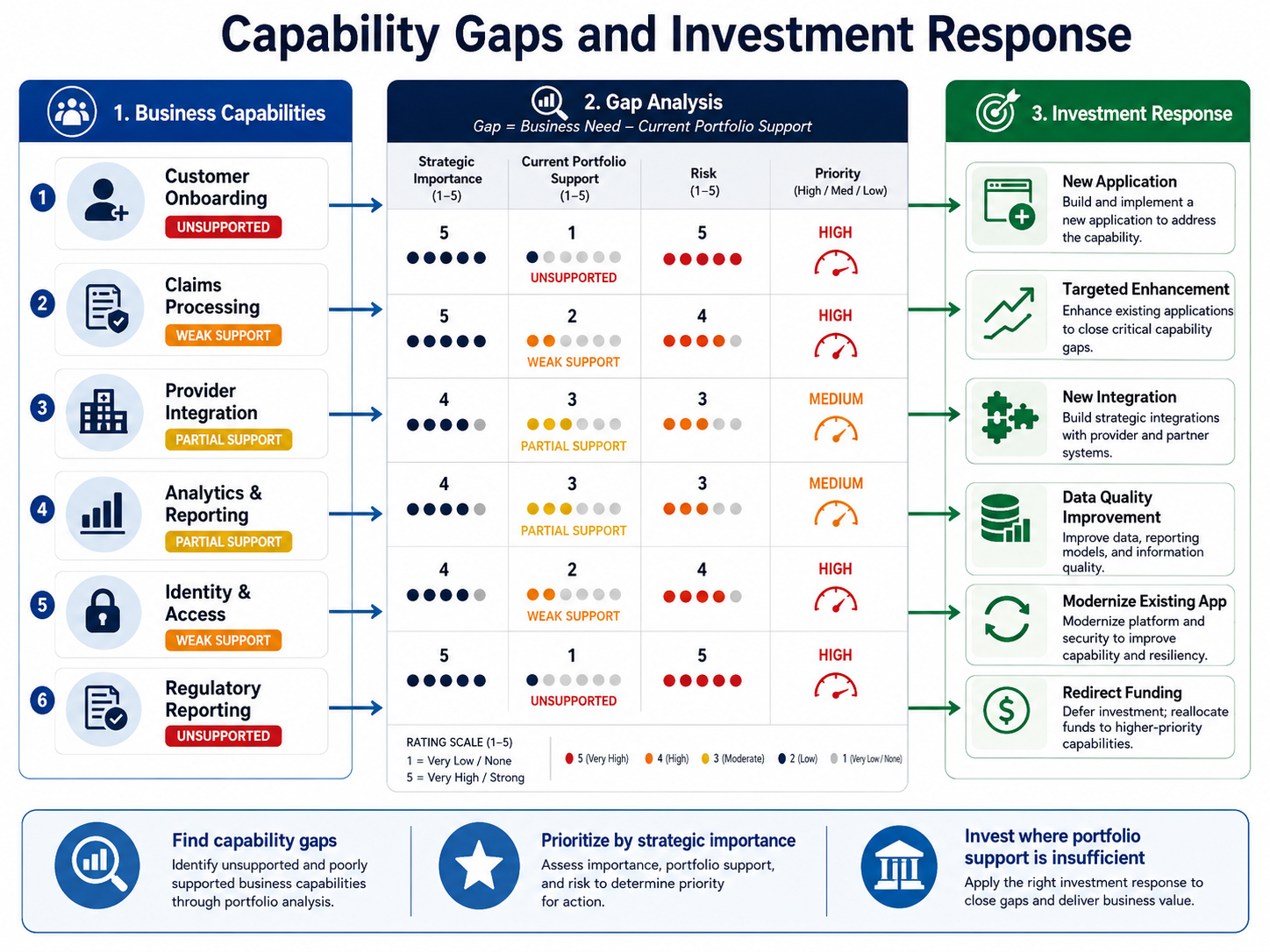
The most visible portfolio management activities - rationalization, cost management, waste elimination, retirement - address what already exists in the portfolio. But the portfolio’s ability to serve the organization also depends critically on what does not yet exist: capabilities that the business needs but that the portfolio does not currently provide at the level of quality, scale, or sophistication required. Capability gaps - the difference between what the business requires and what the portfolio currently delivers - are as important to portfolio strategy as the management of existing applications, and organizations that focus exclusively on rationalizing what they have while ignoring what they need build an efficient portfolio that is strategically incomplete.
Best Practice
Conduct a capability gap analysis as a standard component of every annual portfolio review cycle, using the business capability mapping maintained in the portfolio as the analytical foundation. Compare the business capabilities the organization requires to succeed in its current and planned strategic direction against the capabilities the current portfolio delivers and at what level of quality and scale. Identify capabilities that are underserved by the current portfolio - business needs that existing applications serve inadequately in their current form - and capabilities that are entirely absent from the portfolio. Prioritize identified gaps by strategic importance and financial impact, and develop investment plans that address the highest-priority gaps through new application development or acquisition, targeted investment in existing applications, or rationalization that redirects resources from low-value to high-value investments.
Benefit(s)
Systematic capability gap analysis ensures that the portfolio investment strategy addresses both the optimization of existing capabilities and the development of new ones that strategy requires. The organization does not discover strategic capability gaps only when transformation programs reveal them or competitive pressures demand responses that the current portfolio cannot support. Investment is directed toward the capabilities that most directly enable organizational strategy. The portfolio evolves proactively toward the capability profile that the business requires rather than reactively in response to capability deficiencies that have already limited organizational performance and created competitive disadvantage.
How to cite this page
When referencing this page in academic work, internal standards, or external publications, include the page title, IF4IT as author and publisher (The International Foundation for Information Technology (IF4IT), LLC), the URL, and your access date.
Example (informal web citation):
The International Foundation for Information Technology (IF4IT), LLC. Identify capability gaps in the portfolio and build an investment plan to close them | Application Portfolio Management (APM) Best Practices. https://if4it.org/best-practices/application-portfolio-management-apm/identify-capability-gaps-in-the-portfolio-and-build-an-investment-plan-to-close-them/ (accessed 2026-10-22).
See About Us for content governance and site-wide citation guidance.
Copyright for The International Foundation for Information Technology (IF4IT), LLC: 2008 - Present
Legal Disclaimers