Maintain a complete inventory of all application vendors and license agreements - Application Portfolio Management (APM) Best Practices
Maintain a complete inventory of all application vendors and license agreements
(Chapter 108 of Application Portfolio Management (APM) Best Practices)
Executive Summary: Chapter Overview
IF4ITThe Bottom Line
Core Concepts
| Concept | Definition & Strategic Role |
|---|---|
| Vendor and License Inventory | The governed catalog of all application vendors and their associated license agreements — with attributes for vendor identity, license type, term, financial commitment, renewal timing, and the applications covered by each agreement. |
| Portfolio-Vendor Traceability | The explicit connection between applications and the vendors and agreements that supply them — enabling portfolio decisions to see vendor and license implications and enabling vendor management to see portfolio impact. |
Quick Q&A
Question: Why maintain this as a governed inventory rather than reconstructing on demand?
Question: What is the boundary between this inventory and adjacent inventories?
Read More Below
Overview
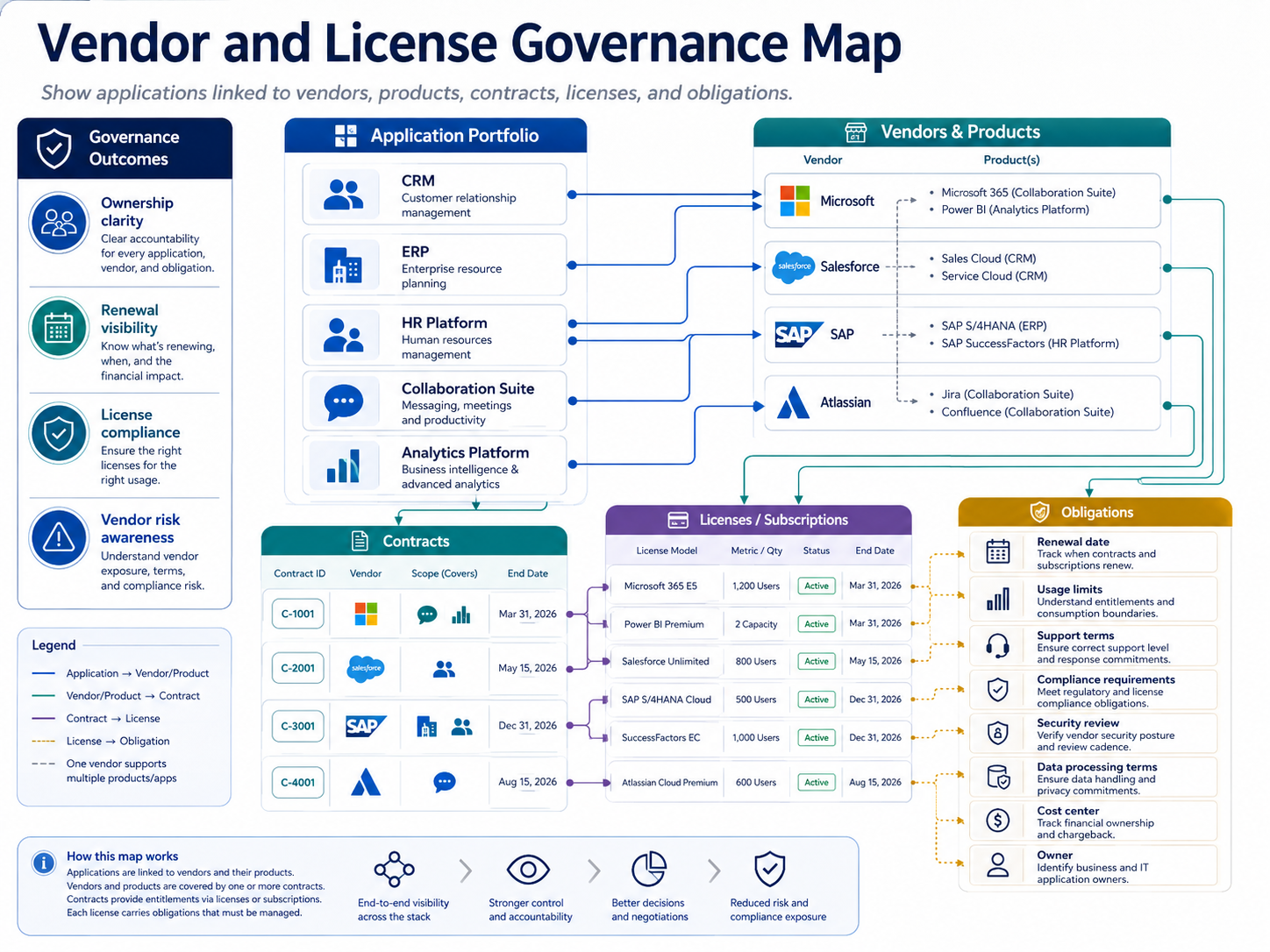
Vendor and license management without a complete inventory is vendor and license management by exception - the organization responds to vendor-initiated renewal conversations, audit notifications, and deadline-driven alerts rather than proactively governing the relationships and agreements that determine a significant portion of its technology expenditure. An incomplete vendor and license inventory means that renewal dates are missed until vendors initiate contact, compliance risks accumulate undetected until audits surface them, negotiation leverage is forfeited because preparation begins too late, and the total cost of vendor relationships is never understood in aggregate because the relationships are managed in isolation from each other.
Best Practice
Maintain a complete inventory of all application vendors and the license and contractual agreements that govern the organization’s use of their products. Connect every application in the portfolio to its vendor entry and its license entries using consistent semantic identifiers that make the connections immediately traversable. Ensure that every vendor entry includes at minimum: the vendor name and semantic identifier, the applications they supply, the total annual spend across all products and agreements with that vendor, the primary relationship contacts, and a summary of the contractual terms governing the most significant aspects of the relationship. Review and validate the vendor and license inventory at least semi-annually and always before any significant vendor engagement.
Benefit(s)
A complete vendor and license inventory produces a comprehensive view of the vendor landscape that enables proactive rather than reactive vendor management. Renewal dates are tracked and negotiation preparation begins well in advance. Total spend by vendor is visible in aggregate, enabling concentration risk assessment and leverage-informed negotiation. The full catalog of vendor agreements is available to APM, Legal, and Finance without requiring ad hoc discovery for each engagement. The organization manages its vendor relationships with the same discipline and strategic intentionality it applies to other significant organizational assets.
How to cite this page
When referencing this page in academic work, internal standards, or external publications, include the page title, IF4IT as author and publisher (The International Foundation for Information Technology (IF4IT), LLC), the URL, and your access date.
Example (informal web citation):
The International Foundation for Information Technology (IF4IT), LLC. Maintain a complete inventory of all application vendors and license agreements | Application Portfolio Management (APM) Best Practices. https://if4it.org/best-practices/application-portfolio-management-apm/maintain-a-complete-inventory-of-all-application-vendors-and-license-agreements/ (accessed 2026-10-22).
See About Us for content governance and site-wide citation guidance.
Copyright for The International Foundation for Information Technology (IF4IT), LLC: 2008 - Present
Legal Disclaimers