Maintain audit readiness - know which applications are subject to which compliance frameworks - Application Portfolio Management (APM) Best Practices
Maintain audit readiness - know which applications are subject to which compliance frameworks
(Chapter 84 of Application Portfolio Management (APM) Best Practices)
Executive Summary: Chapter Overview
IF4ITThe Bottom Line
Core Concepts
| Concept | Definition & Strategic Role |
|---|---|
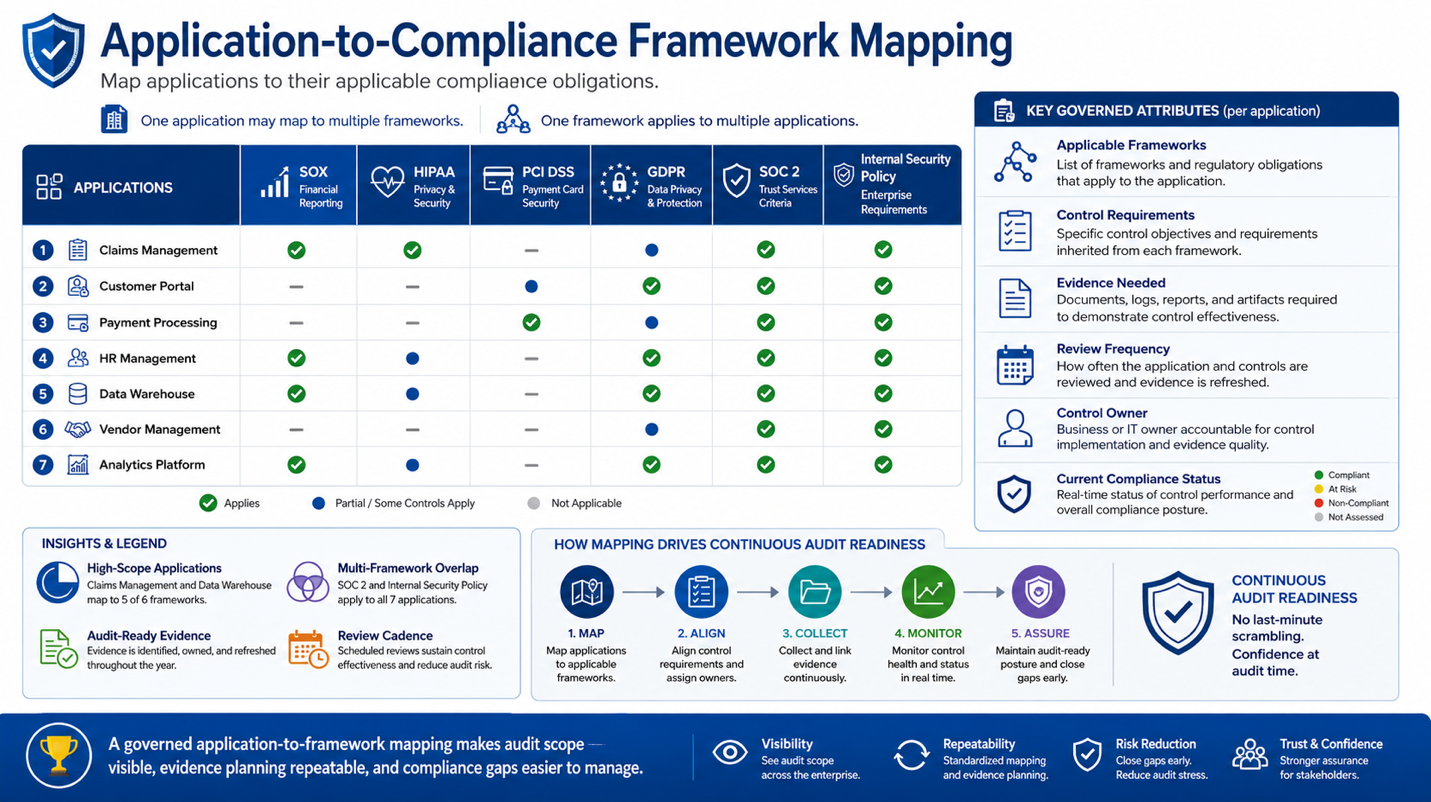
| Application-Framework Mapping | The explicit mapping between applications and the compliance frameworks each is subject to — SOX, HIPAA, GDPR, PCI, industry-specific frameworks, and internal policies — maintained as a portfolio attribute rather than reconstructed at audit time. |
| Continuous Audit Readiness | The state of maintaining evidence, controls, and documentation for compliance frameworks on an ongoing basis, so audits are prepared for at all times rather than assembled reactively when an audit is announced. |
Quick Q&A
Question: Why is knowing the scope in advance essential for audit readiness?
Question: Where does the framework applicability determination come from?
Question: Does audit readiness only require mapping applications to compliance frameworks?
Read More Below
Overview
Organizations subject to regulatory audits routinely discover, during the stressful period of audit preparation, that they lack a clear, current mapping of which applications are subject to which compliance frameworks and what evidence is required to demonstrate compliance. This discovery triggers a costly, time-pressured scramble to collect and validate compliance evidence across the application portfolio before the audit deadline. The scramble is avoidable. A portfolio that maintains an explicit, current compliance framework mapping for every application can produce audit evidence systematically and efficiently without the organizational disruption and rework cost of last-minute preparation.
Best Practice
Maintain a current compliance framework mapping as a standard attribute of every application record. For each application, document the compliance frameworks to which it is subject, the specific controls that apply to it under each framework, the evidence required to demonstrate compliance with each control, the frequency at which compliance must be reviewed or re-attested, and the current compliance status. Review and update this mapping whenever a new regulatory requirement takes effect, whenever an application’s data handling or operational characteristics change in ways that affect its compliance scope, and as a standard component of the annual application record review cycle.
Maintain a decision record for significant portfolio actions — rationalization decisions, disposition changes, retirement approvals — capturing what was decided, why, by whom, and when. This decision history serves two purposes beyond audit readiness itself: it gives future reviewers the context behind a past decision without requiring them to reconstruct it from memory, and it creates the application history and auditability record that lets the organization trace how and why an application’s status changed over time, not only its current state.
For applications operating in regulated pharmaceutical or life-sciences environments, the IF4IT GxP Compliance Framework provides a specialized extension to this audit-readiness guidance, addressing the additional evidence and validation requirements GxP environments impose.
Benefit(s)
Maintaining current compliance framework mappings as a standard portfolio attribute transforms audit preparation from a crisis-driven exercise into a routine reporting activity. Compliance evidence is available on demand rather than requiring emergency collection under deadline pressure. Compliance gaps are identified during routine portfolio reviews rather than during audits when remediation options are most constrained and most expensive. The organization demonstrates to regulators and auditors that its compliance governance is systematic and continuous rather than reactive and episodic - a posture that builds regulatory trust and reduces the intensity of audit scrutiny over time.
How to cite this page
When referencing this page in academic work, internal standards, or external publications, include the page title, IF4IT as author and publisher (The International Foundation for Information Technology (IF4IT), LLC), the URL, and your access date.
Example (informal web citation):
The International Foundation for Information Technology (IF4IT), LLC. Maintain audit readiness - know which applications are subject to which compliance frameworks | Application Portfolio Management (APM) Best Practices. https://if4it.org/best-practices/application-portfolio-management-apm/maintain-audit-readiness-know-which-applications-are-subject-to-which-compliance-frameworks/ (accessed 2026-10-22).
See About Us for content governance and site-wide citation guidance.
Copyright for The International Foundation for Information Technology (IF4IT), LLC: 2008 - Present
Legal Disclaimers