Manage application transitions with governance approval and stakeholder communication - Application Portfolio Management (APM) Best Practices
Manage application transitions with governance approval and stakeholder communication
(Chapter 119 of Application Portfolio Management (APM) Best Practices)
Executive Summary: Chapter Overview
IF4ITThe Bottom Line
Core Concepts
| Concept | Definition & Strategic Role |
|---|---|
| Transition Governance | The defined governance process for approving material application transitions — including the specific change categories that require approval, the required approvers, and the documentation artifacts produced. |
| Stakeholder Communication | The systematic communication of approved transitions to affected stakeholders — including downstream integration owners, dependent business units, and operational teams — with sufficient notice to prepare and respond. |
Quick Q&A
Question: What kinds of transitions require governance approval?
Question: Why is stakeholder communication a governance responsibility?
Read More Below
Overview
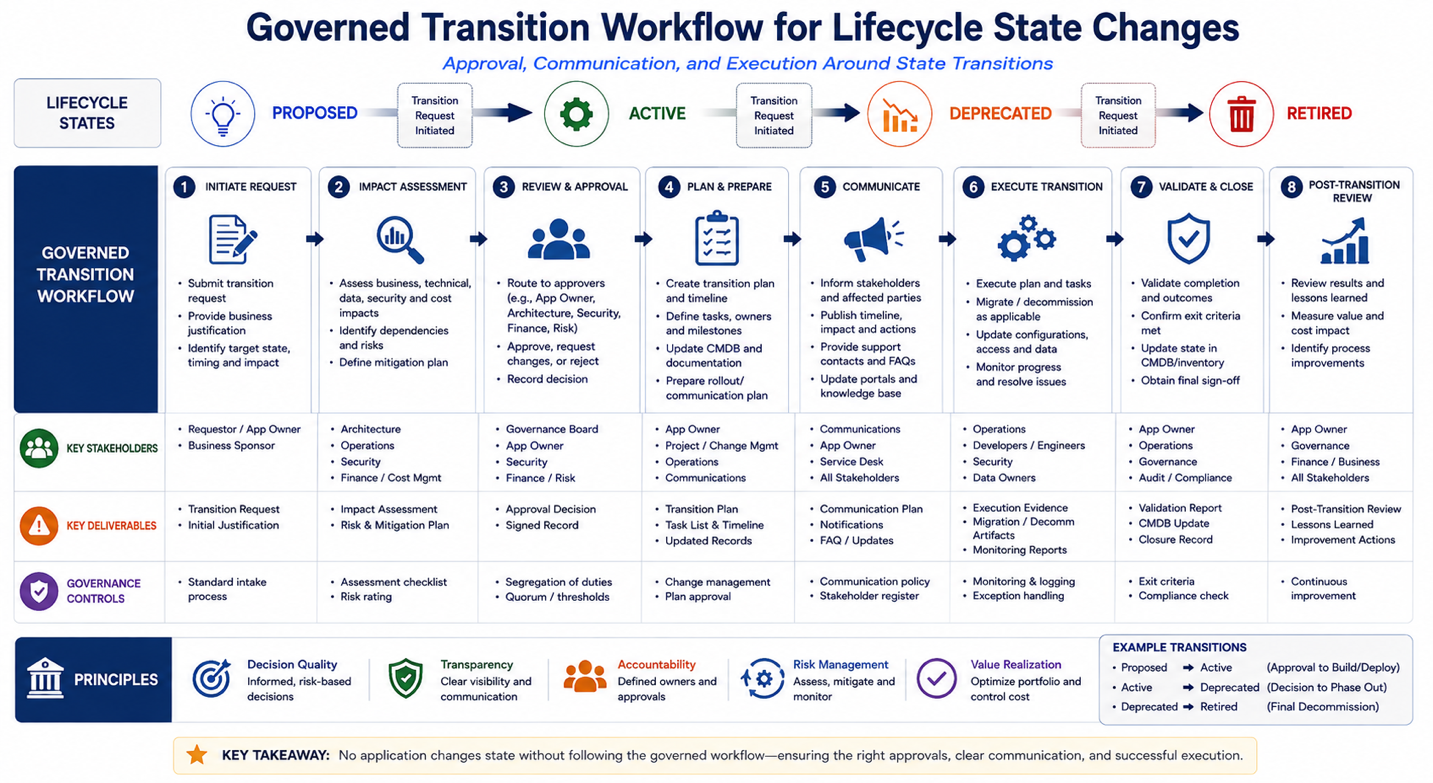
Application lifecycle transitions - particularly deprecation and retirement - affect the users and business processes that depend on the applications being transitioned. Poorly managed transitions without adequate governance review or user communication create operational disruption, erode organizational trust in the APM program, and produce the political resistance that causes rationalization programs to stall. Even transitions that are technically and financially well-justified can fail in execution if they are managed without the organizational change management that transition decisions require.
Best Practice
Require formal governance approval for every application lifecycle transition and establish minimum communication standards for each transition type. Governance approval ensures that transitions are reviewed for organizational readiness, business impact, risk, and alignment with portfolio strategy before execution is authorized. For deprecation decisions, communicate to all affected users the rationale, the planned retirement date, the available migration path, and the support available during transition - at minimum ninety days before the retirement date for applications with significant user bases. For retirement execution, confirm that all users have been transitioned, all integrations addressed, all data properly disposed of per the data disposition plan, and all vendor contracts managed appropriately.
Benefit(s)
Governed, well-communicated lifecycle transitions build organizational confidence in the APM program’s ability to manage change responsibly. Users who receive adequate advance notice and clear transition guidance experience transitions as professionally managed organizational change rather than disruptive events. Governance approval prevents premature, incomplete, or organizationally damaging transitions. The APM program develops a reputation for managing change well - essential for maintaining the organizational support that sustains the program through the difficult rationalization decisions it must make.
How to cite this page
When referencing this page in academic work, internal standards, or external publications, include the page title, IF4IT as author and publisher (The International Foundation for Information Technology (IF4IT), LLC), the URL, and your access date.
Example (informal web citation):
The International Foundation for Information Technology (IF4IT), LLC. Manage application transitions with governance approval and stakeholder communication | Application Portfolio Management (APM) Best Practices. https://if4it.org/best-practices/application-portfolio-management-apm/manage-application-transitions-with-governance-approval-and-stakeholder-communication/ (accessed 2026-10-22).
See About Us for content governance and site-wide citation guidance.
Copyright for The International Foundation for Information Technology (IF4IT), LLC: 2008 - Present
Legal Disclaimers