Manage hybrid integration complexity - on-premises and cloud applications that must work together - Application Portfolio Management (APM) Best Practices
Manage hybrid integration complexity - on-premises and cloud applications that must work together
(Chapter 130 of Application Portfolio Management (APM) Best Practices)
Executive Summary: Chapter Overview
IF4ITThe Bottom Line
Core Concepts
| Concept | Definition & Strategic Role |
|---|---|
| Hybrid Integration Complexity | The distinct integration challenges of hybrid portfolios — network topology across enterprise and cloud boundaries, identity federation across identity systems, data movement across boundaries with cost and performance implications, and latency management for cross-boundary calls — that require deliberate architecture and governance. |
| Cross-Environment Integration Patterns | The specific patterns that address hybrid integration effectively — API gateways at boundaries, identity federation with defined trust models, event-based integration to reduce synchronous cross-boundary calls, and data-locality analysis to place processing where data sits — each addressing a specific complexity dimension. |
Quick Q&A
Question: What breaks when hybrid integration is treated as pure integration?
Question: What governance does hybrid integration require?
Read More Below
Overview
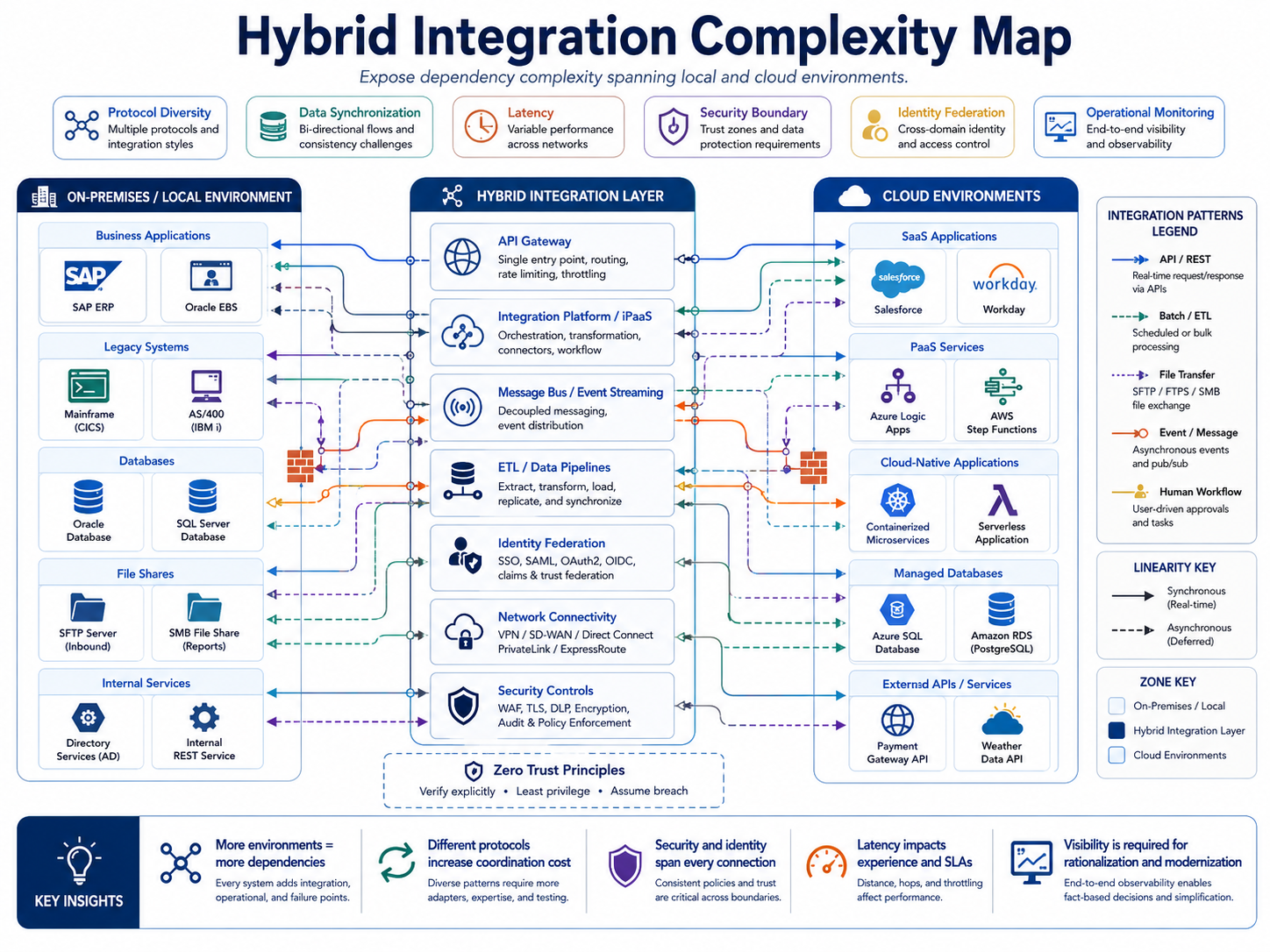
Organizations migrating applications to cloud rarely migrate the entire portfolio simultaneously, and some applications may never be practical cloud migration candidates. The result is a persistent hybrid architecture in which some applications run on-premises and others run in cloud, and many critical integration relationships span the boundary between the two environments. Hybrid integrations - data flows, API calls, event streams, and batch processes crossing the on-premises to cloud boundary - introduce latency characteristics, security complexity, network cost structures, and operational monitoring challenges that do not exist in purely on-premises or purely cloud architectures. The hybrid integration layer is frequently the most complex, most poorly documented, and most operationally fragile aspect of the modern enterprise application portfolio.
Best Practice
Map and actively govern the hybrid integration topology of the application portfolio as a portfolio management discipline, not only as an architectural concern managed by individual application teams. For every integration that crosses the on-premises to cloud boundary, document the integration mechanism, the data flows and their business criticality, the latency and bandwidth requirements and how they compare to actual hybrid network performance, the security controls in place for data in transit across the boundary, and the operational monitoring arrangements providing visibility into hybrid integration health. Assess hybrid integrations as a mandatory input to every migration decision - migrating an application to cloud without accounting for its hybrid integration dependencies frequently produces integration failures that are more expensive to remediate than the migration cost they were intended to avoid.
Benefit(s)
Governing hybrid integration complexity at the portfolio level prevents the most common failure mode of cloud migration programs: discovering that on-premises-to-cloud integrations are significantly more complex, costly, and operationally fragile than anticipated because they were not assessed as part of migration planning. Organizations with a current, governed hybrid integration map make more accurate migration cost estimates, sequence migrations to manage integration dependencies intelligently, and operate their hybrid architectures with the visibility needed to detect and address integration performance and reliability issues before they affect dependent business operations.
How to cite this page
When referencing this page in academic work, internal standards, or external publications, include the page title, IF4IT as author and publisher (The International Foundation for Information Technology (IF4IT), LLC), the URL, and your access date.
Example (informal web citation):
The International Foundation for Information Technology (IF4IT), LLC. Manage hybrid integration complexity - on-premises and cloud applications that must work together | Application Portfolio Management (APM) Best Practices. https://if4it.org/best-practices/application-portfolio-management-apm/manage-hybrid-integration-complexity-on-premises-and-cloud-applications-that-must-work-together/ (accessed 2026-10-22).
See About Us for content governance and site-wide citation guidance.
Copyright for The International Foundation for Information Technology (IF4IT), LLC: 2008 - Present
Legal Disclaimers