Manage vendor concentration risk - avoid over-dependence on any single vendor - Application Portfolio Management (APM) Best Practices
Manage vendor concentration risk - avoid over-dependence on any single vendor
(Chapter 113 of Application Portfolio Management (APM) Best Practices)
Executive Summary: Chapter Overview
IF4ITThe Bottom Line
Core Concepts
| Concept | Definition & Strategic Role |
|---|---|
| Vendor Concentration | The proportion of portfolio spend, critical applications, or strategic capabilities dependent on a single vendor — measured explicitly at portfolio level rather than reasoned about application-by-application. |
| Concentration Thresholds | The defined thresholds at which concentration triggers portfolio-level attention — typically expressed as maximum acceptable percentage of spend or of critical applications on a single vendor — that trigger diversification planning when exceeded. |
Quick Q&A
Question: Why does concentration risk accumulate silently?
Question: What happens when concentration risk materializes?
Read More Below
Overview
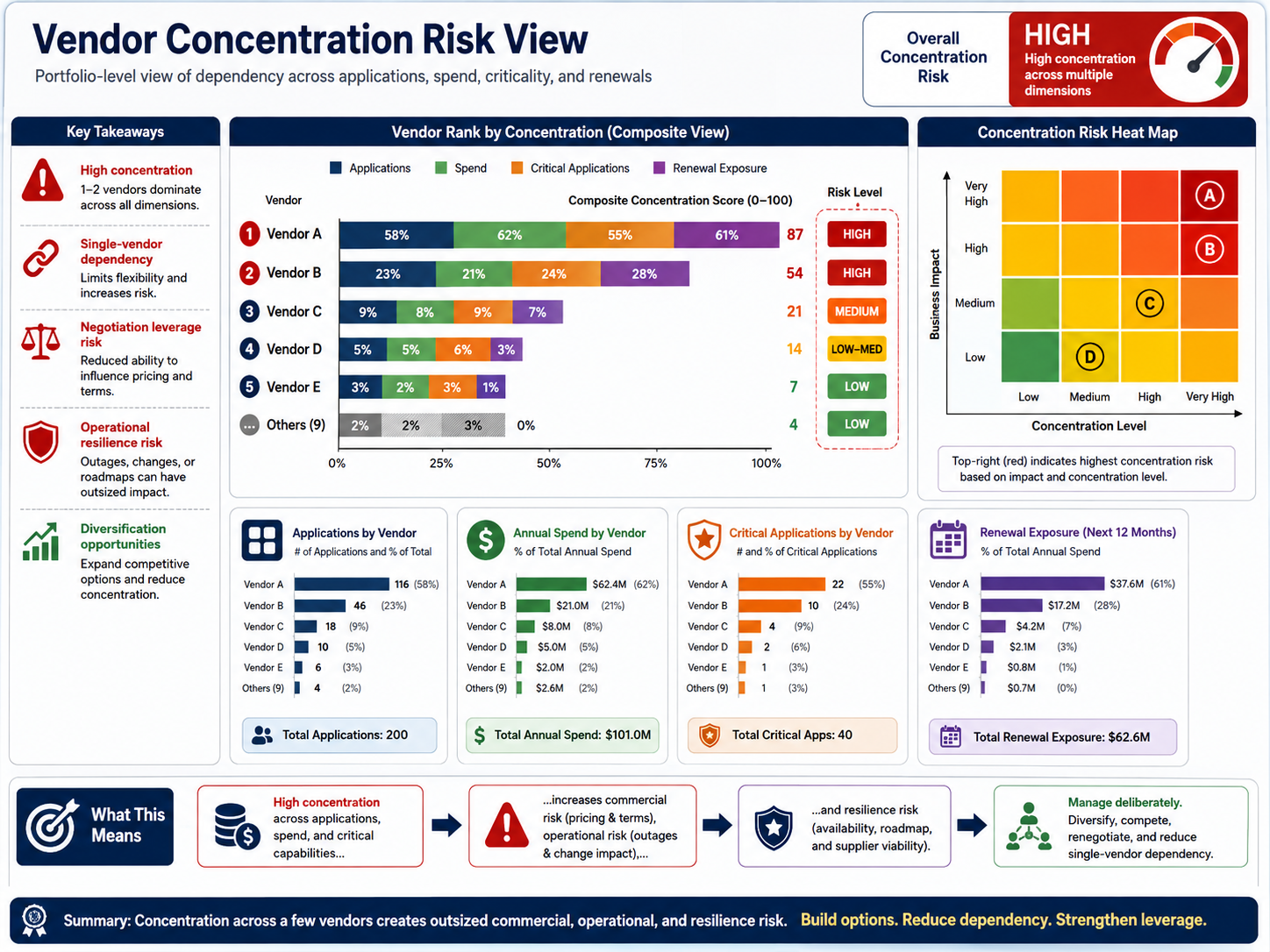
Vendor concentration risk - the organizational exposure created by over-dependence on a single vendor for a disproportionate share of the portfolio - is a systemic risk that is invisible at the individual application level and only visible when the portfolio is analyzed in aggregate. When each application is managed independently, no one sees that forty percent of the portfolio runs on one vendor’s technology, that the majority of cloud spending flows to one provider, or that a single vendor supports the majority of the organization’s most critical business capabilities. When a concentrated vendor experiences a significant problem, the organization discovers its concentration risk through impact rather than through governance.
Best Practice
Analyze the application portfolio for vendor concentration risk at least annually. For each vendor with material portfolio presence, calculate the total applications supplied, the total annual spend, the criticality of the business capabilities those applications support, and the estimated migration complexity if the vendor relationship must be terminated under adverse circumstances. Flag concentrations exceeding defined risk thresholds in the portfolio risk register. Develop mitigation strategies that may include introducing alternative vendors for new investments, negotiating enhanced portability provisions in contracts with concentrated vendors, or accelerating migration away from concentrated vendors for applications where viable alternatives exist.
Benefit(s)
Managing vendor concentration risk at the portfolio level prevents systemic exposure that individual application risk management cannot detect. Concentration risks are identified and managed before they produce organizational crises. Vendor negotiations are informed by the full scope of the relationship, creating strategic context that strengthens the organization’s position. The organization develops a more resilient and balanced vendor landscape over time that reduces its exposure to vendor-specific risks inherent in high-concentration relationships.
How to cite this page
When referencing this page in academic work, internal standards, or external publications, include the page title, IF4IT as author and publisher (The International Foundation for Information Technology (IF4IT), LLC), the URL, and your access date.
Example (informal web citation):
The International Foundation for Information Technology (IF4IT), LLC. Manage vendor concentration risk - avoid over-dependence on any single vendor | Application Portfolio Management (APM) Best Practices. https://if4it.org/best-practices/application-portfolio-management-apm/manage-vendor-concentration-risk-avoid-over-dependence-on-any-single-vendor/ (accessed 2026-09-19).
See About Us for content governance and site-wide citation guidance.
Copyright for The International Foundation for Information Technology (IF4IT), LLC: 2008 - Present
Legal Disclaimers