Measure portfolio business alignment - the percentage of applications linked to active business capabilities - Application Portfolio Management (APM) Best Practices
Measure portfolio business alignment - the percentage of applications linked to active business capabilities
(Chapter 177 of Application Portfolio Management (APM) Best Practices)
Executive Summary: Chapter Overview
IF4ITThe Bottom Line
Core Concepts
| Concept | Definition & Strategic Role |
|---|---|
| Portfolio Business Alignment | The metric expressing the percentage of applications explicitly linked to active business capabilities — surfacing the population of applications whose business justification is either undocumented or questionable. |
| Unlinked Application Population | The set of applications that lack explicit capability linkage — a population requiring investigation because it likely contains a mixture of undocumented-but-legitimate applications, applications serving retired capabilities, and redundant applications that should have been rationalized. |
Quick Q&A
Question: Why measure business alignment at portfolio level?
Question: What follow-up does the metric drive?
Read More Below
Overview
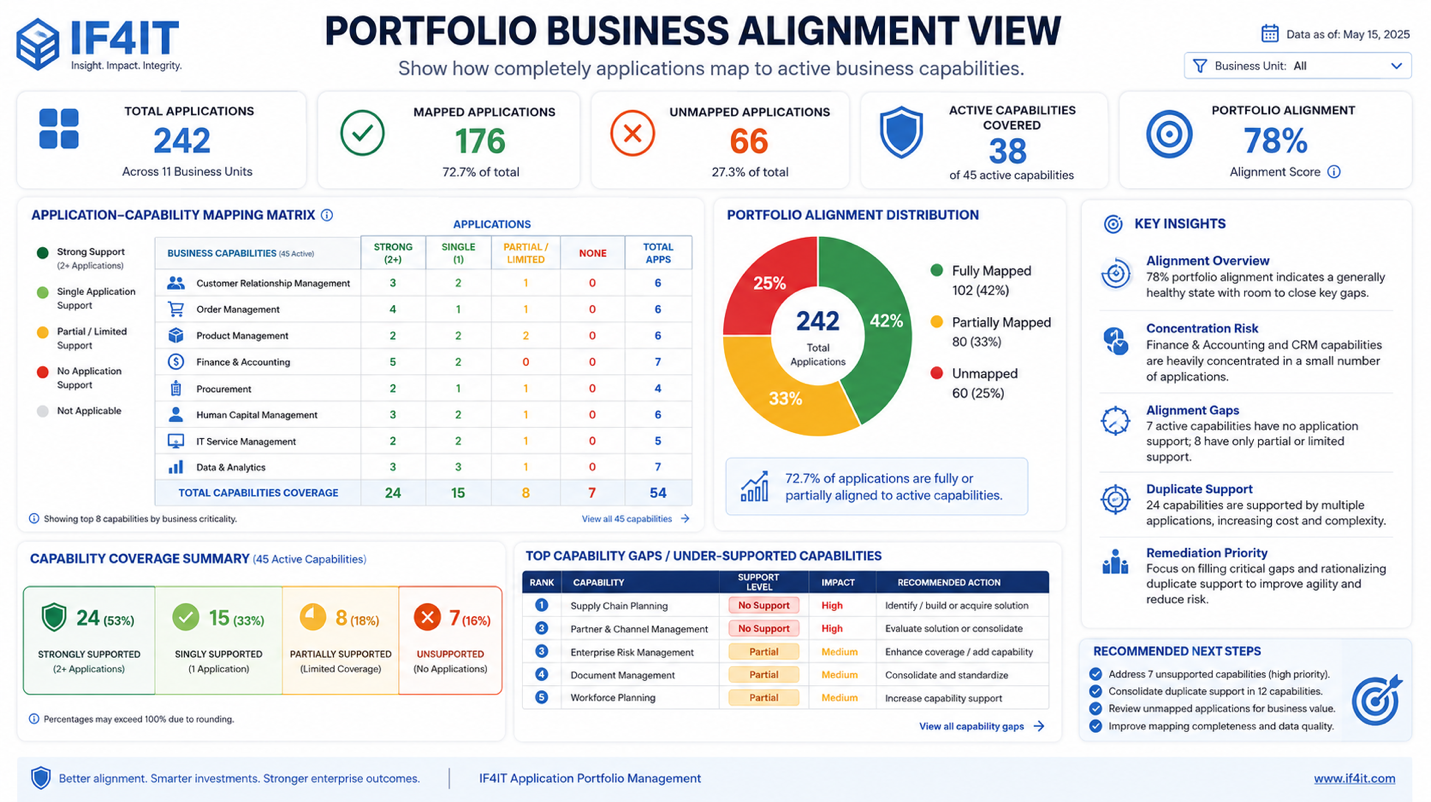
Portfolio business alignment is the metric that most directly connects the application portfolio to organizational strategy and most clearly demonstrates the difference between a portfolio managed as a strategic asset and one managed as an IT inventory. An application that cannot be linked to an active business capability is an application whose organizational justification is unclear - it may be serving a deprecated business purpose, it may be duplicating the functionality of another application that serves the same capability, or it may simply never have had its business purpose documented with sufficient specificity to establish the link. Low business alignment percentages are diagnostic signals of strategic portfolio drift that require investigation and remediation.
Best Practice
Track the percentage of active applications that have a documented, current link to at least one active business capability as a primary portfolio quality and strategic alignment KPI. Set a target percentage consistent with the organization’s APM maturity stage - Crawl stage organizations may have fifty percent or less linked, Walk stage organizations should be targeting eighty percent or above, and Run stage organizations should be at ninety-five percent or above with annual review of all links for currency. For applications that cannot be linked to an active capability after a defined investigation period, treat them as rationalization candidates unless a business justification can be documented that establishes their strategic purpose. Use the business alignment percentage as a required input to annual budget planning - low-alignment applications have a weaker claim on investment resources than high-alignment applications with comparable needs.
Benefit(s)
Tracking portfolio business alignment as a primary KPI creates a continuous, measurable pressure toward strategic portfolio relevance that prevents the gradual drift from strategic alignment that characterizes unmeasured portfolios. Applications lose their link to active business capabilities gradually as organizational strategy evolves, and the only reliable mechanism for detecting this drift before it becomes systemic is a metric that makes current alignment visible and accountable. Business alignment tracking also creates a natural, evidence-based conversation between IT and business leadership about which technology investments are serving current strategy and which are serving historical needs that may no longer require technology investment at their current level.
How to cite this page
When referencing this page in academic work, internal standards, or external publications, include the page title, IF4IT as author and publisher (The International Foundation for Information Technology (IF4IT), LLC), the URL, and your access date.
Example (informal web citation):
The International Foundation for Information Technology (IF4IT), LLC. Measure portfolio business alignment - the percentage of applications linked to active business capabilities | Application Portfolio Management (APM) Best Practices. https://if4it.org/best-practices/application-portfolio-management-apm/measure-portfolio-business-alignment-the-percentage-of-applications-linked-to-active-business-capabilities/ (accessed 2026-10-22).
See About Us for content governance and site-wide citation guidance.
Copyright for The International Foundation for Information Technology (IF4IT), LLC: 2008 - Present
Legal Disclaimers