Measure rationalization progress - applications retired, consolidated, and modernized over time - Application Portfolio Management (APM) Best Practices
Measure rationalization progress - applications retired, consolidated, and modernized over time
(Chapter 178 of Application Portfolio Management (APM) Best Practices)
Executive Summary: Chapter Overview
IF4ITThe Bottom Line
Core Concepts
| Concept | Definition & Strategic Role |
|---|---|
| Rationalization Progress Metrics | The specific metrics that measure rationalization output — count of applications retired per period, count consolidated, count modernized, cost recovered from each activity — producing a measurable record of the portfolio changes the program has driven. |
| Program Output vs. Program Activity | The distinction between metrics of program activity (how many governance meetings held, how many assessments produced) and metrics of program output (what actually changed in the portfolio). Both matter, but leadership evaluates program value primarily by output. |
Quick Q&A
Question: Why is rationalization progress the most defensible program-value metric?
Question: What trending pattern indicates program health?
Read More Below
Overview
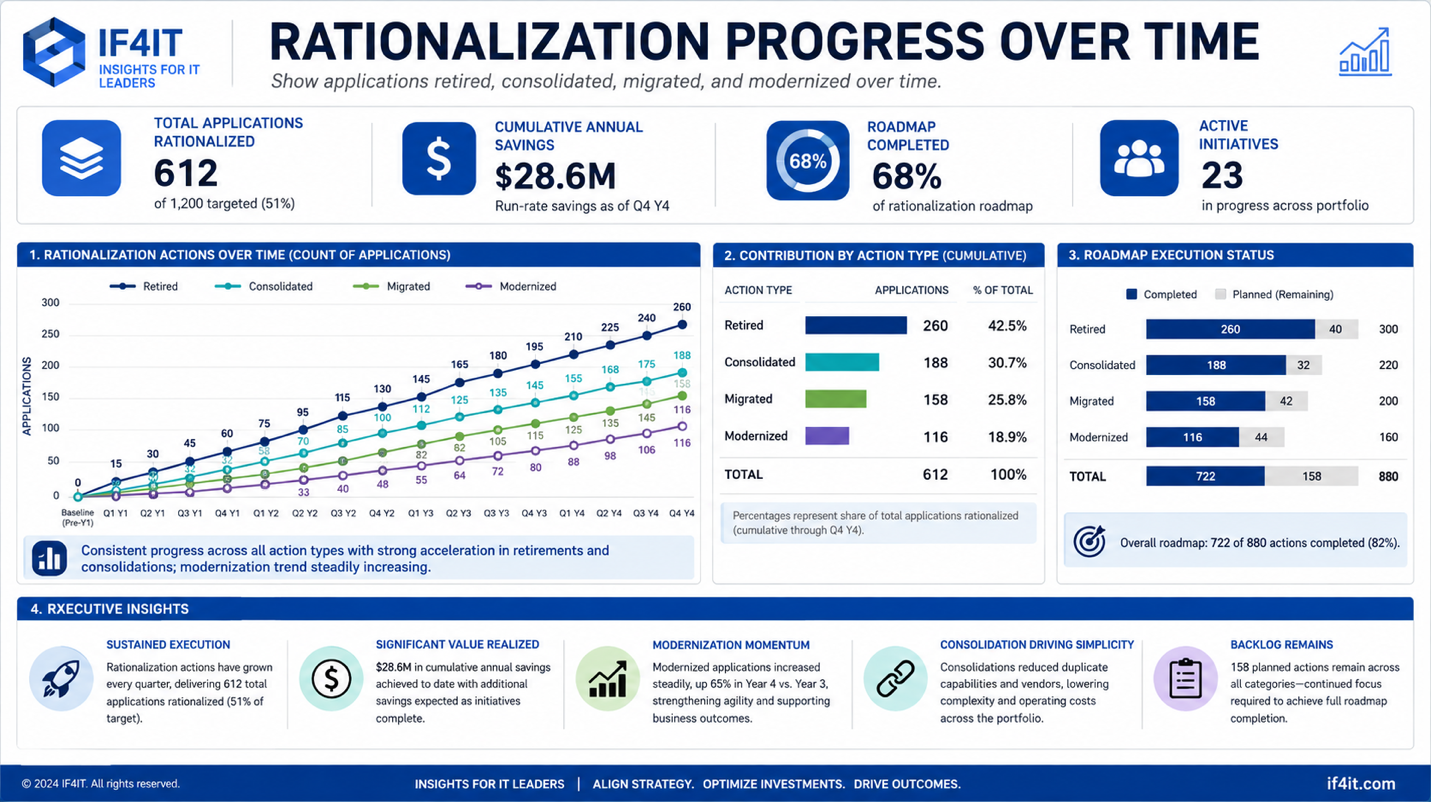
Rationalization progress metrics provide the operational evidence that the APM program is generating the portfolio changes its recommendations identified as necessary - not merely recommending changes that are never executed. A rationalization program that produces recommendations without tracking and reporting their execution rate has no mechanism for detecting when recommendations are failing to move through the organizational approval and execution process, and no evidence to offer leadership that the investment in rationalization analysis is translating into actual portfolio improvement. Tracking rationalization execution provides both the accountability mechanism that drives implementation and the evidence that demonstrates financial and operational returns.
Best Practice
Track rationalization progress metrics as a standard element of portfolio governance reporting, covering three primary execution categories. Retirements track the count and aggregate annual cost savings of applications that have been fully decommissioned during the reporting period and since the inception of the rationalization program - providing the clearest evidence of cost reduction directly attributable to APM. Consolidations track the count and aggregate cost savings of redundancy elimination actions where multiple applications serving the same function have been consolidated to a single governed instance - providing evidence of both cost reduction and operational simplification. Modernizations track the count and status of applications migrated from poor technical fitness to current technology as a result of rationalization investment - providing evidence of technical debt reduction and long-term risk mitigation. Compare execution rates against the rationalization roadmap commitments to identify where implementation is falling behind and investigate the organizational barriers preventing execution.
Benefit(s)
Tracking rationalization progress metrics creates the organizational accountability that drives execution of recommendations that might otherwise remain on the roadmap indefinitely without implementation pressure. Execution rate reporting makes it visible when rationalization recommendations are accumulating without implementation - a pattern that indicates either organizational resistance, resource constraints, or inadequate governance authority that must be addressed before the APM program can deliver its financial and operational objectives. The cumulative rationalization savings metric provides the most compelling possible evidence of APM program return on investment: a specific, auditable financial figure representing the cost that has been eliminated from the portfolio through deliberate management action.
How to cite this page
When referencing this page in academic work, internal standards, or external publications, include the page title, IF4IT as author and publisher (The International Foundation for Information Technology (IF4IT), LLC), the URL, and your access date.
Example (informal web citation):
The International Foundation for Information Technology (IF4IT), LLC. Measure rationalization progress - applications retired, consolidated, and modernized over time | Application Portfolio Management (APM) Best Practices. https://if4it.org/best-practices/application-portfolio-management-apm/measure-rationalization-progress-applications-retired-consolidated-and-modernized-over-time/ (accessed 2026-09-22).
See About Us for content governance and site-wide citation guidance.
Copyright for The International Foundation for Information Technology (IF4IT), LLC: 2008 - Present
Legal Disclaimers