Overview - Application Portfolio Management (APM) Best Practices
Overview
(Chapter 1 of Application Portfolio Management (APM) Best Practices)
Executive Summary: Chapter Overview
IF4ITThe Bottom Line
Core Concepts
| Concept | Definition & Strategic Role |
|---|---|
| APM as an Intelligence Layer | APM is the structured, connected understanding of the enterprise’s applications and their business, financial, technical, and organizational context — not a static inventory or a compliance artifact. |
| Pragmatic APM Adoption | A disciplined approach that starts simple (spreadsheets, minimum viable data, named ownership), scales deliberately, and matures into an enterprise capability that informs investment, risk, and modernization decisions. |
Quick Q&A
Question: Why do most enterprises still not understand their own application landscape?
Question: What outcome does this document exist to produce?
Question: How does Application Portfolio Management relate to Technology Portfolio Management?
Read More Below
Most enterprises do not actually understand their own application landscape.
They may believe they do—through uncontrolled documents, CMDBs, procurement records, or tribal knowledge—but in reality, what they have is fragmented, inconsistent, and often outdated information. Critical decisions about cost, risk, modernization, and transformation are made on top of this incomplete foundation.
This gap is not theoretical. It has direct consequences:
Applications are funded without clear business value
Redundant systems persist unnoticed
Critical dependencies remain hidden until failure
Modernization efforts stall due to unknown impact
Costs accumulate without accountability
Mergers & Acquisitions and Divestitures become far more complicated and take far longer than they should
In this environment, Application Portfolio Management (APM) is often misunderstood as a reporting exercise—a static inventory of applications maintained for compliance or visibility. At best, it becomes a passive reference. At worst, it becomes shelfware.
This is a fundamental mistake.
When implemented correctly, APM is not a list—it is an intelligence layer. It provides the structured, connected understanding required to make informed, defensible decisions about the application landscape and its role within the enterprise.
This document outlines a pragmatic, experience-driven approach to building that capability—starting simple, scaling deliberately, and ultimately transforming APM into a strategic asset that enables better, faster, and more reliable decisions across the organization.
What Is Application Portfolio Management?
Application Portfolio Management (APM) is the organizational discipline of understanding, governing, optimizing, and strategically evolving the full collection of applications an enterprise owns, operates, or depends upon to conduct its business.
Every enterprise runs applications—but very few understand their application landscape with precision. Most operate with incomplete visibility into total cost, hidden dependencies, overlapping capabilities, and misalignment to current business strategy. Decisions are made based on partial information, and the resulting inefficiencies accumulate over time as cost, risk, and complexity.
APM exists to eliminate that uncertainty. It replaces assumption with evidence and replaces reactive management with deliberate, data-informed strategy. It provides a structured understanding of what exists, what it costs, how it is used, how it connects to the rest of the enterprise, and what role it should play going forward.
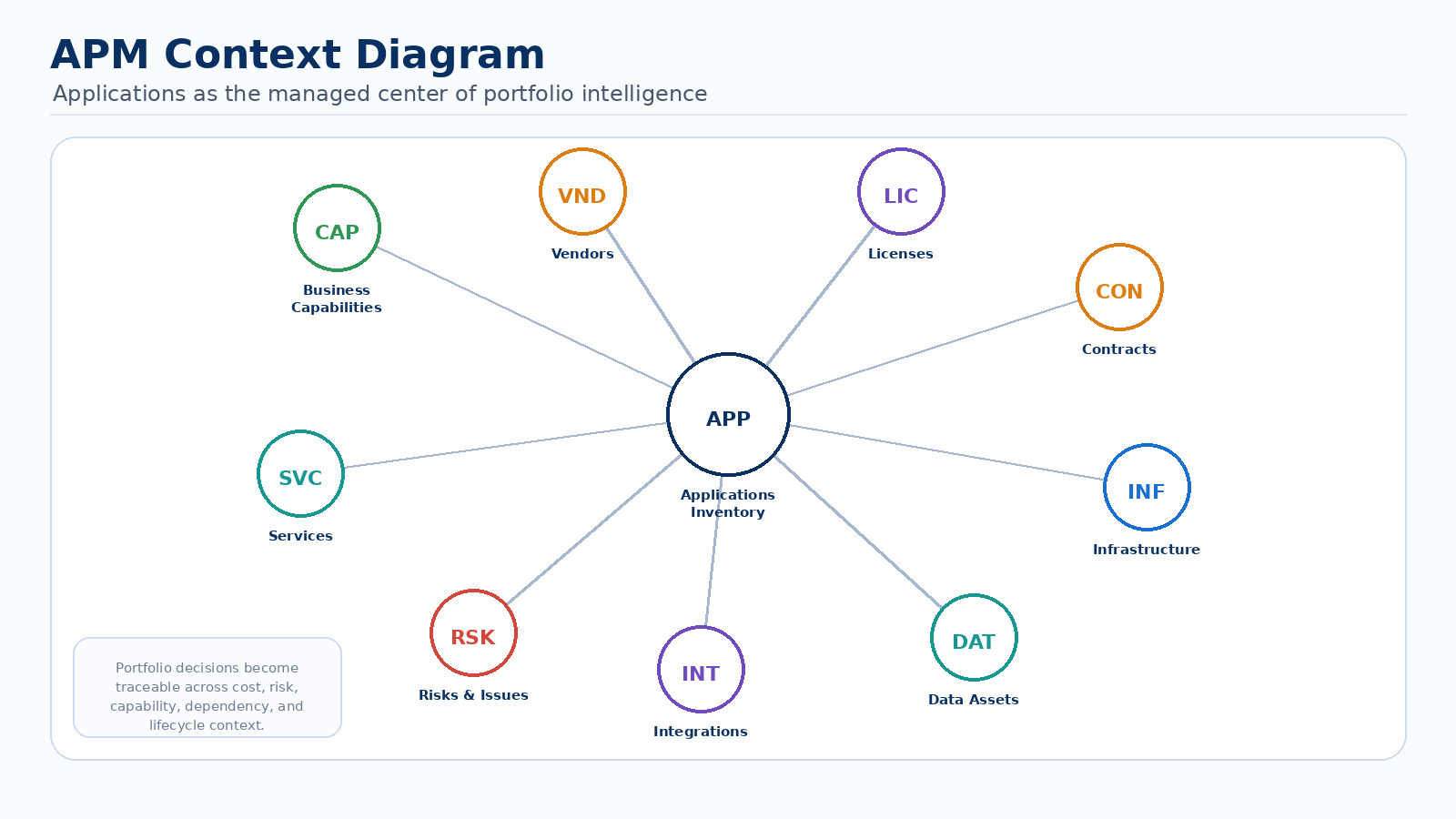
An application portfolio is not simply a list of software - it is a strategic asset. It represents accumulated investment, encodes operational capability, and defines the organization’s ability to adapt, scale, and compete. When managed effectively, the portfolio becomes a source of decision intelligence. When managed poorly, it becomes a source of cost, risk, and constraint.
The quality of Application Portfolio Management directly determines the quality of IT investment decisions, the speed and success of digital transformation, the organization’s ability to identify and mitigate risk, and the efficiency with which it delivers business capability.
Questions This Document Helps You Answer
This document is organized to answer the questions that come up most often as an organization builds and matures its APM practice, including: What is Application Portfolio Management, and how does it relate to Technology Portfolio Management? How do we build and maintain an authoritative inventory of every application we own, operate, or depend upon? How do we decide which applications to invest in, migrate, consolidate, or retire? How do we estimate application cost and complexity when precise financial data does not exist? How do we connect APM to security, financial, and enterprise architecture governance? And how mature is our APM practice today, and what should we do next to advance it? Each question is addressed in depth in the chapters that follow; this document is designed to be navigated by topic, not necessarily read start to finish.
APM is a sub-branch of Technology Portfolio Management (TPM), the overarching enterprise discipline governing every technology type an organization depends upon — including Applications, Software, Hardware, Network, and other technology asset classes. APM applies TPM’s governance, assessment, and lifecycle disciplines specifically to the Applications technology type. The full relationship between APM and TPM is addressed in the chapter that specifically defines and discusses this topic, “Understand the relationship between APM and Technology Portfolio Management.”
Who This Document Is For
This document is designed to serve two audiences simultaneously. For IT leadership - CIOs, CTOs, Chief Architects, Chief Engineers, and COOs - it provides the strategic framework, governance principles, and financial discipline needed to establish APM as an organizational capability that leadership can invest in with confidence. For practitioners - enterprise architects, engineers, and portfolio analysts - it provides the operational guidance, data strategy, assessment frameworks, and AI-assisted techniques needed to build and run APM in practice.
Neither audience is served by a document written only for the other. Leaders who do not understand the operational realities of APM make poor investment and governance decisions. Practitioners who do not understand the leadership perspective build technically sound capabilities that struggle to earn organizational support. This document bridges both perspectives throughout.
The Crawl-Walk-Run Philosophy
APM is not a binary capability. Organizations do not simply have APM or lack it entirely — capability exists in degrees. APM exists on a maturity continuum, and every organization is somewhere on that continuum.

One of the foundational principles of this document is that organizations should approach APM as a journey, moving through Crawl, Walk, and Run maturity stages at a pace that reflects their organizational capacity, their immediate priorities, and the value they are generating at each stage.
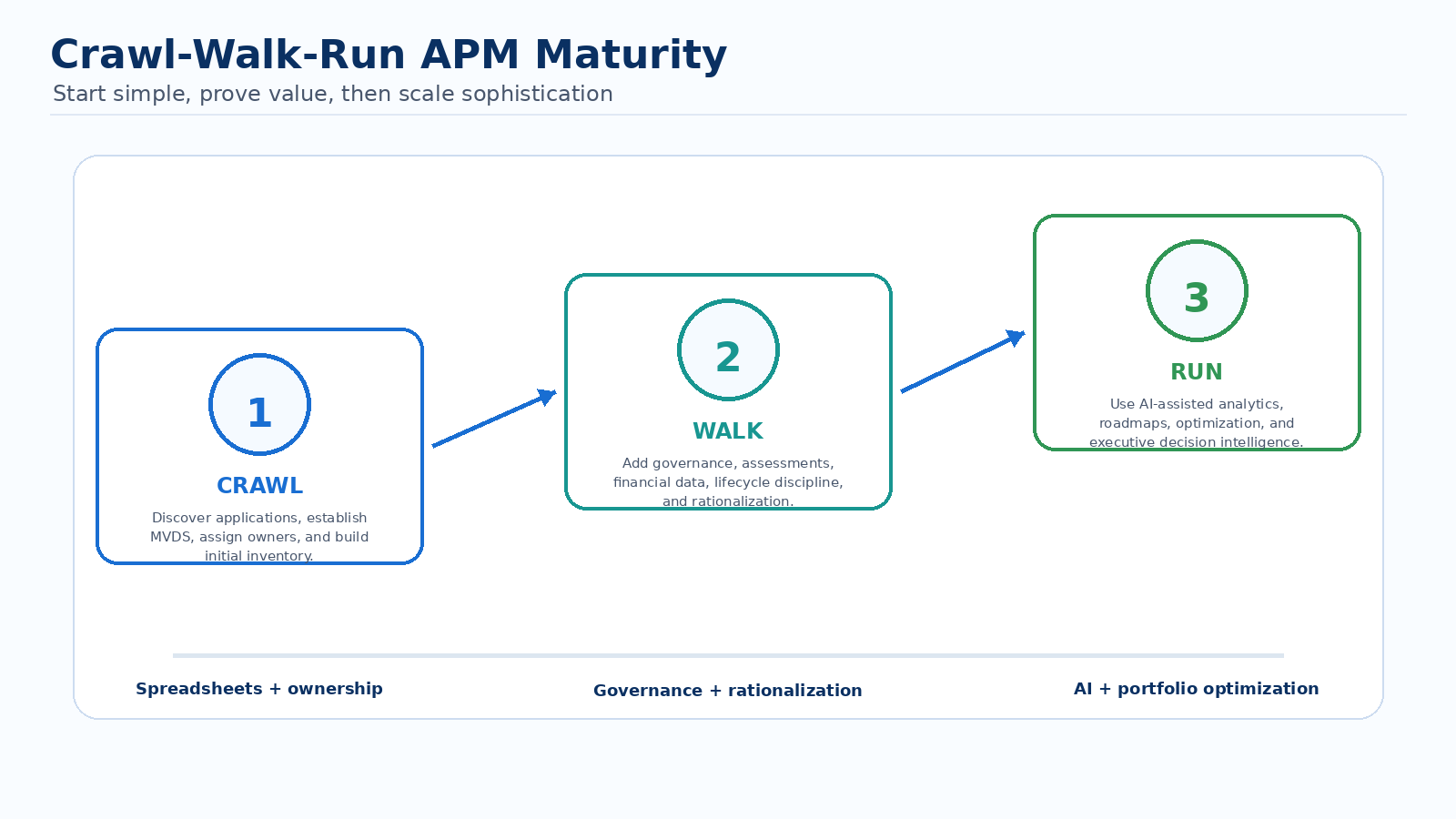
A critical implication of this philosophy is that organizations do not need expensive, specialized APM tooling to start. A well-structured spreadsheet, a consistent naming convention, a clear ownership model, and AI assistance for analysis can produce immediate, meaningful portfolio intelligence at a fraction of the cost and complexity of a purpose-built APM platform. Start simple. Prove the value. Invest in sophistication only when the simplicity genuinely becomes a constraint.
In fact, a common failure pattern in APM initiatives is the attempt to implement comprehensive, fully governed, and deeply integrated portfolio management from the outset. Organizations attempt to solve every problem simultaneously — complete inventory, perfect data quality, full governance, and enterprise-wide integration — before establishing a usable foundation.
This approach consistently fails. It introduces excessive complexity, delays time-to-value, drives up costs, and overwhelms both stakeholders and the teams responsible for implementation. Momentum is lost before the capability has demonstrated tangible benefit.
Effective APM implementations take a different approach. They prioritize early visibility, incremental improvement, and demonstrable value. Rather than attempting completeness from the beginning, they establish a minimal but usable baseline and expand it over time.
The crawl-walk-run model provides a practical and repeatable path for this progression. It allows organizations to establish foundational capability, build confidence through early results, and scale toward more advanced governance, integration, and analytical maturity without introducing unnecessary complexity.
How to Use This Document
This document contains best practices organized across multiple domains. Each best practice follows a consistent structure: an Overview that sets context, one or more Best Practice recommendations, and the Benefits of implementing each recommendation. A Glossary of Terms and Phrases follows this Overview and defines key APM terminology used throughout the document. Reading the Glossary before proceeding to the best practices will make the recommendations easier to understand and apply.
Several subsections of this document address the inventory ecosystem that APM depends on. Readers who are new to the concept that APM requires a family of inventories rather than a single Applications Inventory should read “The APM Inventory Ecosystem” subsection early — even though it appears later in this document — before working through the “Application Portfolio Data and Inventory” and “Enterprise Inventory Integration and Data Leverage” subsections, since the concepts introduced there provide essential context for both. That subsection introduces the three-tier inventory model, explains the Tier 1 inventories that every APM program must directly govern — Applications, Integrations, and Capabilities — and describes how the Integrations Inventory seeds and enriches a broader family of derived inventories over time. It also introduces the Deployment Gate governance mechanism that keeps all inventories current as the portfolio evolves.
For the general principles that govern inventory design, schema definition, data quality, lifecycle management, and AI-assisted population across all inventory types, refer to the IF4IT Enterprise Inventory Management Best Practices document. For the complete attribute taxonomy of any individual inventory type referenced in this document, refer to the corresponding IF4IT Inventory document for that inventory.
How to cite this page
When referencing this page in academic work, internal standards, or external publications, include the page title, IF4IT as author and publisher (The International Foundation for Information Technology (IF4IT), LLC), the URL, and your access date.
Example (informal web citation):
The International Foundation for Information Technology (IF4IT), LLC. Application Portfolio Management (APM) Best Practices. https://if4it.org/best-practices/application-portfolio-management-apm/overview/ (accessed 2026-10-22).
See About Us for content governance and site-wide citation guidance.
Copyright for The International Foundation for Information Technology (IF4IT), LLC: 2008 - Present
Legal Disclaimers