Application Portfolio Management (APM) Best Practices - Start with discovery - know what you have before you claim to manage it
Application Portfolio Management (APM) Best Practices
Chapter 25. Start with discovery - know what you have before you claim to manage it
Executive Summary: Chapter Overview
IF4ITThe Bottom Line
Core Concepts
| Concept | Definition & Strategic Role |
|---|---|
| Application Discovery | The systematic process of identifying every application the enterprise operates, uses, or depends on through multiple complementary sources — not through any single system of record. |
| Discovery Sources | The specific data and human sources that reveal applications: CMDB records, procurement contracts, financial payments, network traffic analysis, stakeholder interviews, and shadow IT reports. |
Quick Q&A
Question: Why is discovery necessary rather than accepting an existing inventory as the starting point?
Question: What is the completeness threshold for initial discovery?
Read More Below
Overview
The most common failure at the beginning of an APM initiative is attempting to build a comprehensive, well-governed portfolio before conducting discovery. Teams populate the portfolio from memory, existing documentation, and organizational charts - producing an inventory that reflects what people believe they have rather than what the organization actually runs. The resulting portfolio systematically misses shadow IT, undocumented departmental tools, legacy applications running on forgotten infrastructure, and SaaS subscriptions procured without central oversight. An inventory built on assumption rather than discovery is wrong before it is finished, and every analysis built on top of it inherits that incorrectness.
Best Practice
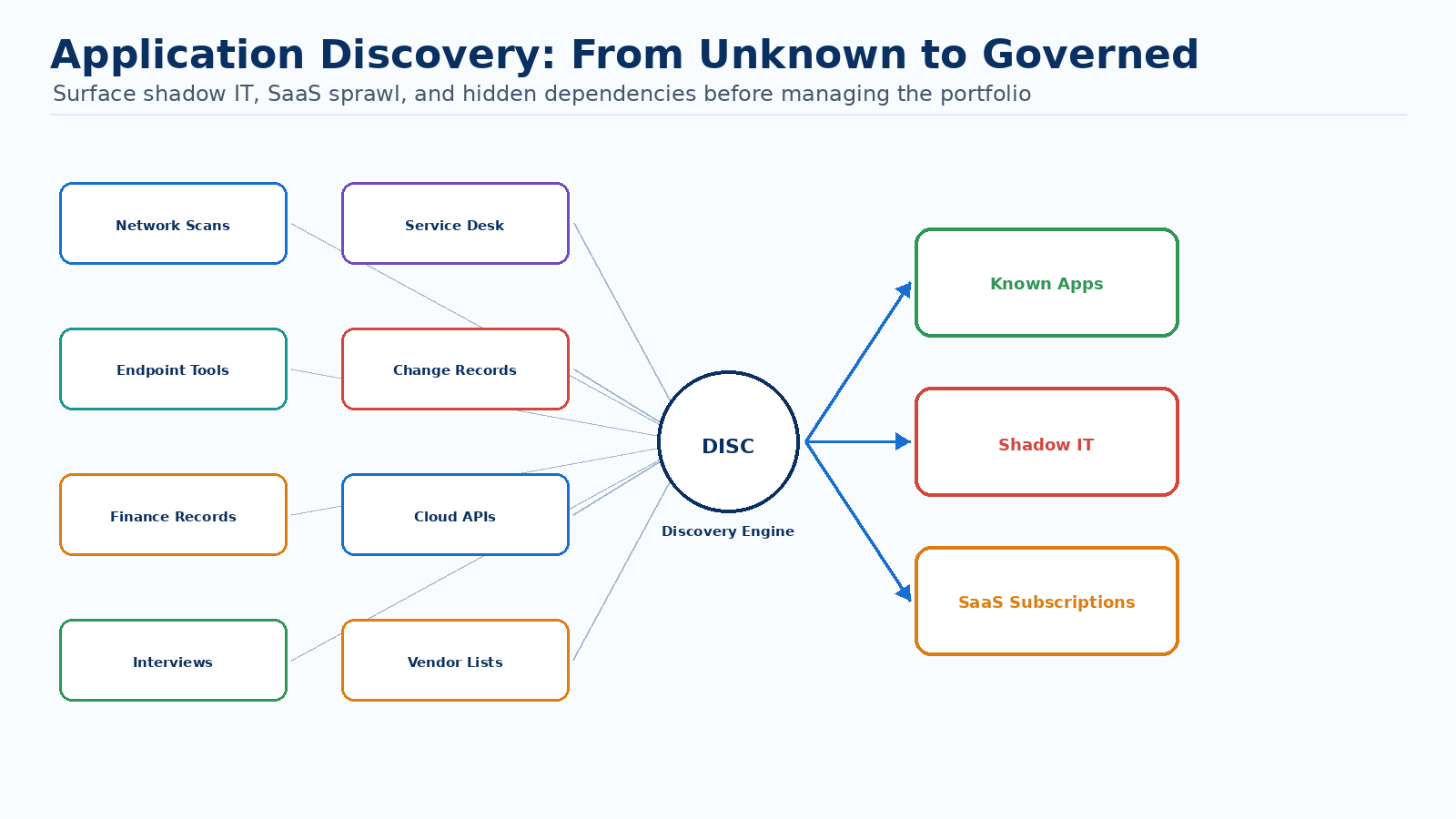
Begin every APM initiative with a structured discovery phase that systematically identifies all applications operating in the enterprise before populating a formal portfolio. Combine multiple discovery approaches: automated scanning of network infrastructure, software deployment systems, and endpoint management tools to surface installed and running applications; financial discovery through accounts payable and procurement records to identify SaaS subscriptions and license purchases; business unit interviews to identify departmental tools and informal applications that automated scanning cannot reach; and review of IT service desk and change management records to surface applications that generate operational activity but are not formally registered anywhere.
Benefit(s)
Discovery before documentation produces an application inventory that reflects organizational reality rather than organizational assumptions. Previously unknown applications - shadow IT, unmanaged SaaS subscriptions, forgotten legacy systems - are surfaced and brought under governance. The scope of the portfolio challenge becomes visible, enabling realistic planning for data collection, governance, and rationalization. Organizations that invest in thorough discovery consistently find that their portfolio is significantly larger, more expensive, and more complex than their pre-discovery estimates suggested - and they are better positioned for it.
How to cite this page
When referencing this page in academic work, internal standards, or external publications, include the page title, IF4IT as author and publisher (The International Foundation for Information Technology (IF4IT), LLC), the URL, and your access date.
Example (informal web citation):
The International Foundation for Information Technology (IF4IT), LLC. Start with discovery - know what you have before you claim to manage it | Application Portfolio Management (APM) Best Practices. https://if4it.org/best-practices/application-portfolio-management-apm/start-with-discovery-know-what-you-have-before-you-claim-to-manage-it/ (accessed 2026-07-22).
See About Us for content governance and site-wide citation guidance.
Copyright for The International Foundation for Information Technology (IF4IT), LLC: 2008 - Present
Legal Disclaimers