Treat well-structured inventory spreadsheets loaded into AI as a connected data graph - no formal data model or ETL pipeline required - Application Portfolio Management (APM) Best Practices
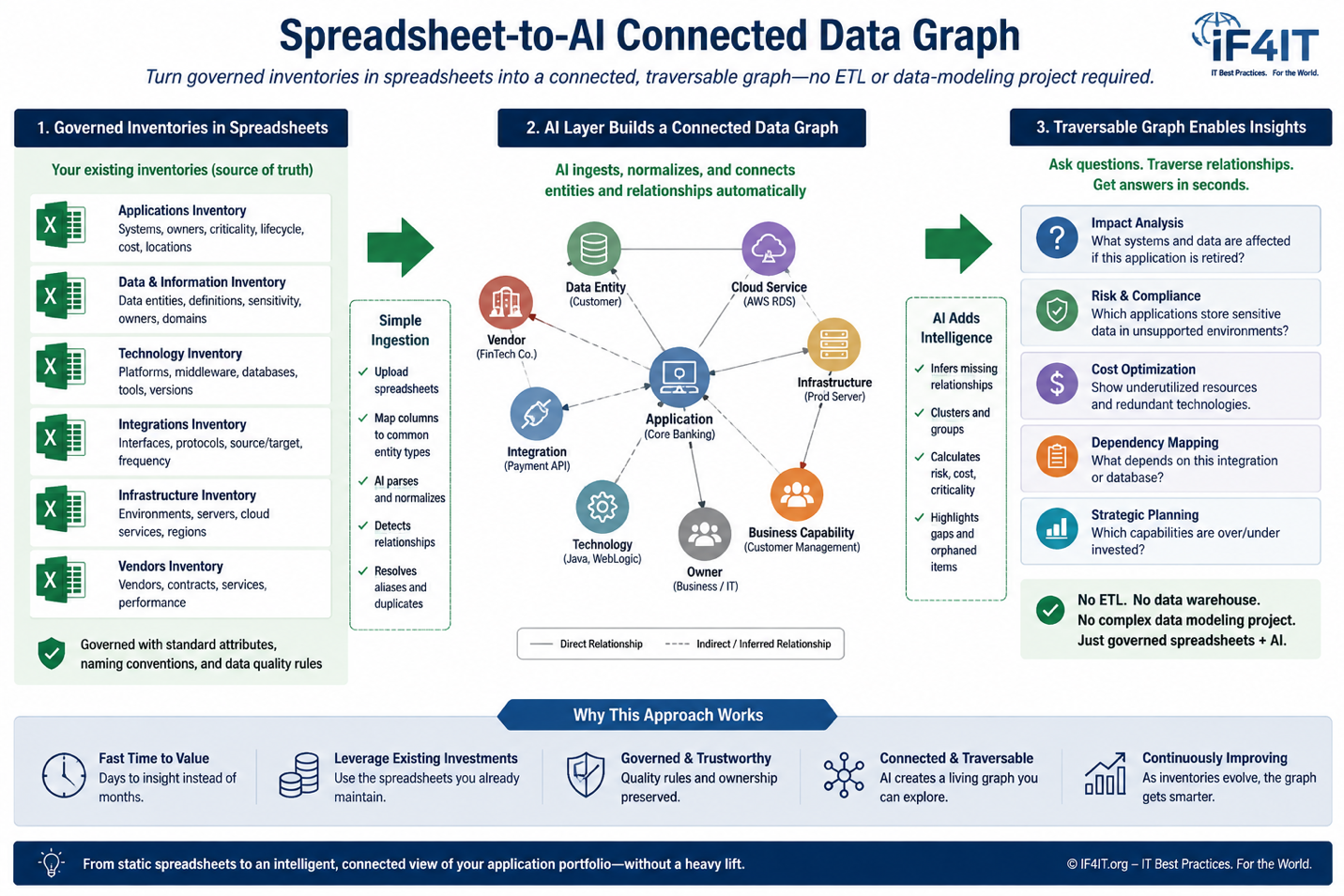
Treat well-structured inventory spreadsheets loaded into AI as a connected data graph - no formal data model or ETL pipeline required
(Chapter 161 of Application Portfolio Management (APM) Best Practices)
Executive Summary: Chapter Overview
IF4ITThe Bottom Line
Core Concepts
| Concept | Definition & Strategic Role |
|---|---|
| AI as Graph Substrate | The capability of AI to operate over multiple loaded spreadsheets as a connected data graph — understanding relationships between records across inventories, executing queries that span inventories, and producing analysis that traditionally required formal graph databases. |
| No-Infrastructure Cross-Inventory Analysis | The practical implication: cross-inventory analysis becomes accessible at the spreadsheet-plus-AI level without the ETL pipelines, formal data models, and integration engineering that traditional cross-inventory analysis required. The cost profile of multi-inventory APM has changed materially. |
Quick Q&A
Question: What kinds of analysis become accessible without formal infrastructure?
Question: What quality discipline is required to make this work?
Read More Below
Overview
Conventional approaches to portfolio analytics require building a formal data model defining how inventory tables relate to each other, building ETL pipelines that extract data from each inventory source and load it into a centralized analytical repository, and building reporting and dashboard tooling on top of that repository. This approach is powerful and scalable at enterprise scale, but it requires specialized data engineering expertise, significant implementation time, and ongoing maintenance of data pipelines that are fragile to source system changes. For organizations at the Crawl and Walk maturity stages - and often even at the Run stage for specific analytical questions - this complexity is both unnecessary and counterproductive to the goal of generating portfolio intelligence quickly and continuously.
Best Practice
Load multiple well-structured inventory spreadsheets into an AI session and treat the resulting session as a connected portfolio data graph without requiring a formal data model or ETL pipeline to be built before analysis can begin. The AI reads the content of each spreadsheet, infers relationships between entities based on shared semantic identifiers, shared names, and contextual patterns, and can answer natural language queries that traverse relationships across inventories with the analytical sophistication of a structured database query but the accessibility of a conversation. Ask the AI which applications have licenses expiring in the next ninety days and no named renewal owner; which vendors supply more than three critical applications and have total annual spend above five hundred thousand dollars; which applications handle regulated data but have no named compliance owner; or any other cross-dimensional question that portfolio governance requires. Validate a sample of AI-produced results to calibrate confidence before treating the outputs as authoritative.
Benefit(s)
Treating AI as the portfolio analytics layer eliminates the data engineering infrastructure cost and complexity that conventional cross-inventory analytics require, making sophisticated portfolio analysis accessible to organizations at any maturity stage using the spreadsheet-based inventories they already maintain. Analysis that would previously have required weeks of data engineering work and specialized analyst skills is available in hours using natural language queries against well-maintained connected inventories. The organization develops an AI-native portfolio analytics capability that scales with the quality and completeness of its inventory data rather than with the sophistication and cost of its data engineering infrastructure.
How to cite this page
When referencing this page in academic work, internal standards, or external publications, include the page title, IF4IT as author and publisher (The International Foundation for Information Technology (IF4IT), LLC), the URL, and your access date.
Example (informal web citation):
The International Foundation for Information Technology (IF4IT), LLC. Treat well-structured inventory spreadsheets loaded into AI as a connected data graph - no formal data model or ETL pipeline required | Application Portfolio Management (APM) Best Practices. https://if4it.org/best-practices/application-portfolio-management-apm/treat-well-structured-inventory-spreadsheets-loaded-into-ai-as-a-connected-data-graph-no-formal-data-model-or-etl-pipeline-required/ (accessed 2026-09-08).
See About Us for content governance and site-wide citation guidance.
Copyright for The International Foundation for Information Technology (IF4IT), LLC: 2008 - Present
Legal Disclaimers