Understand FinOps as the operational discipline of financial accountability for cloud and SaaS spending - Application Portfolio Management (APM) Best Practices
Understand FinOps as the operational discipline of financial accountability for cloud and SaaS spending
(Chapter 99 of Application Portfolio Management (APM) Best Practices)
Executive Summary: Chapter Overview
IF4ITThe Bottom Line
Core Concepts
| Concept | Definition & Strategic Role |
|---|---|
| FinOps as Discipline | The operational discipline of financial accountability for cloud and SaaS spending — combining continuous cost visibility, cross-functional accountability across Finance, Engineering, and Business, and ongoing optimization practices. |
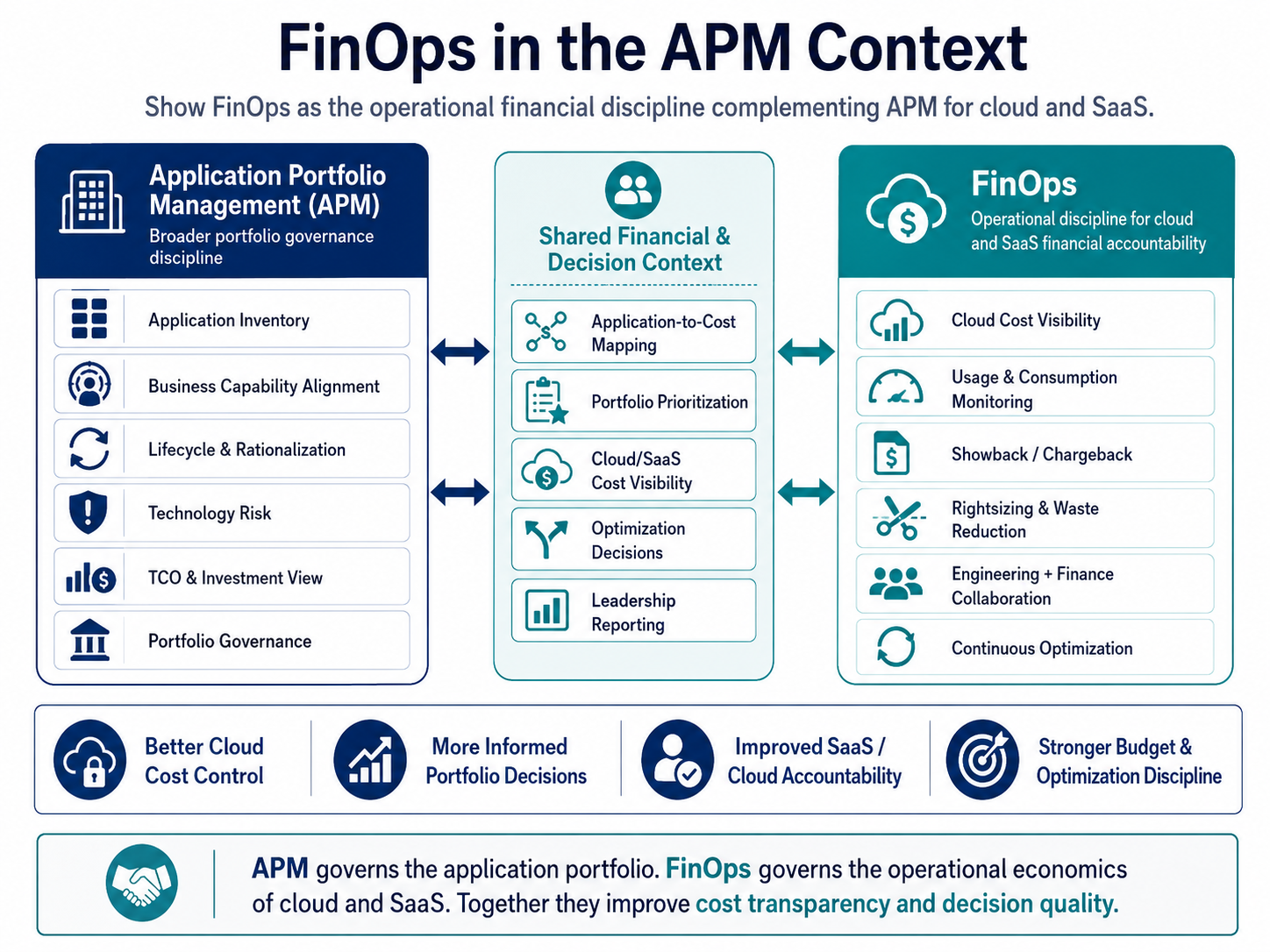
| APM-FinOps Boundary | The distinction between APM (governs the application portfolio) and FinOps (governs the operational financial dynamics of cloud and SaaS) — with FinOps informing APM decisions and APM providing the portfolio context FinOps operates within. |
Quick Q&A
Question: Why is FinOps a distinct discipline rather than an extension of traditional financial management?
Question: What is APM's relationship to FinOps in practice?
Read More Below
Overview
Cloud and SaaS spending has fundamentally different financial characteristics from traditional IT expenditure that make it exceptionally difficult to govern with traditional financial management approaches. It is variable rather than fixed - it changes continuously with usage patterns, not on a procurement cycle. It is distributed rather than centralized - it is incurred by engineering teams making architecture decisions and by business units making tool purchases, not only by a central procurement function. It scales in real time in response to operational activity - a poorly optimized workload or an uncontrolled usage pattern can generate significant unexpected cost before any approval or review process has an opportunity to intercept it. Traditional financial management approaches designed for fixed, centrally procured, slowly-changing IT expenditure are structurally inadequate for governing this type of spending.
Best Practice
Establish FinOps as a distinct operational discipline alongside traditional financial management. FinOps brings engineering, finance, and business teams together around a shared goal: making cloud and SaaS spending visible, understandable, and optimizable in near-real time rather than in retrospect. Establish a FinOps operating model with defined roles spanning Finance, Engineering, and the relevant business units. Define the FinOps operational cadence - the recurring activities that keep cloud and SaaS spending visible and continuously flowing through optimization actions. Integrate FinOps reporting into the broader APM portfolio financial health reporting so that cloud and SaaS costs are governed with the same discipline as other portfolio financial categories.
Benefit(s)
Establishing FinOps as an operational discipline produces continuous cloud and SaaS spending visibility and optimization rather than the periodic snapshots that traditional financial management provides. Cloud spending is understood and optimized continuously rather than audited annually. SaaS utilization is monitored in near-real time rather than discovered once a year at renewal when it is too late to right-size before the next commitment period begins. The organization develops the financial agility that variable cloud and SaaS spending requires - the ability to see spending changes as they occur and respond before they become budget overruns that require retroactive justification.
How to cite this page
When referencing this page in academic work, internal standards, or external publications, include the page title, IF4IT as author and publisher (The International Foundation for Information Technology (IF4IT), LLC), the URL, and your access date.
Example (informal web citation):
The International Foundation for Information Technology (IF4IT), LLC. Understand FinOps as the operational discipline of financial accountability for cloud and SaaS spending | Application Portfolio Management (APM) Best Practices. https://if4it.org/best-practices/application-portfolio-management-apm/understand-finops-as-the-operational-discipline-of-financial-accountability-for-cloud-and-saas-spending/ (accessed 2026-09-08).
See About Us for content governance and site-wide citation guidance.
Copyright for The International Foundation for Information Technology (IF4IT), LLC: 2008 - Present
Legal Disclaimers