Understand the implications of managing a mixed portfolio of on-premises, SaaS, PaaS, and cloud-native applications - Application Portfolio Management (APM) Best Practices
Understand the implications of managing a mixed portfolio of on-premises, SaaS, PaaS, and cloud-native applications
(Chapter 125 of Application Portfolio Management (APM) Best Practices)
Executive Summary: Chapter Overview
IF4ITThe Bottom Line
Core Concepts
| Concept | Definition & Strategic Role |
|---|---|
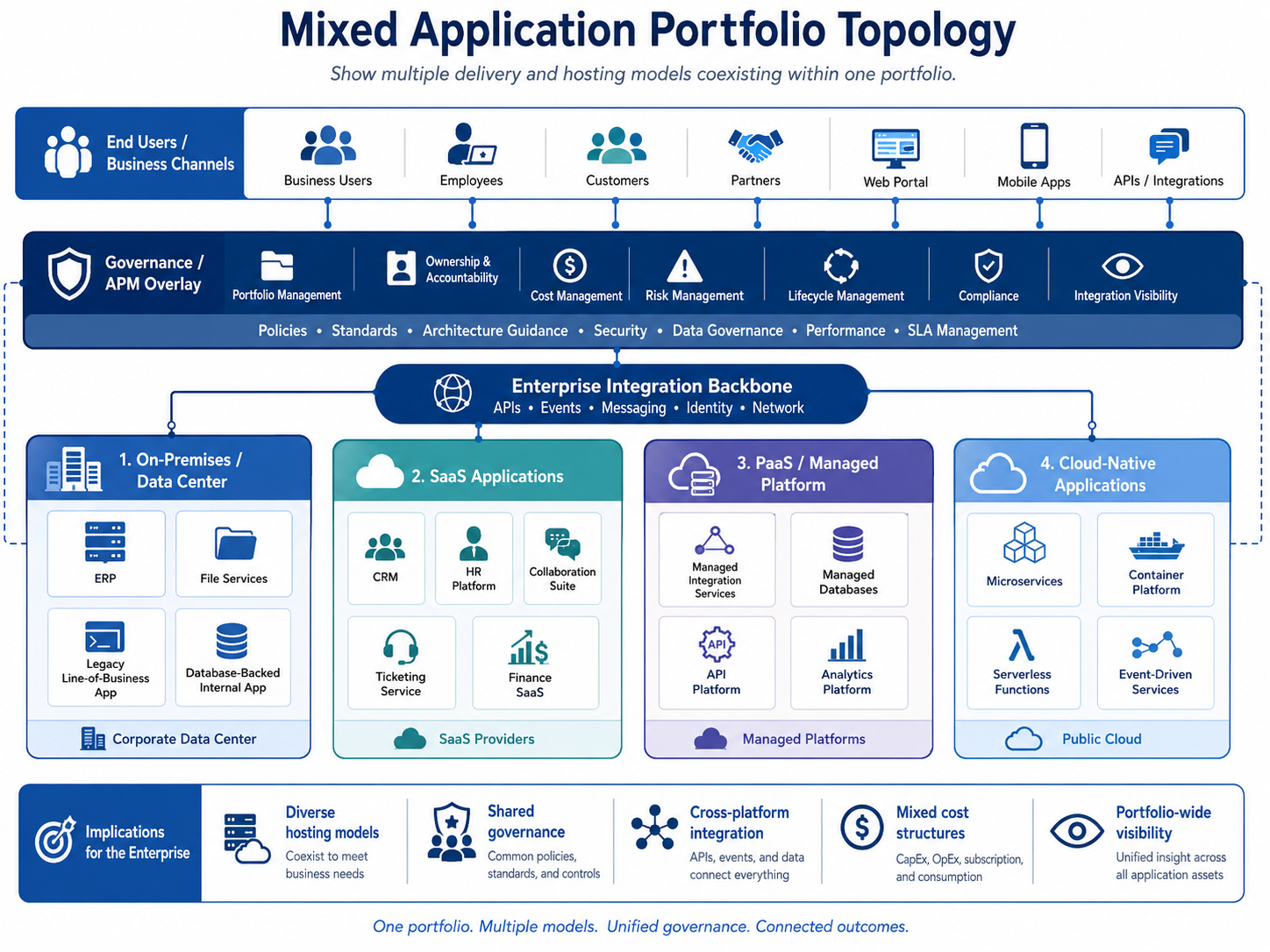
| Mixed Portfolio Composition | The mixture of application deployment models — on-premises (enterprise-owned infrastructure), SaaS (vendor-hosted service subscriptions), PaaS (vendor-hosted platform with enterprise-developed applications), and cloud-native (enterprise-developed applications on cloud infrastructure) — each with distinct financial, governance, and operational characteristics. |
| Deployment-Aware Governance | The application of governance treatment appropriate to each deployment model rather than uniform treatment across the mixed portfolio — recognizing that SaaS renewal management differs from on-premises license management, cloud cost management differs from data center cost management, and so on. |
Quick Q&A
Question: Why does uniform management fail across a mixed portfolio?
Question: What does deployment-aware governance produce that uniform governance does not?
Read More Below
Overview
The modern enterprise application portfolio is almost never homogeneous in its deployment model. It typically contains a complex mix of on-premises applications running on owned or leased infrastructure, SaaS applications delivered as managed services by external vendors, PaaS-based applications built on cloud platform services, and cloud-native applications purpose-built for cloud deployment using cloud-specific services and architectural patterns. Each deployment model has different cost structures, operational characteristics, security governance requirements, organizational ownership patterns, and risk profiles. Managing a mixed portfolio as if it were homogeneous - applying the same governance framework and cost analysis approach regardless of deployment model - produces governance that fits none of the models adequately.
Best Practice
Classify every application in the portfolio by its primary deployment model and apply model-appropriate governance, cost analysis, and operational standards to each class. Maintain the deployment model as a standard attribute of every application record, as it is foundational to financial management, security governance, FinOps discipline, and lifecycle planning decisions. Ensure that portfolio financial analysis accounts for the fundamentally different cost structures of each deployment model rather than applying uniform analysis that misrepresents the economics of cloud-hosted and SaaS-delivered applications relative to on-premises applications.
Benefit(s)
Model-appropriate governance produces a portfolio management approach that fits the actual characteristics of the applications being governed. On-premises applications receive appropriate infrastructure lifecycle and cost governance. SaaS applications receive utilization monitoring, vendor risk management, and renewal discipline. Cloud-native and PaaS applications receive FinOps governance and architectural optimization attention. The organization develops portfolio management capabilities that mature in proportion to the deployment complexity of the applications they govern rather than applying a uniform approach that leaves significant governance gaps across deployment models.
How to cite this page
When referencing this page in academic work, internal standards, or external publications, include the page title, IF4IT as author and publisher (The International Foundation for Information Technology (IF4IT), LLC), the URL, and your access date.
Example (informal web citation):
The International Foundation for Information Technology (IF4IT), LLC. Understand the implications of managing a mixed portfolio of on-premises, SaaS, PaaS, and cloud-native applications | Application Portfolio Management (APM) Best Practices. https://if4it.org/best-practices/application-portfolio-management-apm/understand-the-implications-of-managing-a-mixed-portfolio-of-on-premises-saas-paas-and-cloud-native-applications/ (accessed 2026-10-22).
See About Us for content governance and site-wide citation guidance.
Copyright for The International Foundation for Information Technology (IF4IT), LLC: 2008 - Present
Legal Disclaimers