Understand the progression from spreadsheets to dedicated tooling - and when the transition is justified - Application Portfolio Management (APM) Best Practices
Understand the progression from spreadsheets to dedicated tooling - and when the transition is justified
(Chapter 152 of Application Portfolio Management (APM) Best Practices)
Executive Summary: Chapter Overview
IF4ITThe Bottom Line
Core Concepts
| Concept | Definition & Strategic Role |
|---|---|
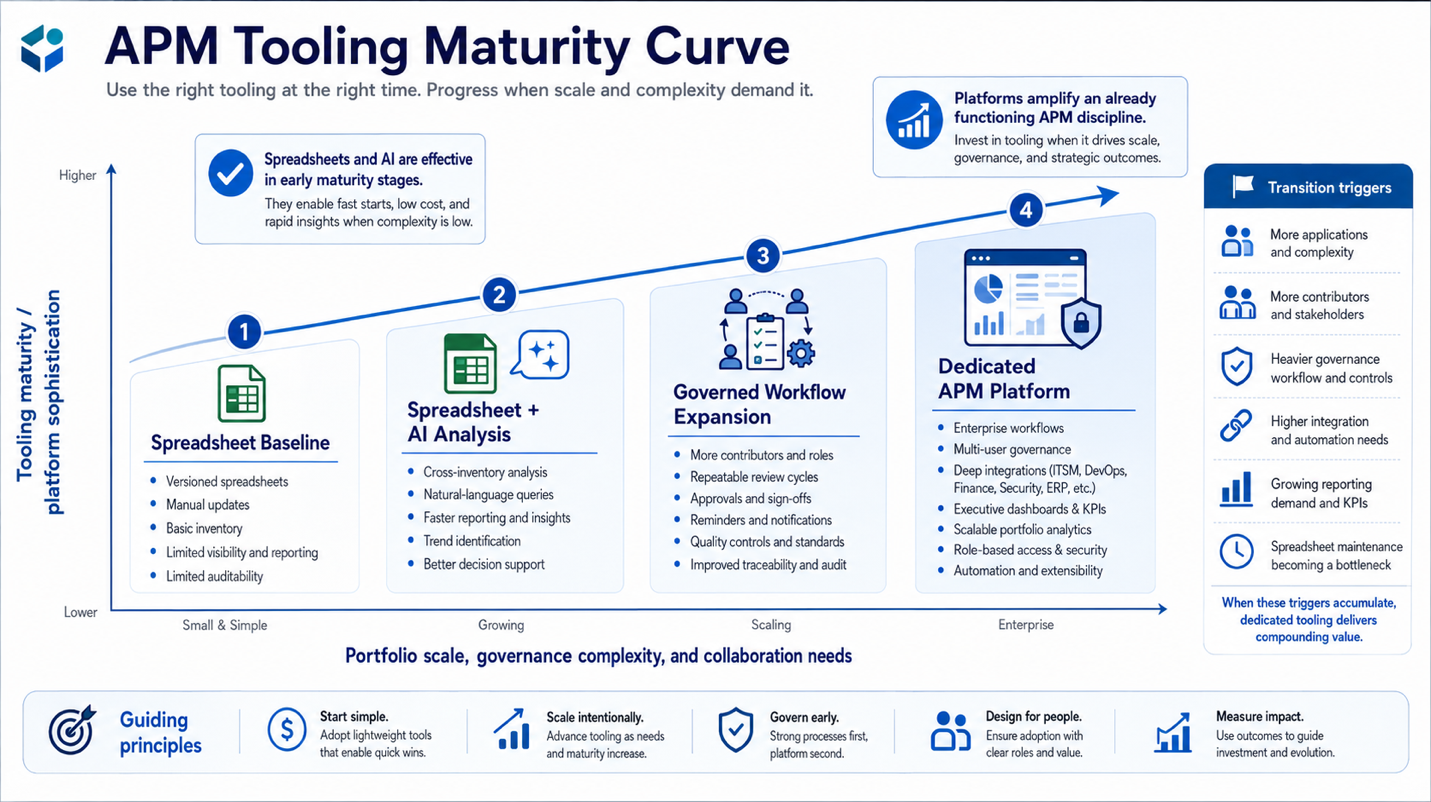
| Spreadsheet-to-Tooling Progression | The maturity progression from spreadsheet-based APM (efficient at low-to-moderate scale and maturity) through hybrid approaches (spreadsheets augmented with AI and lightweight tools) to dedicated APM tooling (justified when scale, complexity, or workflow needs exceed what spreadsheets can support). |
| Transition Triggers | The specific conditions that justify the transition to dedicated tooling — inventory scale exceeding what spreadsheets can support with quality, multi-user editing complexity, workflow automation needs, integration with enterprise systems, and analysis needs that exceed AI-augmented spreadsheet capability. |
Quick Q&A
Question: What are the typical triggers for the transition?
Question: What warns against premature transition?
Read More Below
Overview
Spreadsheet-based APM with AI-assisted analysis is a genuinely capable operating model for the Crawl and Walk maturity stages, but it has natural limits that become genuine operational constraints as the portfolio grows in size, contributor count, and analytical complexity. Recognizing the specific constraints that signal readiness for dedicated tooling investment - rather than responding to vendor marketing pressure or organizational status anxiety about using spreadsheets - is the key to making tooling investment decisions that are justified by organizational need rather than driven by aspiration.
Best Practice
Invest in dedicated APM tooling when specific, concrete constraints of the spreadsheet approach are limiting portfolio management quality or analytical capability in ways that are measurable and material. The primary signals that justify tooling investment include: concurrent editing by multiple contributors creating version conflicts that cannot be managed manually without unacceptable risk of data loss or corruption; portfolio item counts growing to a level where manual validation and quality assurance are impractical within the available analyst capacity; integration requirements with operational systems such as the CMDB, financial systems, or ITSM platforms that require programmatic data exchange the spreadsheet approach cannot support; and analytical complexity requirements that consistently exceed what AI-assisted spreadsheet analysis can efficiently produce. Graduate because the specific constraints justify the investment, not because the vendor market or organizational comparison suggests it should have been made earlier.
Benefit(s)
Graduating to dedicated tooling at the point where specific constraints justify the investment ensures that the platform investment produces a measurable improvement in portfolio management quality that could not be achieved with the simpler approach. The organization invests in platform capability from a position of data quality, governance maturity, and analytical discipline that makes the investment productive from implementation day rather than from the extended period of data cleanup and governance establishment that follows premature tooling adoption. The data structures established in the spreadsheet phase provide the platform migration data model, making migration faster and producing cleaner initial platform data than migration from unstructured sources would achieve.
How to cite this page
When referencing this page in academic work, internal standards, or external publications, include the page title, IF4IT as author and publisher (The International Foundation for Information Technology (IF4IT), LLC), the URL, and your access date.
Example (informal web citation):
The International Foundation for Information Technology (IF4IT), LLC. Understand the progression from spreadsheets to dedicated tooling - and when the transition is justified | Application Portfolio Management (APM) Best Practices. https://if4it.org/best-practices/application-portfolio-management-apm/understand-the-progression-from-spreadsheets-to-dedicated-tooling-and-when-the-transition-is-justified/ (accessed 2026-09-22).
See About Us for content governance and site-wide citation guidance.
Copyright for The International Foundation for Information Technology (IF4IT), LLC: 2008 - Present
Legal Disclaimers