Understand the relationship between APM and the Enterprise Model - Application Portfolio Management (APM) Best Practices
Understand the relationship between APM and the Enterprise Model
(Chapter 11 of Application Portfolio Management (APM) Best Practices)
Executive Summary: Chapter Overview
IF4ITThe Bottom Line
Core Concepts
| Concept | Definition & Strategic Role |
|---|---|
| Enterprise Model | The unified graph of governed enterprise inventories — applications, integrations, capabilities, vendors, risks, and others — that connects every IT Management discipline through consistent semantic identifiers and shared relationship data. |
| APM Contribution and Consumption | APM contributes the Applications, Integrations, and Capabilities Inventories to the Enterprise Model and consumes data from adjacent inventories so portfolio decisions are grounded in cross-domain evidence. |
Quick Q&A
Question: Why can't APM be practiced effectively in isolation from the Enterprise Model?
Question: What is APM's specific role within the Enterprise Model?
Read More Below
Overview
The Enterprise Model is the connected representation of the enterprise’s capabilities, systems, data, integrations, vendors, contracts, people, and risks—and the relationships that bind them together. It is not simply a collection of inventories. It is a structured intelligence layer that describes how the enterprise actually operates.
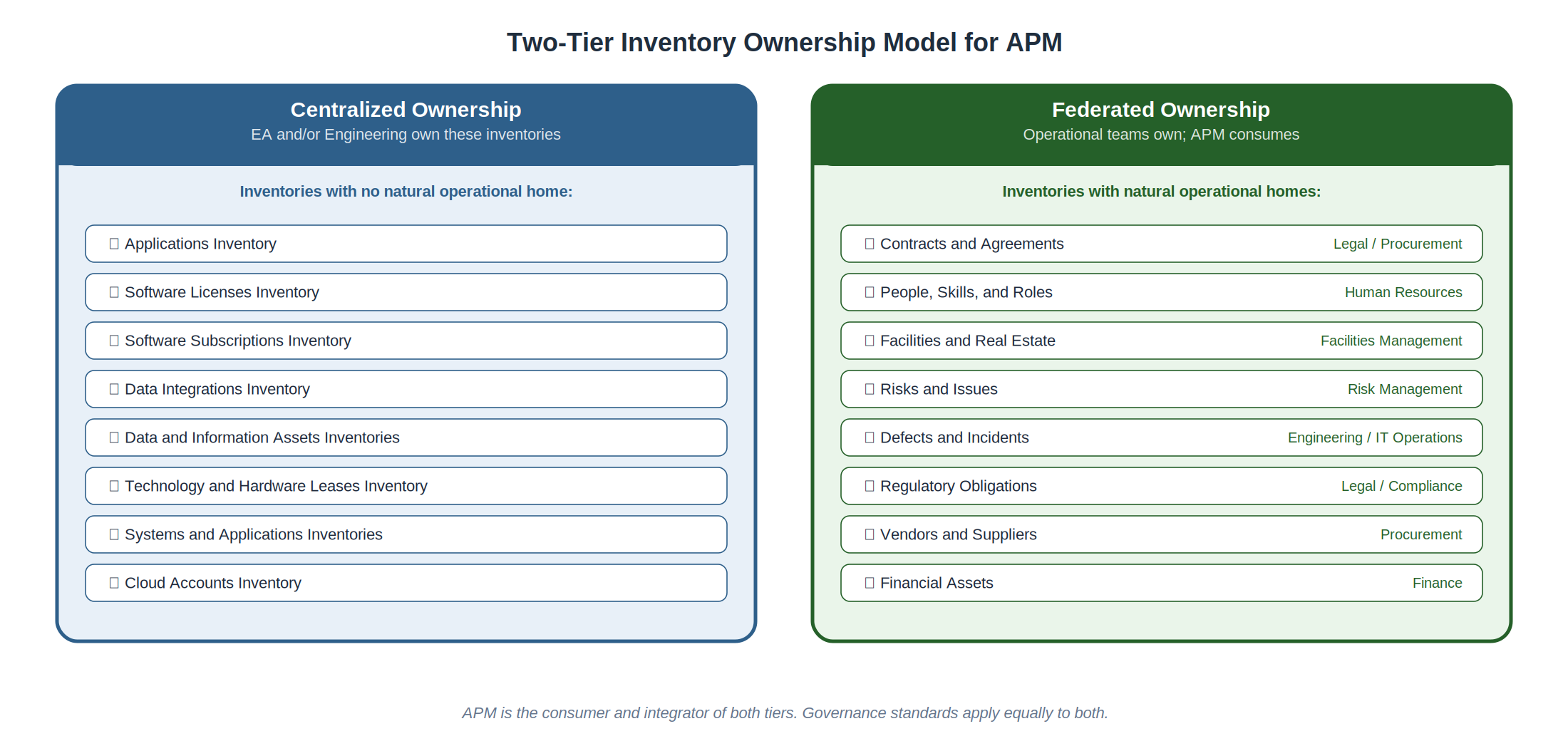
Within this model, the Applications Inventory is one of the most critical nodes, and Application Portfolio Management (APM) is the discipline responsible for governing it. However, the value of APM is fundamentally limited when the Applications Inventory is treated in isolation. An isolated view answers only basic questions: what applications exist and, at best, what they cost.
The analytical power of APM increases dramatically when the Applications Inventory is connected to the broader Enterprise Model. When these connections are established, applications can be understood in context: which vendors supply them, which contracts govern them, which licenses authorize them, what data they process, which integrations they participate in, who owns and operates them, and what risks they introduce.
This shift—from isolated inventory to connected model—transforms APM from a tracking exercise into a source of enterprise-wide decision intelligence. Leaders can move beyond static reporting and begin to understand consequence. If a vendor relationship changes, which applications are affected? If a contract expires, which capabilities are at risk? If a system is modified or retired, what downstream dependencies are impacted? These questions become immediately answerable when APM is integrated into the Enterprise Model.
Best Practice
Design and operate APM as an integral part of the Enterprise Model rather than as a standalone practice. Doing so helps achieve the higher levels of maturity necessary for better analysis and decision making by providing a more complete picture. Ensure that every application in the portfolio has relationships to the relevant nodes in the Enterprise Model: the vendors that supply it, the contracts that govern it, the licenses that authorize it, the data it processes, the integrations it participates in, the people who own and operate it, and the risks it creates. Treat these relationships as first-class APM data - as important as the descriptive attributes of the application data itself - not as optional enrichments to be added when time permits.
Look to automation to help create and maintain these relationships, since they can be voluminous and difficult to create and maintain manually.
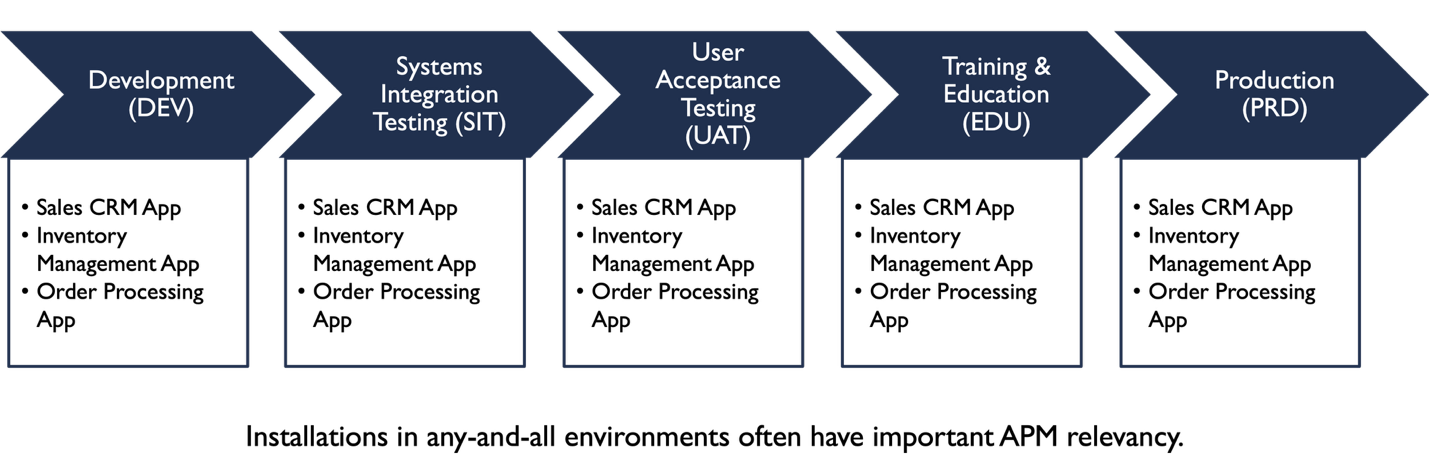
For the complete treatment of Enterprise Model structure, modeling conventions, and governance across all IT Management disciplines, refer to the IF4IT Enterprise Model and Modeling Best Practices document as the governing source.
Benefit(s)
When APM is implemented in a manner that is fully grounded in the Enterprise Model, it produces portfolio intelligence that isolated application inventories simply cannot deliver. Impact analysis becomes possible when an application’s full context is visible across the connected Enterprise Model, not just within the Applications Inventory. Technology Portfolio Management, a closely related companion discipline to APM, is addressed in the chapter that follows.
How to cite this page
When referencing this page in academic work, internal standards, or external publications, include the page title, IF4IT as author and publisher (The International Foundation for Information Technology (IF4IT), LLC), the URL, and your access date.
Example (informal web citation):
The International Foundation for Information Technology (IF4IT), LLC. Understand the relationship between APM and the Enterprise Model | Application Portfolio Management (APM) Best Practices. https://if4it.org/best-practices/application-portfolio-management-apm/understand-the-relationship-between-apm-and-the-enterprise-model/ (accessed 2026-10-22).
See About Us for content governance and site-wide citation guidance.
Copyright for The International Foundation for Information Technology (IF4IT), LLC: 2008 - Present
Legal Disclaimers