Use APM maturity models to assess current capability and guide improvement investment - Application Portfolio Management (APM) Best Practices
Use APM maturity models to assess current capability and guide improvement investment
(Chapter 184 of Application Portfolio Management (APM) Best Practices)
Executive Summary: Chapter Overview
IF4ITThe Bottom Line
Core Concepts
| Concept | Definition & Strategic Role |
|---|---|
| APM Maturity Model | A structured framework for assessing APM capability across multiple dimensions — governance, inventory quality, financial management, assessment rigor, rationalization execution, tooling maturity, AI integration, and reporting effectiveness — that reveals the full capability picture rather than the most visible parts. |
| Maturity-Guided Improvement | The use of maturity assessment to guide improvement investment toward the dimensions that most significantly limit program value — typically the dimensions weakest relative to the program’s operating maturity — rather than toward the dimensions most visible or most recently discussed. |
Quick Q&A
Question: Why is a maturity model necessary for improvement prioritization?
Question: How is the maturity assessment conducted rigorously?
Read More Below
Overview
APM maturity models provide the structured framework for assessing the current state of an APM program across multiple capability dimensions simultaneously and for defining the improvement investments that will produce the greatest advancement in program effectiveness. Without a maturity model framework, APM improvement assessments tend to focus on the dimensions that are most visible or most recently discussed rather than on the dimensions that most significantly limit the program’s ability to deliver its full potential value. Maturity models create the comprehensive assessment framework that reveals the full picture of capability strengths and gaps and enables improvement investment to be directed toward the areas with the greatest impact on overall program effectiveness.
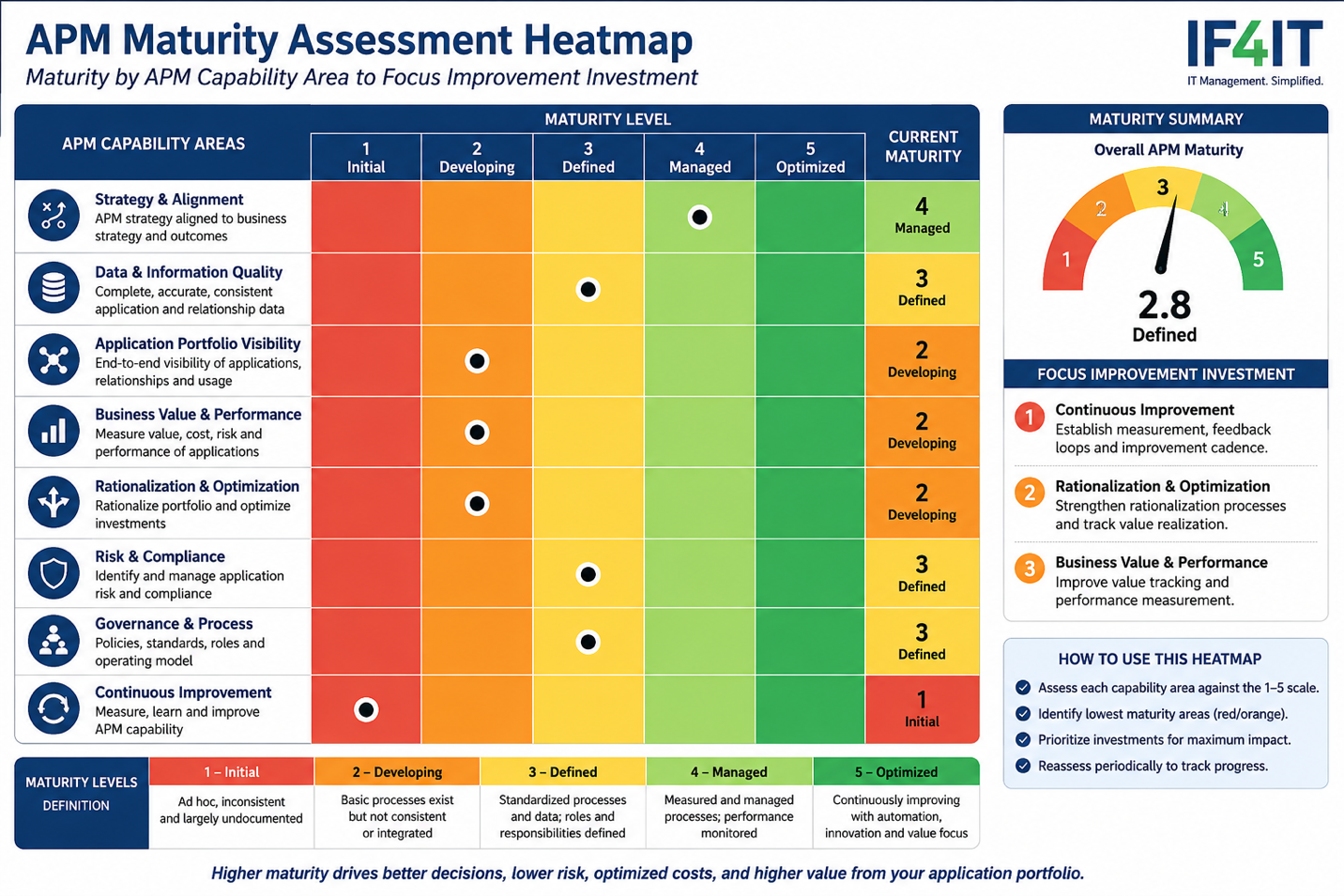
Best Practice
Use the Crawl-Walk-Run maturity framework defined in this document as the primary lens for annual APM maturity assessment, supplemented by any additional maturity model frameworks that the organization finds useful for specific capability dimensions. For each capability dimension assessed - governance, inventory quality, financial management, assessment rigor, rationalization execution, tooling maturity, AI integration, service management integration, and reporting effectiveness - determine the current maturity stage honestly and document the specific evidence that supports the assessment. Identify the capability dimensions where the program is furthest from its target maturity stage and the specific investments - in process, governance, tools, or organizational capacity - that would most effectively advance those dimensions. Use the assessment output as the primary input to the annual APM improvement planning cycle.
Benefit(s)
Using a structured maturity model framework for APM capability assessment produces improvement investment decisions that are grounded in an objective, comprehensive assessment of program capability rather than in the subjective impressions of program participants who are closest to the program and may not see its limitations clearly. The maturity model creates a shared language for describing APM capability that facilitates productive conversations between program practitioners, organizational leadership, and external benchmarking sources. The annual rhythm of maturity assessment, improvement planning, and progress review creates the organizational accountability and directed investment that enables the APM program to advance through the Crawl, Walk, and Run stages rather than stabilizing at a maturity level that delivers partial value when the full capability of a Run-stage program is achievable and organizationally justified.
How to cite this page
When referencing this page in academic work, internal standards, or external publications, include the page title, IF4IT as author and publisher (The International Foundation for Information Technology (IF4IT), LLC), the URL, and your access date.
Example (informal web citation):
The International Foundation for Information Technology (IF4IT), LLC. Use APM maturity models to assess current capability and guide improvement investment | Application Portfolio Management (APM) Best Practices. https://if4it.org/best-practices/application-portfolio-management-apm/use-apm-maturity-models-to-assess-current-capability-and-guide-improvement-investment/ (accessed 2026-10-22).
See About Us for content governance and site-wide citation guidance.
Copyright for The International Foundation for Information Technology (IF4IT), LLC: 2008 - Present
Legal Disclaimers