Use APM to support digital transformation planning and execution - Application Portfolio Management (APM) Best Practices
Use APM to support digital transformation planning and execution
(Chapter 135 of Application Portfolio Management (APM) Best Practices)
Executive Summary: Chapter Overview
IF4ITThe Bottom Line
Core Concepts
| Concept | Definition & Strategic Role |
|---|---|
| APM as Transformation Baseline | The role of APM in providing the current-state portfolio baseline that digital transformation planning depends on — surfacing what applications, capabilities, dependencies, and constraints the transformation must address. |
| Transformation Impact Visibility | The maintained visibility of how transformation is actually changing the portfolio — new applications added, existing applications modernized or retired, dependencies restructured — producing accountability against transformation targets. |
Quick Q&A
Question: Why does digital transformation without APM fail more often than transformation with APM?
Question: What specifically does APM contribute during transformation execution?
Read More Below
Overview
Digital transformation programs consistently encounter application portfolio realities that their planners did not anticipate and did not account for in their initial scope, timeline, and budget commitments: integration complexity that makes capability delivery more expensive than estimated; legacy dependencies that constrain the pace of change; data quality issues embedded in applications that the transformation must rely on; and portfolio redundancy that creates ambiguity about which applications are the authoritative sources of capability the transformation needs to integrate with. These portfolio realities are knowable in advance through APM and routinely cause transformation delays and cost overruns because they are not discovered until the transformation program is already underway and commitments cannot easily be reversed.
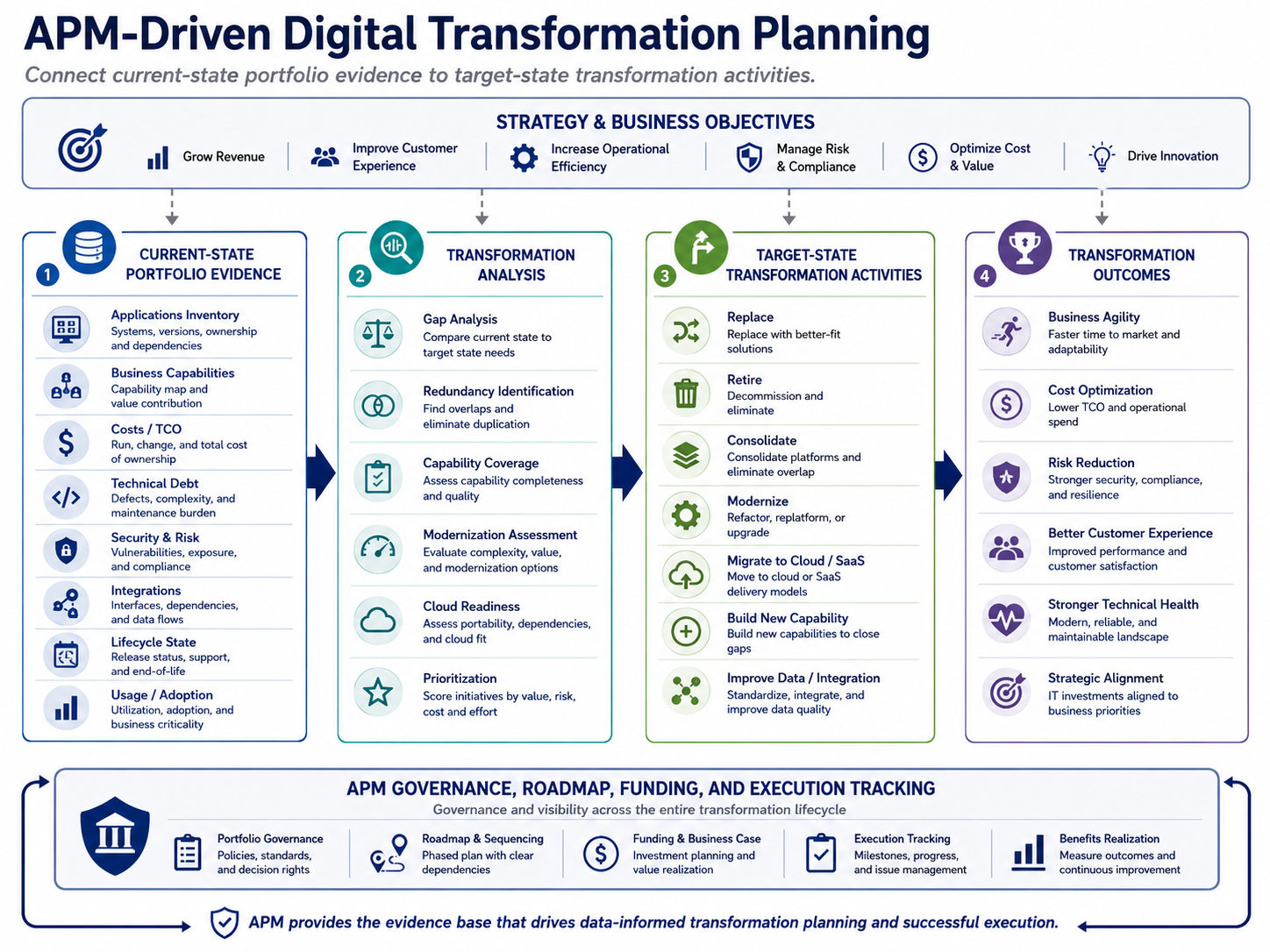
Best Practice
Use APM as a foundational analytical input to digital transformation planning, conducted before transformation scope, timeline, and budget commitments are finalized. Before committing to transformation milestones and investment levels, conduct a portfolio assessment that identifies the applications the transformation will depend on and their current technical fitness, the integration complexity the transformation will encounter, the data quality issues it must address or work around, and the legacy constraints that will affect the achievable pace of change. Use this assessment to inform realistic transformation scope definition, sequencing decisions, and cost estimation. During transformation execution, use the portfolio as the authoritative source of integration and dependency intelligence that guides architecture decisions and prevents the discovery of portfolio constraints as mid-program surprises.
This is what application portfolio transformation looks like in practice: not a one-time initiative, but portfolio data actively shaping each transformation decision as it is made.
Benefit(s)
Digital transformations informed by APM are better scoped, better sequenced, and more accurately estimated than those that begin without portfolio intelligence. Portfolio realities that would have been discovered as costly surprises during execution are known before commitments are made, enabling transformation programs to account for them in scope and budget rather than managing them as crises that demand emergency scope changes or budget overruns. The organization develops the integration between portfolio management and transformation execution that makes large-scale technology change more predictable, more transparent, and more consistently successful.
How to cite this page
When referencing this page in academic work, internal standards, or external publications, include the page title, IF4IT as author and publisher (The International Foundation for Information Technology (IF4IT), LLC), the URL, and your access date.
Example (informal web citation):
The International Foundation for Information Technology (IF4IT), LLC. Use APM to support digital transformation planning and execution | Application Portfolio Management (APM) Best Practices. https://if4it.org/best-practices/application-portfolio-management-apm/use-apm-to-support-digital-transformation-planning-and-execution/ (accessed 2026-10-22).
See About Us for content governance and site-wide citation guidance.
Copyright for The International Foundation for Information Technology (IF4IT), LLC: 2008 - Present
Legal Disclaimers