Use Rationalization Postures and Strategic Dispositions together to produce a complete portfolio strategy picture - Application Portfolio Management (APM) Best Practices
Use Rationalization Postures and Strategic Dispositions together to produce a complete portfolio strategy picture
(Chapter 71 of Application Portfolio Management (APM) Best Practices)
Executive Summary: Chapter Overview
IF4ITThe Bottom Line
Core Concepts
| Concept | Definition & Strategic Role |
|---|---|
| Combined Portfolio Picture | The joint view of every application’s current Rationalization Posture and declared Strategic Disposition — producing the two-dimensional map that shows operational state and strategic intent simultaneously. |
| Portfolio Strategy Reporting | The regular reporting of the combined view to leadership — showing how many applications sit at each combination of posture and disposition, where posture and disposition diverge, and where the distributions are shifting over time. |
| Four Combination Patterns | The four categories that emerge from comparing Posture and Disposition together: Alignment (both point the same direction), Strategic Pressure (disposition more demanding than posture), Reassessment Signals (the two appear to conflict), and Drift (neither reviewed recently enough to reflect current reality) — each implying a different governance response. |
Quick Q&A
Question: What does the combined view enable that either framework alone does not?
Question: How should the combined view be structured for leadership consumption?
Read More Below
Overview
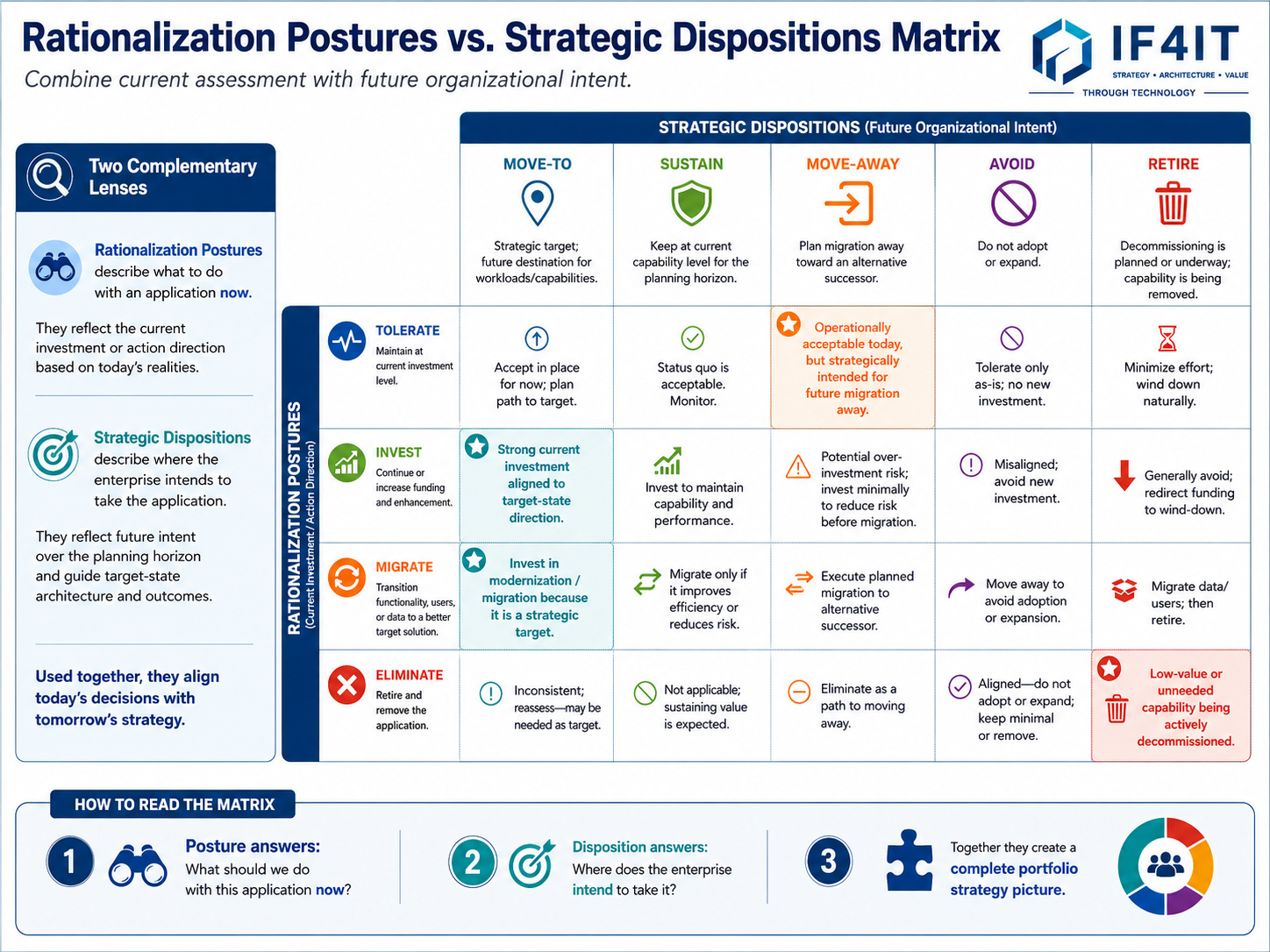
Rationalization Postures and Strategic Dispositions are designed to be used together. Each framework answers a different question about each application in the portfolio, and the combination of the two answers produces a richer, more actionable strategic picture than either framework can produce alone. A Rationalization Posture without a Strategic Disposition tells you what to do with an application now but not where the organization intends to take it. A Strategic Disposition without a Rationalization Posture tells you where the organization intends to go but not what the current evidence says about the application’s fitness to get there. Together they produce a two-dimensional view of the portfolio that connects current assessment to strategic intent — the present-state picture and the forward-looking declaration — in a way that makes portfolio decisions genuinely governable and genuinely strategic.
Best Practice
It is recommended that every application in the portfolio carry both a current Rationalization Posture and a current Strategic Disposition, and that the combination of the two be reviewed together at every portfolio governance cycle. Reviewing them together surfaces four categories of strategic insight that individual review of either framework alone cannot produce.
Alignment — cases where the Rationalization Posture and Strategic Disposition point in the same direction and reinforce each other. An application that is assessed as Invest and carries a Move-To disposition is straightforwardly a strategic asset deserving active investment. An application assessed as Eliminate carrying a Retire disposition is straightforwardly a decommissioning priority. Aligned combinations require governance confirmation and execution rather than strategic deliberation.
Strategic pressure — cases where the Strategic Disposition is more demanding than the Rationalization Posture suggests. An application assessed as Tolerate carrying a Move-Away disposition is operationally acceptable but strategically earmarked for replacement — the governance response is to begin planning the migration even though current condition does not yet force it. An application assessed as Tolerate carrying a Move-To disposition is a strategic target that is not yet performing at the level its strategic role requires — the governance response is to understand why and determine what investment is needed to close the gap. Strategic pressure combinations reveal where the organization needs to act ahead of operational necessity.
Reassessment signals — cases where the Rationalization Posture and Strategic Disposition appear to conflict in ways that warrant governance attention. An application assessed as Invest carrying a Move-Away disposition may indicate that the strategic direction has not been communicated to the assessment team, that the assessment criteria do not fully reflect strategic context, or that the Move-Away disposition was set before the application’s recent improvement in fitness and should be reconsidered. An application assessed as Eliminate carrying a Move-To disposition is a significant governance signal — the organization has declared a strategic target that its current assessment says is unfit for the role it is being asked to play. Reassessment signals require governance deliberation rather than routine execution.
Drift — cases where neither the Posture nor the Disposition has been reviewed recently enough to reflect current organizational reality. Drift is detected through the review cadence rather than through posture-disposition comparison, but it is most visible when a combination that made sense in a prior period no longer reflects the current strategic context. An application carrying a Sustain disposition that has been in place for four years without review in an organization whose strategy has shifted significantly is a drift candidate that the governance cycle should surface and address.
It is recommended that portfolio reporting include a posture-disposition matrix — a view of the full portfolio organized by the combination of each application’s current Rationalization Posture and Strategic Disposition — as a standard governance artifact reviewed at least annually and presented to IT and business leadership as part of portfolio health reporting. This matrix makes the collective strategic posture of the portfolio visible in a single view, surfacing the alignment, pressure, reassessment, and drift patterns that governance should act on. AI-assisted analysis of the portfolio data can generate this matrix and surface the most significant combination patterns for governance attention automatically, making what was previously a labor-intensive analytical exercise a routine portfolio intelligence output.
Benefit(s)
Using Rationalization Postures and Strategic Dispositions together transforms portfolio governance from a periodic assessment exercise into a continuous strategic management discipline. Every application in the portfolio has both a current evidence-based classification and a forward-looking governance declaration, and the relationship between the two is actively monitored rather than assumed. Portfolio decisions are grounded in both present-state evidence and declared organizational intent simultaneously — producing investment, rationalization, and roadmapping decisions that are more defensible, more strategically coherent, and more consistently aligned with organizational priorities than decisions made from either framework alone. The posture-disposition matrix gives leadership a portfolio strategy view that is immediately comprehensible, actionable, and connected to the evidence that underlies it — making the portfolio a genuine strategic management tool rather than a governance artifact that describes the past without illuminating the future.
How to cite this page
When referencing this page in academic work, internal standards, or external publications, include the page title, IF4IT as author and publisher (The International Foundation for Information Technology (IF4IT), LLC), the URL, and your access date.
Example (informal web citation):
The International Foundation for Information Technology (IF4IT), LLC. Use Rationalization Postures and Strategic Dispositions together to produce a complete portfolio strategy picture | Application Portfolio Management (APM) Best Practices. https://if4it.org/best-practices/application-portfolio-management-apm/use-rationalization-postures-and-strategic-dispositions-together-to-produce-a-complete-portfolio-strategy-picture/ (accessed 2026-10-22).
See About Us for content governance and site-wide citation guidance.
Copyright for The International Foundation for Information Technology (IF4IT), LLC: 2008 - Present
Legal Disclaimers