Use Rationalization Postures to classify applications by their current investment and action direction - Application Portfolio Management (APM) Best Practices
Use Rationalization Postures to classify applications by their current investment and action direction
(Chapter 69 of Application Portfolio Management (APM) Best Practices)
Executive Summary: Chapter Overview
IF4ITThe Bottom Line
Core Concepts
| Concept | Definition & Strategic Role |
|---|---|
| IF4IT Rationalization Postures (Gartner TIME) | The four postures that classify every application by its current investment and action direction: Tolerate (maintain), Invest (build up), Migrate (transition), Eliminate (retire) — commonly referenced as the Gartner TIME model. |
| Posture as Shared Vocabulary | The role of the posture framework as the shared language that makes portfolio decisions understandable, comparable, and actionable across organizational boundaries — enabling stakeholders to reach unambiguous understanding of what is happening to each application. |
Quick Q&A
Question: Why is a shared posture vocabulary necessary rather than case-by-case description?
Question: What conditions distinguish each posture?
Question: Does selecting Migrate as a posture also determine the specific migration approach?
Read More Below
Overview
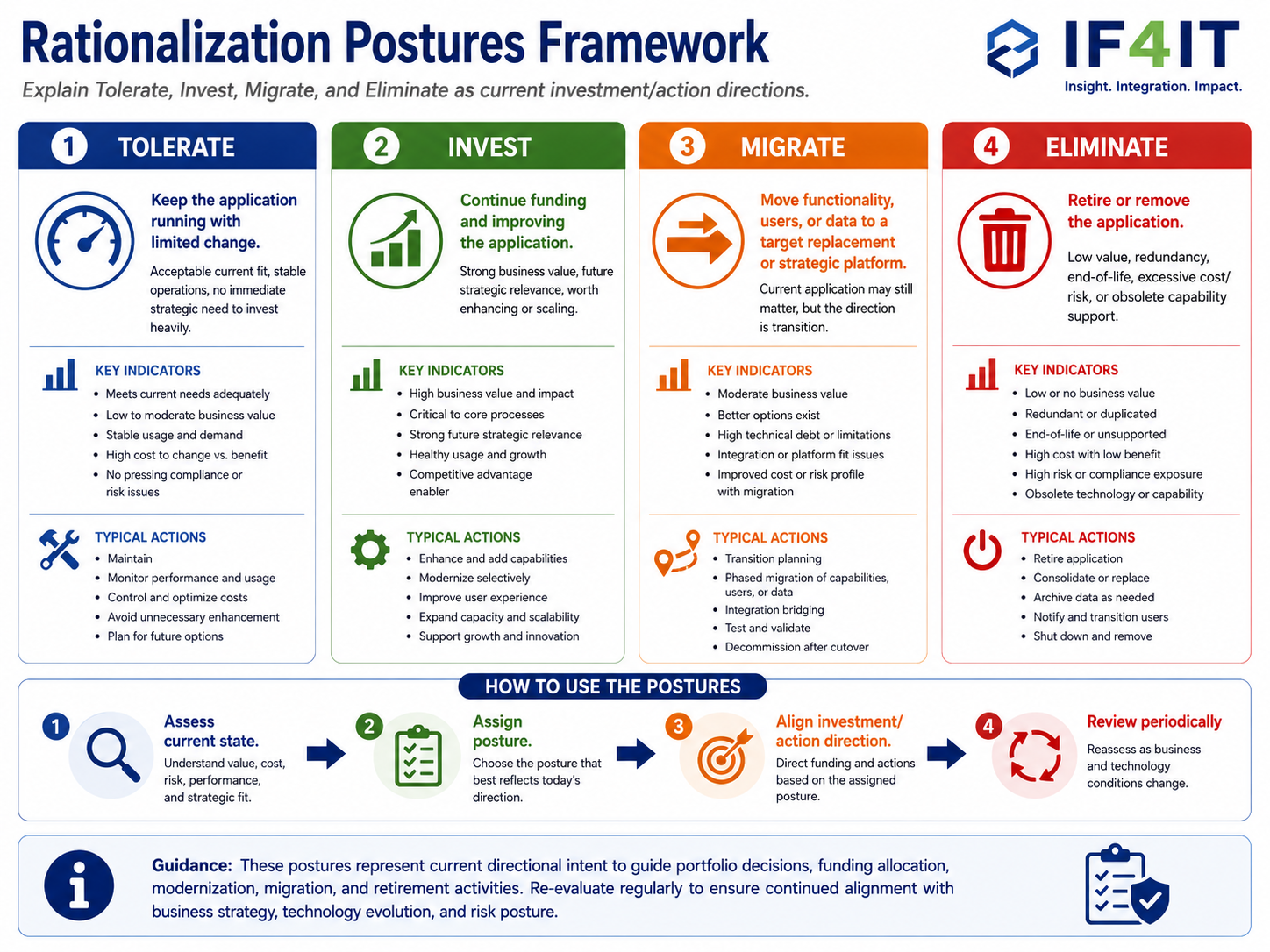
The IF4IT Rationalization Postures framework defines four postures — Tolerate, Invest, Migrate, and Eliminate — that classify every application in the portfolio by the investment and action direction appropriate to its current assessment. This framework is commonly referenced in the industry as the Gartner TIME model, and organizations familiar with that terminology will recognize the same four postures under that name.
Portfolio rationalization requires a clear vocabulary for describing the strategic dispositions available for each application and the conditions under which each disposition is appropriate. Without a shared rationalization vocabulary, stakeholders describe the same conclusions in incompatible terms, plans are made without clear operational implications, and the portfolio map becomes a document of assessments without a coherent plan of action. A consistent rationalization framework creates the shared language that makes portfolio decisions understandable, comparable, and actionable across organizational boundaries.
Best Practice
Adopt something like the IF4IT Rationalization Postures model that is based on the Gartner TIME model (or similar) as a standard rationalization vocabulary for the APM program.
Tolerate: the application has low or moderate business value and acceptable technical fitness - maintain it at current investment levels, reduce cost where possible through right-sizing or renegotiation, and do not invest in capability improvement.
Invest: the application has high business value and good technical fitness - continue or increase investment to evolve the application in support of growing or changing business requirements.
Migrate: the application has high business value but poor technical fitness or significant technical debt that constrains its evolution - the business need is real and must be met, but the current application is not the right long-term vehicle; invest in migration to a more technically fit solution.
Eliminate: the application has low business value and poor technical fitness - retire it and redirect the resources it consumes to higher-value investments. Apply these dispositions consistently as the documented output of every application assessment cycle.
Selecting Migrate as an application’s Rationalization Posture is a disposition decision — it declares that the application should move away from its current state — but it does not, by itself, specify a migration strategy. Once Migrate is selected, a separate decision follows: what specific approach the migration will take (for example, replatforming to newer infrastructure, refactoring the application itself, or replacing it outright with a different solution). Treat disposition and migration strategy as sequential decisions, not a single choice — selecting Migrate opens the migration-strategy question, it does not answer it.
Benefit(s)
The Gartner TIME model provides a clear, shared vocabulary for rationalization decisions that is immediately understood by both technical and business stakeholders. Portfolio maps produced using the Gartner TIME framework are actionable because each disposition implies a specific investment and operational direction. Leadership conversations about portfolio strategy become more productive because the rationalization options are clearly defined and the criteria for each are explicit and consistently applied. The organization develops a portfolio optimization cadence rather than episodic rationalization campaigns that start from scratch each time. Rationalization Postures describe what the organization should do with each application now, based on current assessment. They work in tandem with Strategic Dispositions, which describe where the organization intends to take each application over the strategic planning horizon — a distinction addressed in the next part.
How to cite this page
When referencing this page in academic work, internal standards, or external publications, include the page title, IF4IT as author and publisher (The International Foundation for Information Technology (IF4IT), LLC), the URL, and your access date.
Example (informal web citation):
The International Foundation for Information Technology (IF4IT), LLC. Use Rationalization Postures to classify applications by their current investment and action direction | Application Portfolio Management (APM) Best Practices. https://if4it.org/best-practices/application-portfolio-management-apm/use-rationalization-postures-to-classify-applications-by-their-current-investment-and-action-direction/ (accessed 2026-09-20).
See About Us for content governance and site-wide citation guidance.
Copyright for The International Foundation for Information Technology (IF4IT), LLC: 2008 - Present
Legal Disclaimers