Use semantic identifiers across all APM-relevant inventories - reduce transformation complexity and make inventory data human-readable, AI-friendly, and self-documenting - Application Portfolio Management (APM) Best Practices
Use semantic identifiers across all APM-relevant inventories - reduce transformation complexity and make inventory data human-readable, AI-friendly, and self-documenting
(Chapter 30 of Application Portfolio Management (APM) Best Practices)
Executive Summary: Chapter Overview
IF4ITThe Bottom Line
Core Concepts
| Concept | Definition & Strategic Role |
|---|---|
| Semantic Identifier | A human-readable, self-documenting identifier that conveys meaning about the entity it identifies — for example, an application’s identifier includes a recognizable form of its name and a domain — as opposed to an opaque numeric or UUID key. |
| Cross-Inventory Consistency | The use of the same semantic identifier for the same entity across every inventory that references it, so joins between inventories are direct rather than requiring translation tables. |
Quick Q&A
Question: Why do opaque numeric identifiers create transformation cost?
Question: What makes an identifier semantic in practice?
Question: Does semantic identifier discipline also cover the application's human-readable name?
Read More Below
Overview
Most APM implementations default to machine-generated identifiers—numeric sequences, system-assigned codes, or UUID strings—as the primary keys for application and inventory records. While these identifiers are stable and unique, they are opaque. They provide no inherent meaning to a human reader and no usable context to an AI system attempting to understand relationships across inventories.
This opacity introduces a persistent layer of friction. Every interaction with the portfolio—analysis, reporting, integration, or decision-making—requires translation (e.g., ETL). Identifiers must be looked up, decoded, or mapped before they can be understood. This translation cost is small in isolation but significant in aggregate, and it limits both the accessibility and the analytical power of APM.
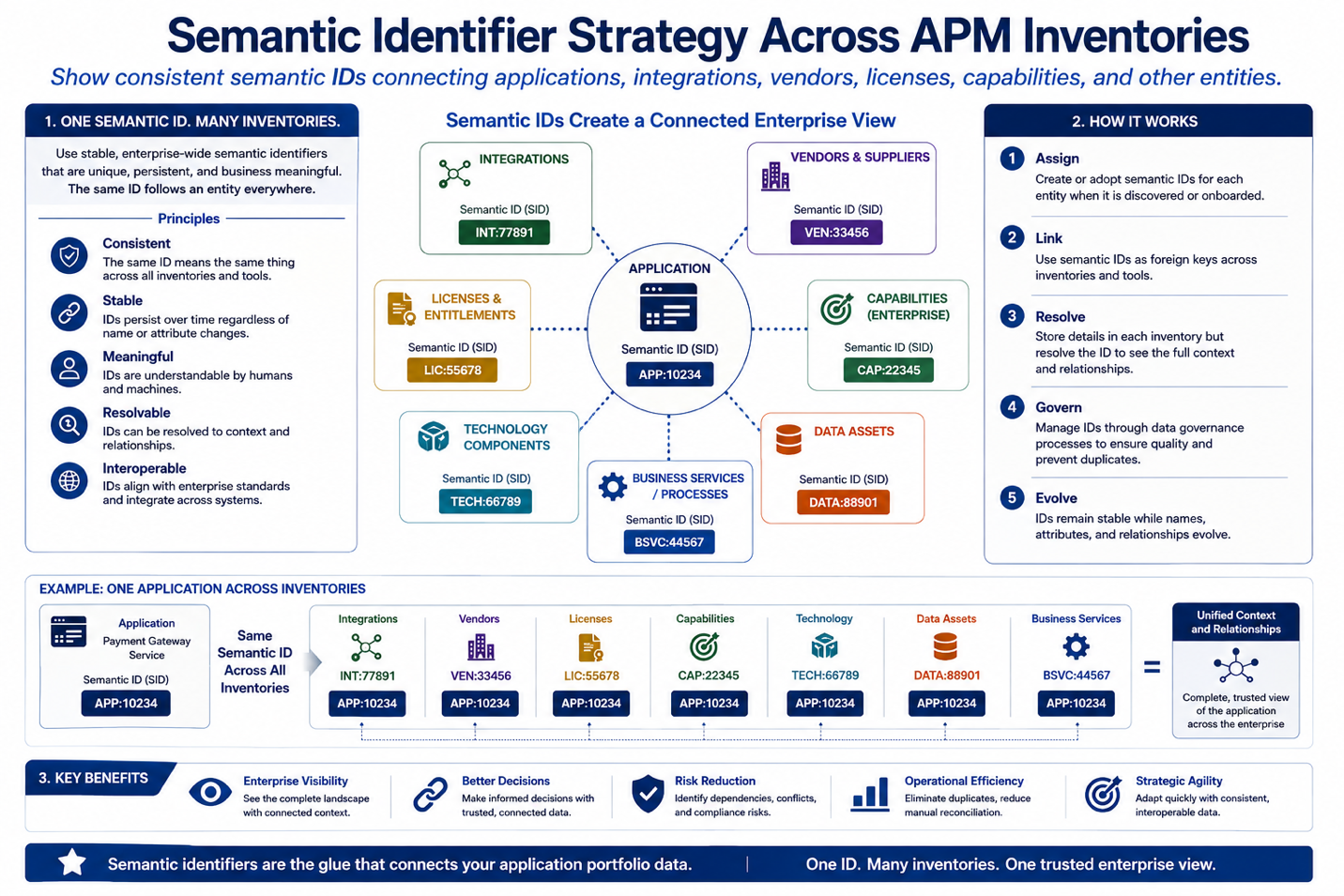
Best Practice
Adopt semantic identifiers for applications and extend the practice consistently across all APM-relevant inventories. A semantic identifier encodes meaningful information in its structure, allowing the identifier itself to communicate both identity and context.
For example, APP-CRM-SALESFORCE immediately communicates that the entity is an application, within the CRM domain, specifically Salesforce. VND-SALESFORCE clearly represents the vendor, and LIC-SALESFORCE-ENT represents the enterprise license agreement. The identifier becomes both the key and the context.
When applied consistently across all inventories, semantic identifiers create a natural linkage model. Relationships between applications, vendors, licenses, contracts, data assets, and integrations become immediately visible without transformation logic or lookup tables. The identifier itself functions as the join key across inventories.
Each organization should define its own semantic identifier conventions as a formal standard. The specific structure—prefixes, naming rules, and constraints—should reflect organizational context. However, consistency is non-negotiable: the same entity must be identifiable by the same semantic pattern across every inventory in which it appears.
Alongside the semantic identifier itself, define a lightweight naming standard for the application’s human-readable name — consistent capitalization, no ambiguous abbreviations, and a documented list of known aliases or prior names the application has gone by. Aliases matter in practice: applications frequently accumulate colloquial nicknames, legacy names inherited from acquisitions, or prior product names that predate a rebrand, and searches or integrations that only recognize the current official name will miss real matches.
Benefit(s)
Semantic identifiers transform APM data from something that must be interpreted into something that is immediately understood. Human analysts can read and interpret portfolio data without relying on intermediary systems or documentation, and AI systems can traverse relationships across multiple inventories directly using identifiers as semantic anchors.
Integration complexity is reduced because the identifier itself serves as the linking mechanism. The portfolio becomes inherently self-describing, reducing dependency on transformation layers, lookup systems, and data specialists. As a result, analytical work becomes faster, less error-prone, far more affordable, and more accessible to a broader set of stakeholders.
How to cite this page
When referencing this page in academic work, internal standards, or external publications, include the page title, IF4IT as author and publisher (The International Foundation for Information Technology (IF4IT), LLC), the URL, and your access date.
Example (informal web citation):
The International Foundation for Information Technology (IF4IT), LLC. Use semantic identifiers across all APM-relevant inventories - reduce transformation complexity and make inventory data human-readable, AI-friendly, and self-documenting | Application Portfolio Management (APM) Best Practices. https://if4it.org/best-practices/application-portfolio-management-apm/use-semantic-identifiers-across-all-apm-relevant-inventories-reduce-transformation-complexity-and-make-inventory-data-human-readable-ai-friendly-and-self-documenting/ (accessed 2026-10-22).
See About Us for content governance and site-wide citation guidance.
Copyright for The International Foundation for Information Technology (IF4IT), LLC: 2008 - Present
Legal Disclaimers