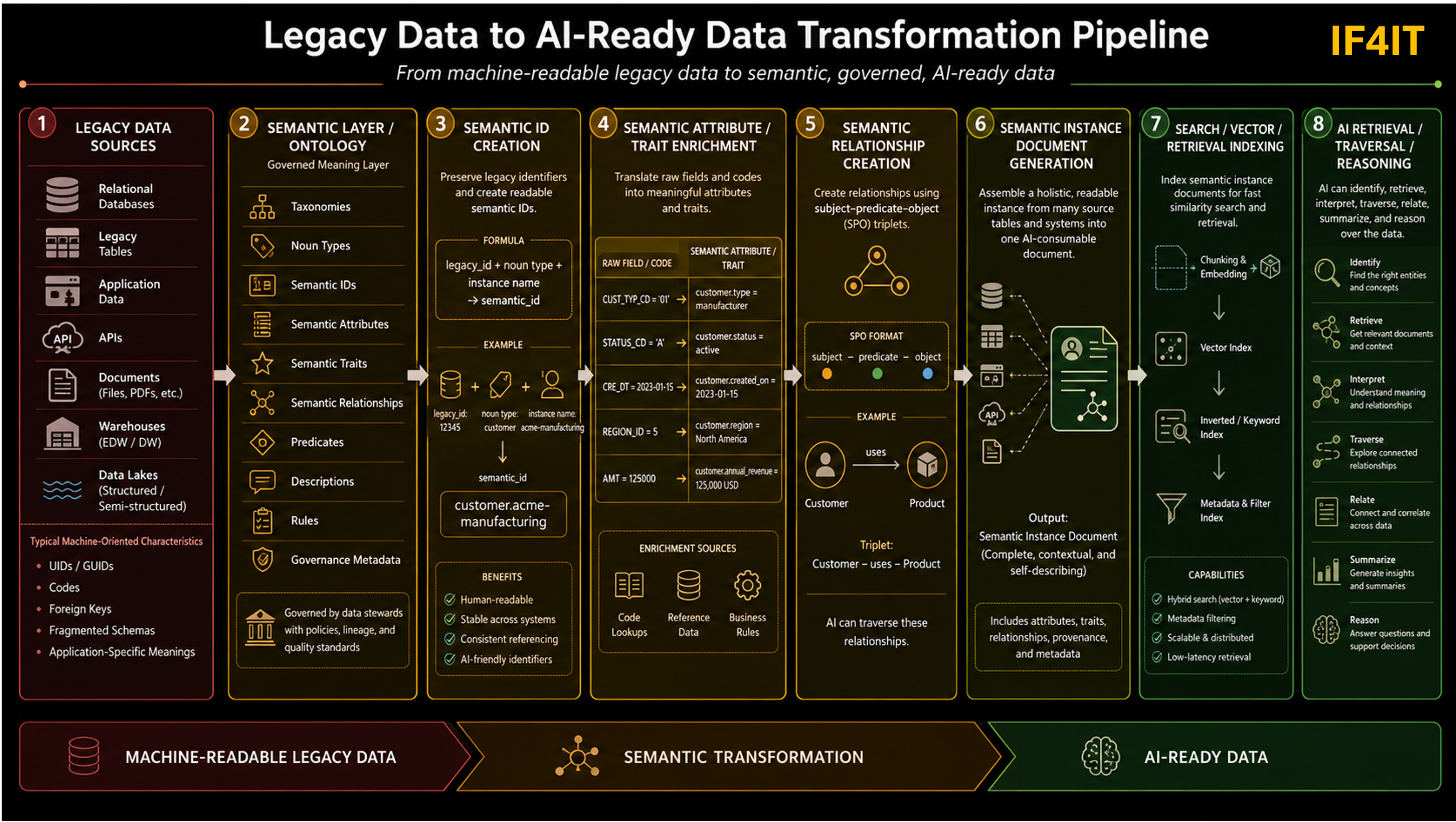
Best Practices for Making Legacy Data Semantic and AI-Ready
Executive Summary: Document Overview
IF4ITThe Bottom Line
Making legacy data semantic and AI-ready is an enterprise knowledge discipline that preserves source integrity while adding governed meaning, relationships, lineage, and retrieval context. When enterprises treat connectivity, indexing, or model access as sufficient, Knowledge Debt, ambiguous semantics, weak ownership, and uncontrolled AI interpretation increase risk and limit value. A disciplined conversion operating model, AI-friendly design practices, enrichment and governed publication for AI retrieval, and continuous governance enable people, systems, and AI to retrieve, traverse, reason over, and use enterprise data responsibly.
Core Pillars & Document Modules
| Document Pillar / Focus Area | Strategic Business Outcome & Intent |
|---|---|
| Knowledge Debt & Readiness Strategy | Exposes hidden meaning gaps, human dependencies, and semantic risk so enterprises can assess, prioritize, fund, and govern the work required to make legacy data trustworthy for AI. |
| Semantic Conversion & Meaning Model | Converts opaque identifiers, attributes, codes, rules, and technical joins into governed Semantic IDs, attributes, relationships, Ontology-linked rules, whole-instance context, and enriched, indexed, and published semantic representations that AI can interpret, retrieve, and traverse. |
| Multidisciplinary Operating Model | Unifies Business Analysis, domain expertise, architecture, Knowledge Management, governance, engineering, and AI capabilities through explicit responsibilities, evidence, decision rights, validation, and approval workflows. |
| AI-Friendly Design & Prevention | Prevents new Knowledge Debt by embedding semantic clarity, source authority, lineage, explainability, and governed AI-use requirements into architecture, data models, interfaces, modernization, procurement, and release controls. |
| Lifecycle Governance & Trust | Sustains reliable AI-ready data through refresh, drift detection, lineage, revalidation, access controls, evidence retention, metrics, exception handling, and retirement. |
Quick Q&A (Macro Executive Reference)
Question: Why is connecting or indexing legacy data not enough to make it AI-ready?
Answer: Connectivity gives AI access, but it does not resolve Knowledge Debt or explain identity, definitions, codes, relationships, source authority, lineage, permitted use, and confidence. This document establishes the semantic conversion, operating-model, validation, and governance practices needed to turn accessible legacy data into trustworthy enterprise knowledge.
Question: What is the first milestone for making a legacy data domain semantic and AI-ready?
Answer: Select a bounded, high-value or high-risk domain, identify its sources and Knowledge Debt, preserve source identifiers, and assign accountable business, data, semantic, and technical authorities. That foundation allows the enterprise to define the Semantic Layer, create governed mappings and relationships, validate reconstructed meaning, and publish retrieval-ready representations incrementally.
Question: Who owns semantic conversion and the prevention of new Knowledge Debt?
Answer: No single team owns every decision. Business and Data Owners remain accountable for meaning and permitted use; Business Analysts and domain experts discover and validate knowledge; architects and governance practitioners define semantic structures and controls; engineers operationalize them; and delivery leaders prevent new debt through architecture, design, modernization, and release gates.
Read Full Table of Contents Below
Table of Contents
Overview and Glossary
Foundation and Strategy
- Steps for Making Legacy Data Ready for AI
- Understand why legacy data must become semantic for AI
- Recognize, assess, and manage Knowledge Debt in legacy data
- Establish a multidisciplinary operating model for semantic conversion
- Design systems and data to be semantic and AI-friendly by default
- Define the Semantic Layer and AI-ready data
- Preserve legacy identifiers while adding Semantic IDs
Semantic Construction
- Make attributes and traits semantic
- Discover relationships from foreign keys and other sources
- Create semantic relationships with descriptive predicates
AI-Ready Representation
- Prepare Semantic Instance Documents for AI retrieval
- Enrich, index, and publish semantic representations for AI consumption
- Use ontologies and rules to govern semantic conversion
- Use AI to accelerate semantic conversion
Governance and Improvement
Closing and Next Steps
Copyright for The International Foundation for Information Technology (IF4IT), LLC: 2008 - Present