Best Practices for Making Legacy Data Semantic and AI-Ready - Create semantic relationships with descriptive predicates
Best Practices for Making Legacy Data Semantic and AI-Ready
Chapter 12. Create semantic relationships with descriptive predicates
Executive Summary: Chapter Overview
IF4ITThe Bottom Line
Core Concepts
| Concept | Definition & Strategic Role |
|---|---|
| Subject-Predicate-Object | A triple-like semantic relationship structure that connects one instance to another through a meaningful predicate. |
| Descriptive Predicate | The natural-language relationship phrase that explains the business, operational, technical, or regulatory meaning of a connection. |
| Inverse Predicate | The corresponding relationship phrase used when traversing the same relationship in the opposite direction. |
| Candidate Relationship | A possible relationship discovered from a foreign key, shared code, lineage path, API reference, rule, documentation, or AI-assisted inference. |
Quick Q&A
Question: Why are descriptive predicates required for AI-ready relationships?
Question: Should every candidate relationship become a semantic relationship?
Read More Below
Overview
Legacy relational models contain many technical relationships, but those relationships are often optimized for storage, transactions, joins, and application behavior rather than AI reasoning. A foreign key can tell a database how to join two tables. It does not necessarily tell AI what the relationship means, what direction matters, whether the relationship is current, or how the relationship should be described in natural language.
Semantic Relationships convert technical connections into explicit Subject-Predicate-Object statements. The subject is the source instance, the predicate is the meaningful relationship phrase, and the object is the related instance. For example, Customer Acme Manufacturing is managed by Person Jane Smith. In the opposite direction, Person Jane Smith manages Customer Acme Manufacturing.
This pattern is consistent with semantic modeling approaches already used across IF4IT documents. It also allows AI to traverse relationships across data instances and reason over connected context. AI-ready data is not merely searchable; it is traversable. For deeper treatment of relationship structures, consult Understanding Reified Relationships, N-Tuples, and How They Give Life to Data.
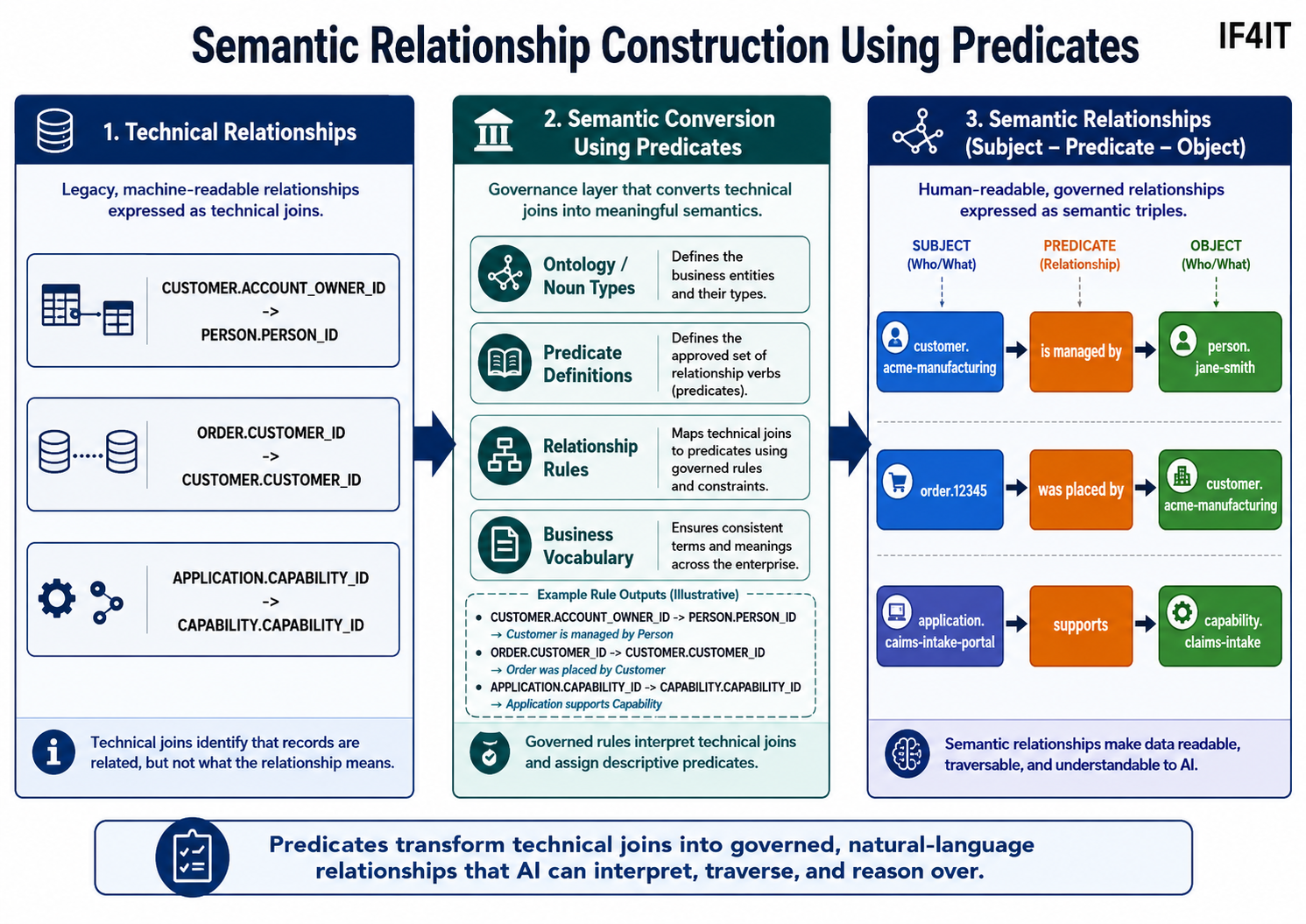
Figure: Semantic Relationship Construction Using Predicates converts technical joins into governed Subject–Predicate–Object relationships with descriptive predicates that make connected data understandable and traversable by AI systems.
Examples
The following illustrate this step in practice.
Example 1: A foreign-key relationship between APPLICATION.CAPABILITY_ID and CAPABILITY.ID becomes the readable statement, Claims Intake Portal supports Claims Processing.
Example 2: A vendor-to-contract join becomes, Acme Software is governed by Contract CT-2026-104, rather than remaining an unexplained pair of database keys.
Best Practice
Represent important relationships using a Subject-Predicate-Object structure. Each relationship should identify the subject Semantic ID, predicate, object Semantic ID, relationship type, source evidence, confidence or approval status, and effective dates when they are relevant.
Benefit(s)
AI receives relationships as meaningful statements rather than opaque technical joins. This improves traversal, reasoning, impact analysis, dependency analysis, explanation, and retrieval-augmented responses.
Best Practice
Define descriptive predicates for every governed relationship type. Predicates should be written in clear natural language and should describe the meaning of the relationship, not the mechanics of the source join.
Benefit(s)
Descriptive predicates allow AI to understand whether one instance owns, uses, supports, depends on, manages, contains, produces, governs, complies with, fulfills, or is affected by another instance. This prevents AI from inferring meaning from table names or key names alone.
Best Practice
Define inverse predicates when relationships are useful in both directions. For example, Customer is managed by Person may have the inverse predicate Person manages Customer. Application supports Capability may have the inverse predicate Capability is supported by Application.
Benefit(s)
Inverse predicates make semantic traversal clearer and more reliable. AI can answer questions from either side of the relationship without guessing how to reverse the meaning.
Best Practice
Treat foreign keys and other technical references as evidence for candidate relationships, not as complete semantic relationships. Convert a candidate relationship into a governed Semantic Relationship only after assigning a predicate, validating direction, and confirming that the relationship has business, operational, technical, or regulatory meaning.
Benefit(s)
This avoids filling the Semantic Layer with meaningless or misleading edges. It also gives governance teams a disciplined process for turning technical clues into AI-ready relationship knowledge.
How to cite this page
When referencing this page in academic work, internal standards, or external publications, include the page title, IF4IT as author and publisher (The International Foundation for Information Technology (IF4IT), LLC), the URL, and your access date.
Example (informal web citation):
The International Foundation for Information Technology (IF4IT), LLC. Create semantic relationships with descriptive predicates | Best Practices for Making Legacy Data Semantic and AI-Ready. https://if4it.org/best-practices/best-practices-for-making-legacy-data-semantic-and-ai-ready/create-semantic-relationships-with-descriptive-predicates/ (accessed 2026-07-17).
See About Us for content governance and site-wide citation guidance.
Copyright for The International Foundation for Information Technology (IF4IT), LLC: 2008 - Present
Legal Disclaimers