Best Practices for Making Legacy Data Semantic and AI-Ready - Define the Semantic Layer and AI-ready data
Best Practices for Making Legacy Data Semantic and AI-Ready
Chapter 8. Define the Semantic Layer and AI-ready data
Executive Summary: Chapter Overview
IF4ITThe Bottom Line
Core Concepts
| Concept | Definition & Strategic Role |
|---|---|
| Semantic Layer | The governed operational expression of the Ontology over real data, including identities, definitions, relationships, predicates, rules, aliases, lineage, and governance metadata. |
| AI-Ready Data | Data with enough explicit and governed meaning for AI to identify, retrieve, interpret, traverse, reason over, and use within approved constraints. |
| Representation Neutrality | The principle that semantic readiness may be expressed through structured records, graphs, JSON-LD, RDF, APIs, documents, metadata, vectors, or indexes rather than prose alone. |
| Ontology Authority | The governed meaning model that constrains valid Noun Types, classifications, predicates, rules, and interpretations within the Semantic Layer. |
Quick Q&A
Question: Does making legacy data AI-ready require turning every record into natural-language prose?
Question: Why must the Semantic Layer be governed by an Ontology?
Read More Below
Overview
Many sources use the term Semantic Layer to describe a layer that gives business meaning to data. In this document, the term is used in an IF4IT-specific way: the Semantic Layer is the governed, Ontology-based layer of meaning that makes legacy data interpretable, traversable, and usable for AI reasoning.
The Semantic Layer includes Taxonomies, Noun Types, Semantic IDs, Semantic Attributes, Semantic Traits, Semantic Relationships, descriptive predicates, descriptions, rules, aliases, metadata, and governance constraints. The Ontology defines and governs these elements so semantic meaning is consistent rather than improvised. For detailed IF4IT guidance on Ontology construction, consult Key IF4IT Enterprise Model Component 2 — the Ontology; for Taxonomy construction, consult Key IF4IT Enterprise Model Component 1 — the Taxonomy.
AI-ready data is data that AI can identify, retrieve, interpret, traverse, relate, summarize, reason over, and use within governed constraints. Access alone does not make data AI-ready; the data must carry enough semantic meaning and context for AI to use it responsibly.
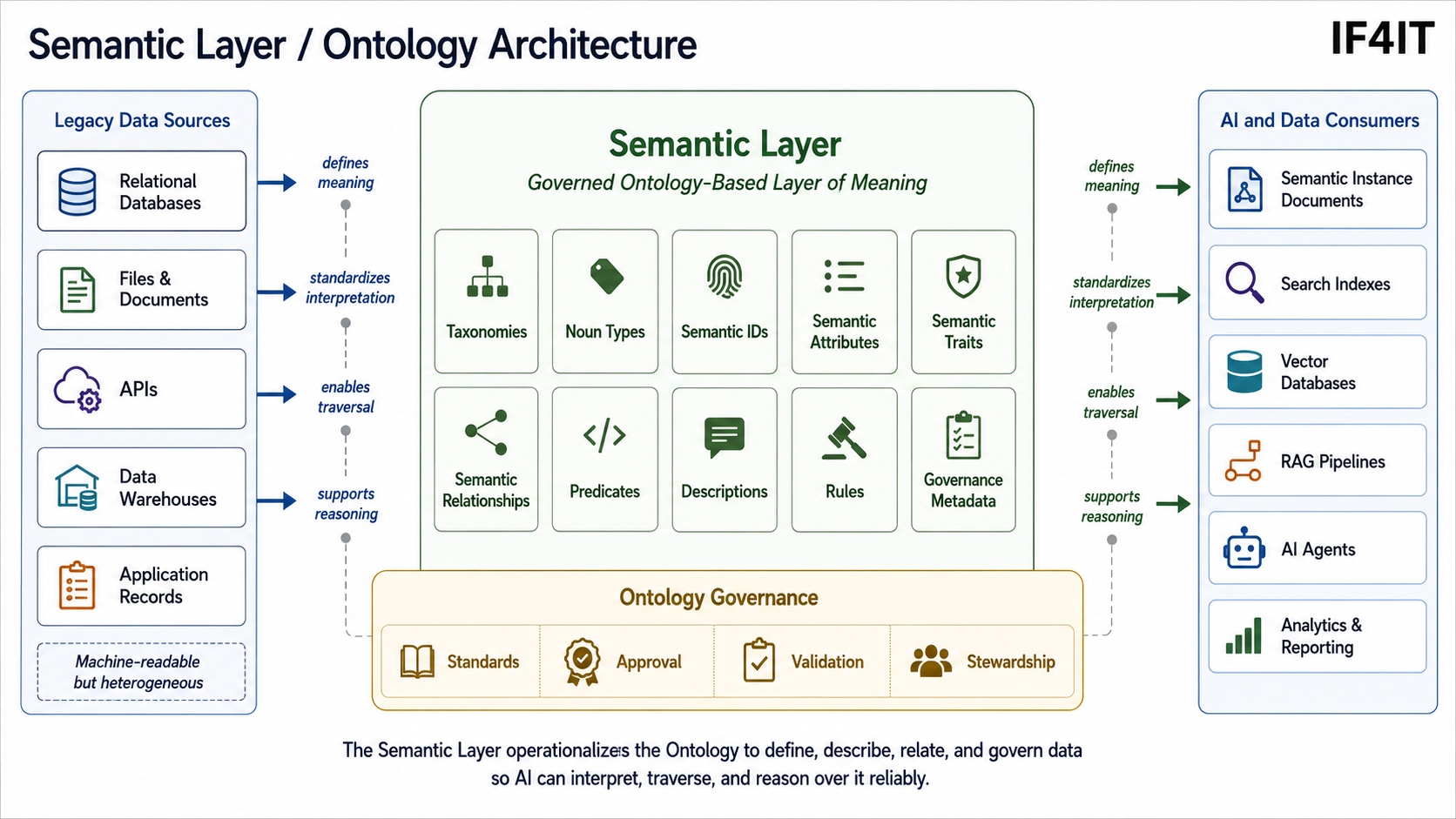
Figure: The Semantic Layer operationalizes the Ontology by defining the meaning, rules, relationships, predicates, and governance metadata that make legacy data interpretable, traversable, and usable by AI systems.
This document treats the Ontology and Semantic Layer as governed conceptual artifacts and does not prescribe a specific representational technology. Enterprises implementing the Semantic Layer against W3C standards will find natural alignment with the Resource Description Framework (RDF) for representing instances and relationships, the Web Ontology Language (OWL) for defining Noun Types and predicates, the Shapes Constraint Language (SHACL) for encoding validation rules, and the Simple Knowledge Organization System (SKOS) for governing Taxonomies. Property-graph and vendor-native semantic technologies can also carry the same concepts, provided governance, identity, and relationship semantics are preserved.
Examples
The following illustrate this step in practice.
Example 1: An enterprise defines whether Customer, Client, and Account Holder are approved synonyms or distinct concepts, preventing AI from treating them inconsistently across systems.
Example 2: A healthcare payer defines the governed meanings and relationships among Member, Subscriber, Dependent, Plan, Benefit, Claim, Provider, and Authorization before allowing AI to reason across them.
Best Practice
Define the Semantic Layer as the governed Ontology-based layer of meaning that includes Taxonomies, Noun Types, Semantic IDs, Semantic Attributes, Semantic Traits, Semantic Relationships, predicates, descriptions, rules, aliases, metadata, and governance constraints.
Benefit(s)
This prevents the Semantic Layer from becoming an uncontrolled set of labels, aliases, and descriptions. It establishes the Ontology as the authority for what things exist, what they mean, how they relate, which predicates are valid, and which rules govern AI-ready interpretation.
Best Practice
Define AI-ready data in operational terms. AI-ready data is not just searchable or accessible; it is data that AI can traverse and reason over because it carries explicit semantic identifiers, attributes, traits, relationships, predicates, descriptions, lineage, and governance context.
Benefit(s)
This gives data teams, architecture teams, and AI teams a shared target state. It also helps them test whether a data source is merely connected to AI or genuinely prepared for AI use.
Best Practice
Do not equate AI-ready data with converting everything into prose. AI-ready meaning may be represented through structured data, metadata, graphs, Resource Description Framework, JavaScript Object Notation, JavaScript Object Notation for Linked Data, APIs, vectors, documents, Ontologies, Taxonomies, controlled vocabularies, and retrieval indexes, provided the representation preserves explicit identity, meaning, relationships, lineage, rules, and governance.
Benefit(s)
This allows enterprises to choose representations appropriate to operational, analytical, graph, retrieval, and AI workloads without sacrificing semantic clarity. It also prevents unnecessary duplication or denormalization undertaken solely because natural-language models can consume text.
How to cite this page
When referencing this page in academic work, internal standards, or external publications, include the page title, IF4IT as author and publisher (The International Foundation for Information Technology (IF4IT), LLC), the URL, and your access date.
Example (informal web citation):
The International Foundation for Information Technology (IF4IT), LLC. Define the Semantic Layer and AI-ready data | Best Practices for Making Legacy Data Semantic and AI-Ready. https://if4it.org/best-practices/best-practices-for-making-legacy-data-semantic-and-ai-ready/define-the-semantic-layer-and-ai-ready-data/ (accessed 2026-07-17).
See About Us for content governance and site-wide citation guidance.
Copyright for The International Foundation for Information Technology (IF4IT), LLC: 2008 - Present
Legal Disclaimers