Best Practices for Making Legacy Data Semantic and AI-Ready - Make attributes and traits semantic
Best Practices for Making Legacy Data Semantic and AI-Ready
Chapter 10. Make attributes and traits semantic
Executive Summary: Chapter Overview
IF4ITThe Bottom Line
Core Concepts
| Concept | Definition & Strategic Role |
|---|---|
| Semantic Attribute | A meaningful named property and value that explains a fact about an instance in language humans and AI can understand. |
| Semantic Trait | A meaningful characteristic often inferred or derived from one or more source attributes, codes, rules, or relationships. |
| Code Translation | The governed process of converting opaque legacy codes, flags, abbreviations, and enumerations into explicit semantic values. |
| Attribute Meaning Rule | A rule that explains how a source field, code, or value should be interpreted and represented in the Semantic Layer. |
Quick Q&A
Question: How is a Semantic Attribute different from a legacy column or field?
Question: Why distinguish Semantic Attributes from Semantic Traits?
Read More Below
Overview
Legacy data often contains column names, codes, flags, and abbreviations that make sense only to the application, report, database designer, or long-tenured subject matter expert. Examples include CUST_TYP_CD, STAT_CD, PROD_FAM, APP_ID, SEG_CD, RGN, or a value such as A, I, P1, 004, or X. These values may be perfectly valid for systems, but they are weak inputs for AI when their meaning is not explicit.
Making attributes semantic means converting those opaque fields and values into meaningful facts. A Semantic Attribute should express what the property is, what the value means, and how it should be interpreted. A Semantic Trait should express a meaningful characteristic that may be derived from one or more attributes, relationships, rules, or calculations.
For example, a source field such as STAT_CD = A might become Status = Active. A combination of Contract Tier = Platinum, Annual Revenue = 250M, and Relationship Duration = 10 Years might support the semantic trait Strategic Customer. AI can reason over Active Customer and Strategic Customer more reliably than it can reason over STAT_CD = A or SEG_CD = STRAT without context.
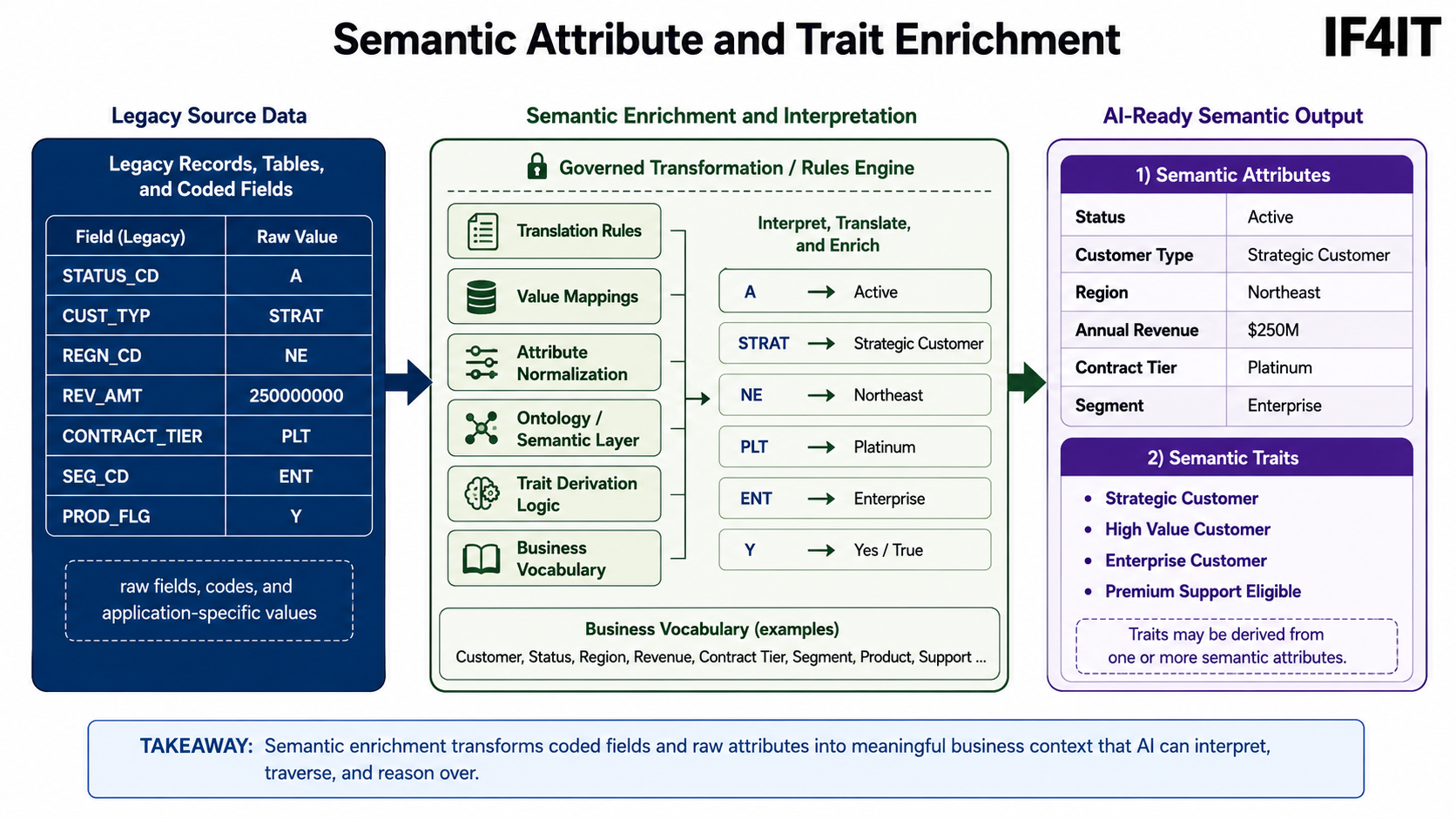
Figure: Semantic Attribute and Trait Enrichment converts raw fields and coded values into meaningful Semantic Attributes and derived Semantic Traits using governed rules, value mappings, business vocabulary, and the Ontology-based Semantic Layer.
Examples
The following illustrate this step in practice.
Example 1: A database column named CTR is mapped to the Semantic Attribute Customer, with a definition explaining whether it refers to a customer identifier, a customer count, or a customer category.
Example 2: A field named STAT_CD = A is converted into Lifecycle Status = Active, with the allowed values, source code mapping, effective date, and governing definition retained.
Best Practice
Translate opaque source fields, codes, flags, and abbreviations into meaningful Semantic Attributes. Each Semantic Attribute should have a clear name, a readable value, a description, a source mapping, and a rule that explains how the value was produced or interpreted.
Benefit(s)
AI can interpret meaningful facts instead of opaque values. Humans can also validate whether the semantic translation is accurate, which improves trust, explainability, and governance.
Best Practice
Define Semantic Traits separately from Semantic Attributes when the meaning is inferred, classified, or derived. Use traits to represent important characteristics such as Strategic Customer, High-Risk Vendor, Mission-Critical Application, Regulated Data Product, Reusable Service, or Customer-Facing Process.
Benefit(s)
This distinction prevents derived meaning from being confused with raw source facts. AI can reason over higher-level characteristics while governance teams can trace each trait back to the attributes, relationships, and rules that produced it.
Best Practice
Create attribute meaning rules that are linked to the Ontology. These rules should define how source fields map to Semantic Attributes, how source values translate to readable values, how derived traits are produced, and how exceptions or ambiguous values are handled.
Benefit(s)
Rules make semantic conversion repeatable and testable. They also allow AI to assist with interpretation while ensuring that authoritative meaning comes from the governed Semantic Layer, not from ad hoc prompting or uncontrolled inference.
Best Practice
Preserve the original source values alongside their semantic translations when the values are needed for lineage, audit, reconciliation, or downstream system interactions. Do not discard source codes merely because a readable semantic value has been created.
Benefit(s)
This allows the enterprise to use AI-friendly semantic values while retaining the ability to trace every semantic fact back to the source data that produced it. It also helps detect translation errors, semantic drift, and source-system changes.
How to cite this page
When referencing this page in academic work, internal standards, or external publications, include the page title, IF4IT as author and publisher (The International Foundation for Information Technology (IF4IT), LLC), the URL, and your access date.
Example (informal web citation):
The International Foundation for Information Technology (IF4IT), LLC. Make attributes and traits semantic | Best Practices for Making Legacy Data Semantic and AI-Ready. https://if4it.org/best-practices/best-practices-for-making-legacy-data-semantic-and-ai-ready/make-attributes-and-traits-semantic/ (accessed 2026-07-17).
See About Us for content governance and site-wide citation guidance.
Copyright for The International Foundation for Information Technology (IF4IT), LLC: 2008 - Present
Legal Disclaimers