Best Practices for Making Legacy Data Semantic and AI-Ready - Manage refresh, drift, lineage, and governance
Best Practices for Making Legacy Data Semantic and AI-Ready
Chapter 17. Manage refresh, drift, lineage, and governance
Executive Summary: Chapter Overview
IF4ITThe Bottom Line
Core Concepts
| Concept | Definition & Strategic Role |
|---|---|
| Refresh | The controlled regeneration or update of semantic artifacts when source data, mappings, ownership, rules, or Ontology definitions change. |
| Semantic Drift | The divergence of a semantic representation from current source data, business meaning, relationships, rules, ownership, or intended use. |
| Lineage | The trace from every semantic output to its source records, transformations, rule versions, Ontology elements, evidence, and approvals. |
| Revalidation | The repeat review and testing required after material changes, new AI uses, incidents, drift, or expiration of prior approvals. |
| Lifecycle Governance | The ownership, access, exception, versioning, monitoring, evidence, retirement, and reporting controls that sustain trustworthy semantic knowledge. |
Quick Q&A
Question: When must AI-ready semantic data be revalidated?
Question: How do lifecycle controls prevent new Knowledge Debt?
Read More Below
Overview
AI-ready semantic data is not created once and then forgotten. Source records change, legacy codes are retired, ownership changes hands, product names evolve, customers merge, applications are replaced, relationships are added, and Ontology rules improve over time. Every one of these changes can make previously generated semantic representations inaccurate.
The enterprise must therefore govern the Semantic Layer as a living data product. Semantic IDs, Semantic Attributes, Semantic Traits, Semantic Relationships, and Semantic Instance Documents must be refreshed, reviewed, versioned, retired, and traced back to their source records and conversion rules. The vector database or search index is not the authority; it is a retrieval layer populated from governed semantic representations.
The IF4IT Model and Modeling Best Practices document provides the broader modeling context for governing Ontologies, Taxonomies, Noun Types, relationships, and rules. This chapter applies those ideas to legacy-data conversion so that AI-ready representations remain aligned with both source-system reality and governed semantic meaning.
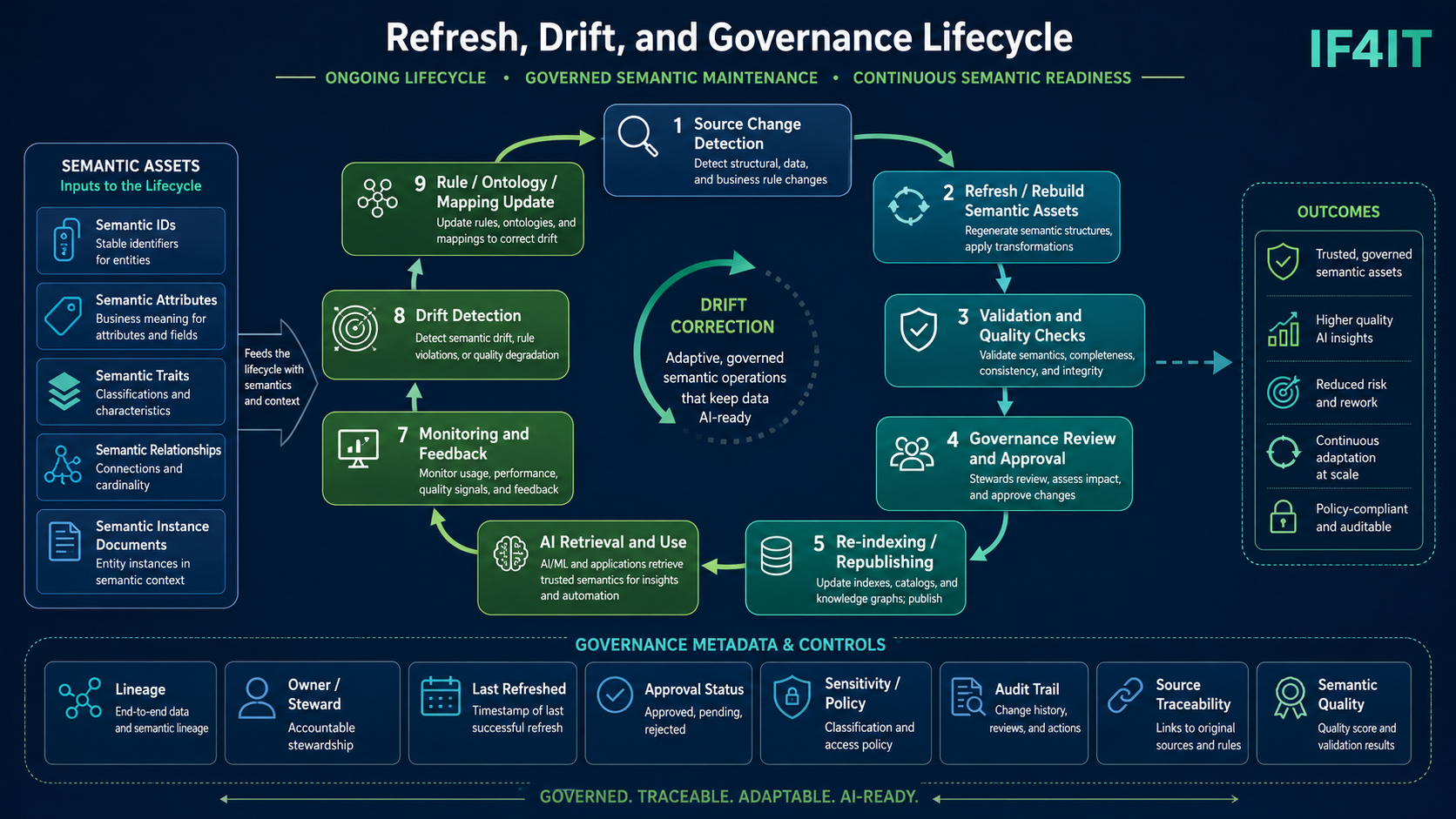
Figure: Refresh, Drift, and Governance Lifecycle shows how semantic assets stay AI-ready through continuous source change detection, refresh, validation, governance review, re-indexing, monitoring, drift detection, and rule or Ontology updates.
Examples
The following illustrate this step in practice.
Example 1: When an application owner, supported capability, or production status changes, the semantic representation is regenerated, revalidated, and reindexed automatically.
Example 2: A nightly drift process detects that a source code definition changed from Active to Active or Pending Closure, flags the semantic mapping for steward review, and prevents the old meaning from being treated as authoritative.
Best Practice
Track lineage for every semantic representation.
Every Semantic ID, Semantic Attribute, Semantic Trait, Semantic Relationship, and Semantic Instance Document should trace back to the source system, source table or API, source record, source field, rule version, Ontology element, and generation process that produced it. When AI retrieves a semantic document, the enterprise should be able to determine where the document came from, which source values it summarizes, and which rules shaped its meaning.
Benefit(s)
Lineage makes AI-ready data auditable. It allows stewards, architects, data owners, and AI governance teams to investigate bad answers, identify stale or incorrect semantic mappings, prove source provenance, and correct the underlying rule or source record rather than patching individual AI outputs. For broader controls around AI evidence, accountability, and risk, consult Enterprise AI Governance Best Practices.
Best Practice
Define refresh patterns for Semantic Instance Documents and indexed representations.
Semantic Instance Documents should be refreshed using schedules, events, or both. High-change instances may require event-driven refresh from source-system changes. Lower-change reference data may be refreshed on a scheduled cadence. The refresh process should update the generated document, its metadata, its embeddings or search index entries, and any relationship edges that depend on the changed data.
Benefit(s)
Defined refresh patterns keep AI-ready representations synchronized with source-system reality. They also prevent teams from relying on stale vector entries, outdated relationship graphs, or obsolete descriptions that no longer reflect how the enterprise actually operates.
Best Practice
Detect and manage semantic drift.
Semantic drift should be treated as a governed quality issue. Drift occurs when semantic documents, predicates, descriptions, aliases, or inferred traits no longer match current source data, current business meaning, or the current Ontology. Drift can be detected through source-change monitoring, data-quality checks, steward review, AI-assisted comparison, failed retrieval patterns, or user feedback. The article Stale Data Lies — Why an Inventory Is Never “Done” reinforces the need for continuous maintenance of governed knowledge assets.
Benefit(s)
Drift management prevents the Semantic Layer from becoming a stale shadow model. It protects AI systems from retrieving outdated context and helps the enterprise continuously improve its rules, Ontology, and generated documents based on observed gaps.
Best Practice
Govern ownership, stewardship, approval status, and sensitivity for semantic data.
Semantic representations should include governance metadata that identifies the data owner, data steward, approval status, sensitivity classification, retention class, refresh date, and rule version. Sensitive or regulated data should also include usage constraints that AI systems and retrieval pipelines can enforce.
Benefit(s)
Governance metadata helps AI consumers understand whether a semantic representation is trusted, current, approved, and safe to use. It also supports policy enforcement, access filtering, audit review, retention management, and responsible AI use. These controls should align with Enterprise AI Governance Best Practices when semantic data feeds governed AI systems.
Best Practice
Retire or suppress semantic representations when source instances are retired, merged, or invalidated.
Legacy instances do not only change; they also disappear, merge, split, or become invalid. A customer may merge with another customer, a product may retire, a person may leave the enterprise, or an application may be decommissioned. The Semantic Layer should define how generated documents, relationships, aliases, and index entries are retired, redirected, or suppressed.
Benefit(s)
Retirement controls prevent AI systems from retrieving obsolete entities as if they were current. They also preserve historical traceability where needed without confusing current-state reasoning, reporting, or decision support.
Best Practice
Define human revalidation triggers for material semantic change. Revalidation should occur when source structures, business definitions, Ontology elements, mappings, ownership, regulations, AI use cases, or model behavior change, and when incidents, drift findings, conflicting evidence, or incorrect AI outputs call existing meaning into question.
Benefit(s)
Trigger-based revalidation keeps approved semantic knowledge aligned with current enterprise reality. It also prevents a representation that was once correct from remaining authoritative after the evidence, context, permitted use, or risk has materially changed.
How to cite this page
When referencing this page in academic work, internal standards, or external publications, include the page title, IF4IT as author and publisher (The International Foundation for Information Technology (IF4IT), LLC), the URL, and your access date.
Example (informal web citation):
The International Foundation for Information Technology (IF4IT), LLC. Manage refresh, drift, lineage, and governance | Best Practices for Making Legacy Data Semantic and AI-Ready. https://if4it.org/best-practices/best-practices-for-making-legacy-data-semantic-and-ai-ready/manage-refresh-drift-lineage-and-governance/ (accessed 2026-07-17).
See About Us for content governance and site-wide citation guidance.
Copyright for The International Foundation for Information Technology (IF4IT), LLC: 2008 - Present
Legal Disclaimers