Best Practices for Making Legacy Data Semantic and AI-Ready - Overview
Best Practices for Making Legacy Data Semantic and AI-Ready
Chapter 1. Overview
Executive Summary: Chapter Overview
IF4ITThe Bottom Line
Core Concepts
| Concept | Definition & Strategic Role |
|---|---|
| Last Mile of Data | The gap between data that systems can store or retrieve and data that people and AI can understand, relate, and use responsibly. Closing it requires explicit semantic meaning rather than access alone. |
| Knowledge Debt | The backlog of missing, fragmented, implicit, outdated, or poorly governed knowledge that makes legacy data difficult and risky for people, systems, and AI to interpret. |
| Semantic Conversion | The governed sequence that preserves source integrity while adding explicit identity, definitions, attributes, relationships, rules, lineage, and retrieval context. |
| Operating Model | The coordinated responsibilities, decision rights, evidence, validation, and approval practices that make semantic conversion accountable and repeatable. |
| AI-Friendly Design | The upstream architecture and delivery discipline that exposes semantic meaning from the outset and prevents new Knowledge Debt from accumulating. |
Quick Q&A
Question: Why does the overview connect the Last Mile of Data to Knowledge Debt?
Question: How does the overview organize the path from legacy data to sustainable AI readiness?
Read More Below
Overview
Legacy data was built primarily for applications, transactions, integrations, reports, and human-controlled analysis. It can be precise, valuable, and authoritative while still being very difficult for AI to interpret and use because its identifiers, fields, codes, relationships, and rules are often expressed in system-specific forms (i.e., machine codes) rather than in semantic language. AI works best with natural language, which means that for legacy data to be useful it must be converted or enriched to be semantic.
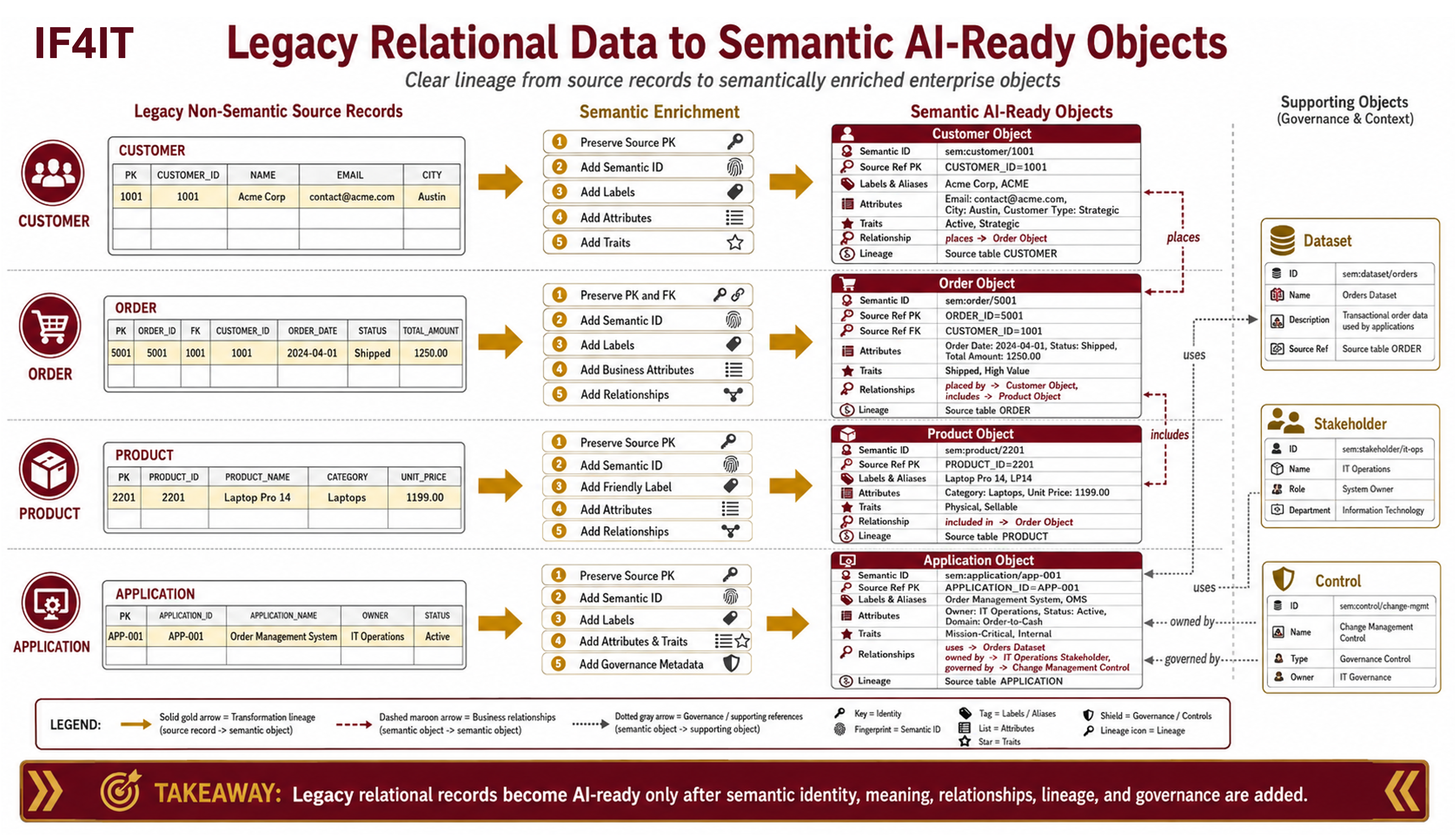
Figure: Example transformation of legacy relational source records into semantic AI-ready objects, showing preserved source keys, semantic IDs, attributes, traits, relationships, lineage, and governance context.
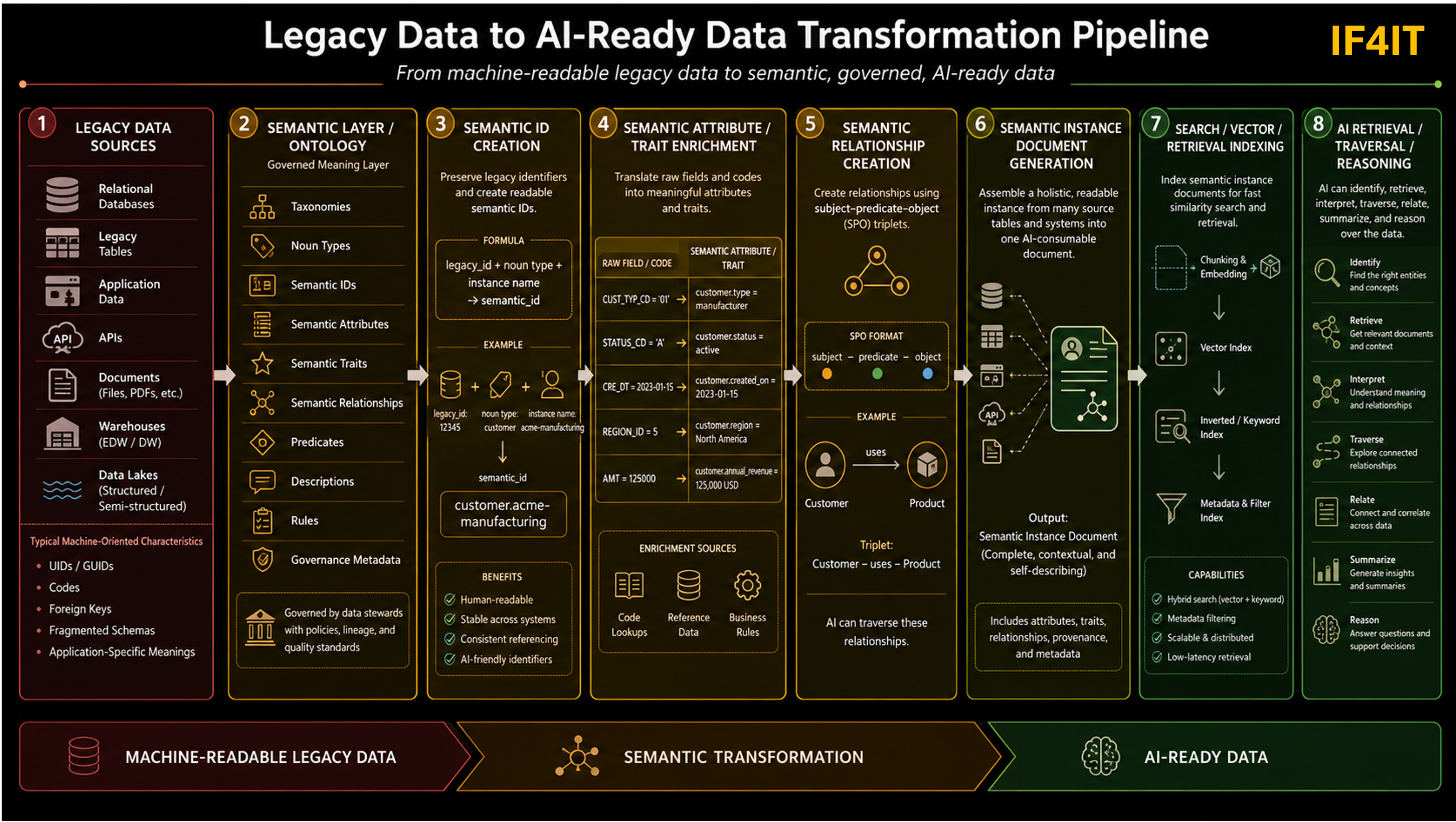
This document follows a practical sequence for making legacy data semantic and AI-ready: preserve source identifiers, define the Semantic Layer, create Semantic IDs, make attributes and traits meaningful, create semantic relationships, govern conversion through Ontology-linked rules, generate Semantic Instance Documents, index those documents for retrieval, and manage refresh and drift.
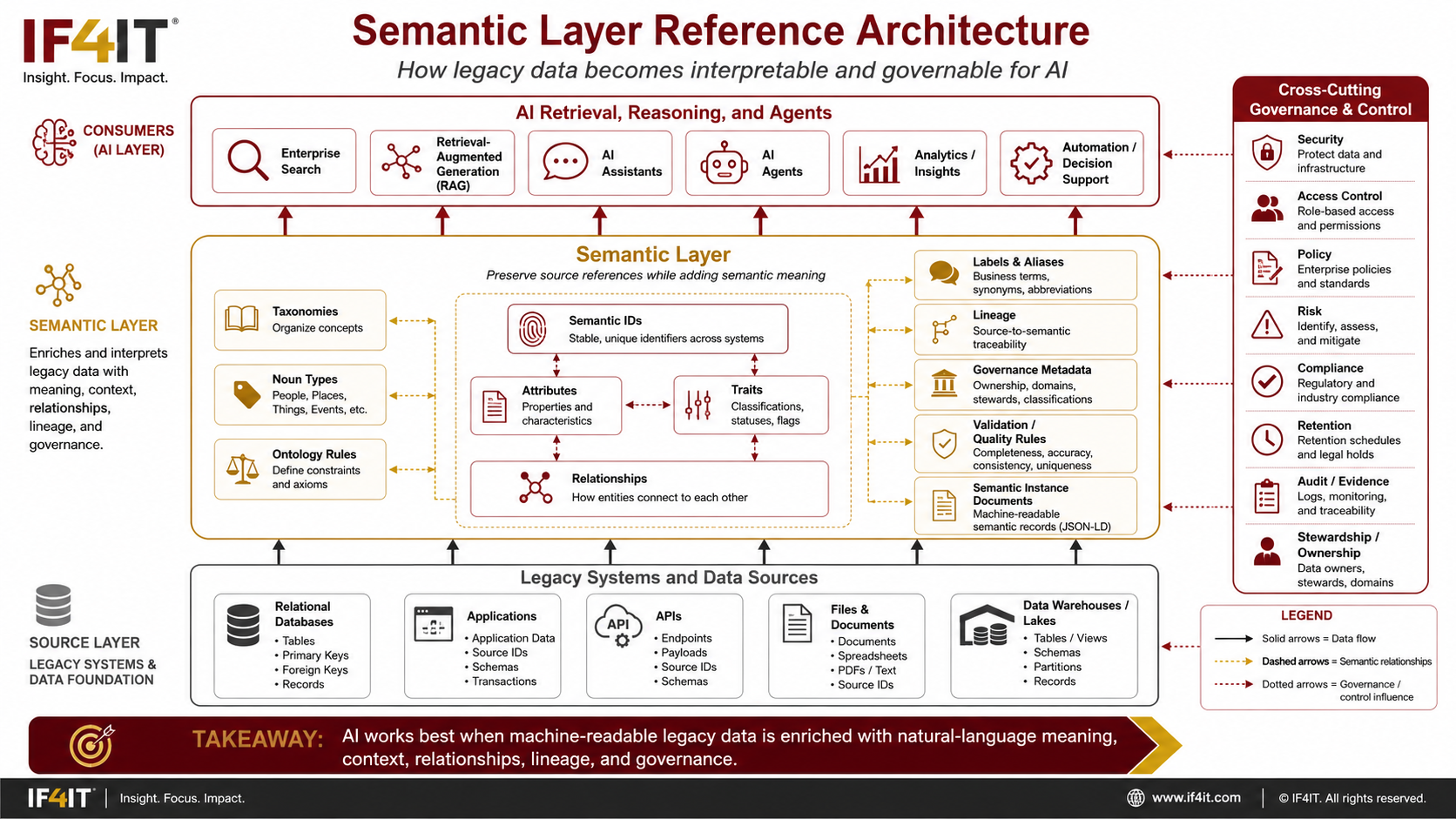
Figure: Semantic Layer reference architecture showing how legacy systems and data sources are enriched through taxonomies, ontology rules, semantic IDs, attributes, traits, relationships, lineage, and governance to support AI retrieval, reasoning, and agents.
The chapter Steps for Making Legacy Data Ready for AI summarizes that sequence in a more complete form. The chapters that follow then explain each step through specific Best Practices and Benefit(s).
Best Practice
Treat AI-readiness as a semantic conversion discipline, not as a data connectivity exercise. Start by acknowledging that data access, API access, warehouse access, and document access do not automatically make data understandable to AI.
Benefit(s)
This prevents teams from over-investing in connectors while under-investing in meaning. It also helps leaders understand that AI quality depends on the semantic condition of the data being retrieved, not merely on whether the data can be reached.
Best Practice
Use the Overview as the roadmap for the rest of the document. Explain the progression from legacy machine-readable records to Semantic IDs, Semantic Attributes, Semantic Relationships, Ontology-linked rules, Semantic Instance Documents, and governed retrieval context.
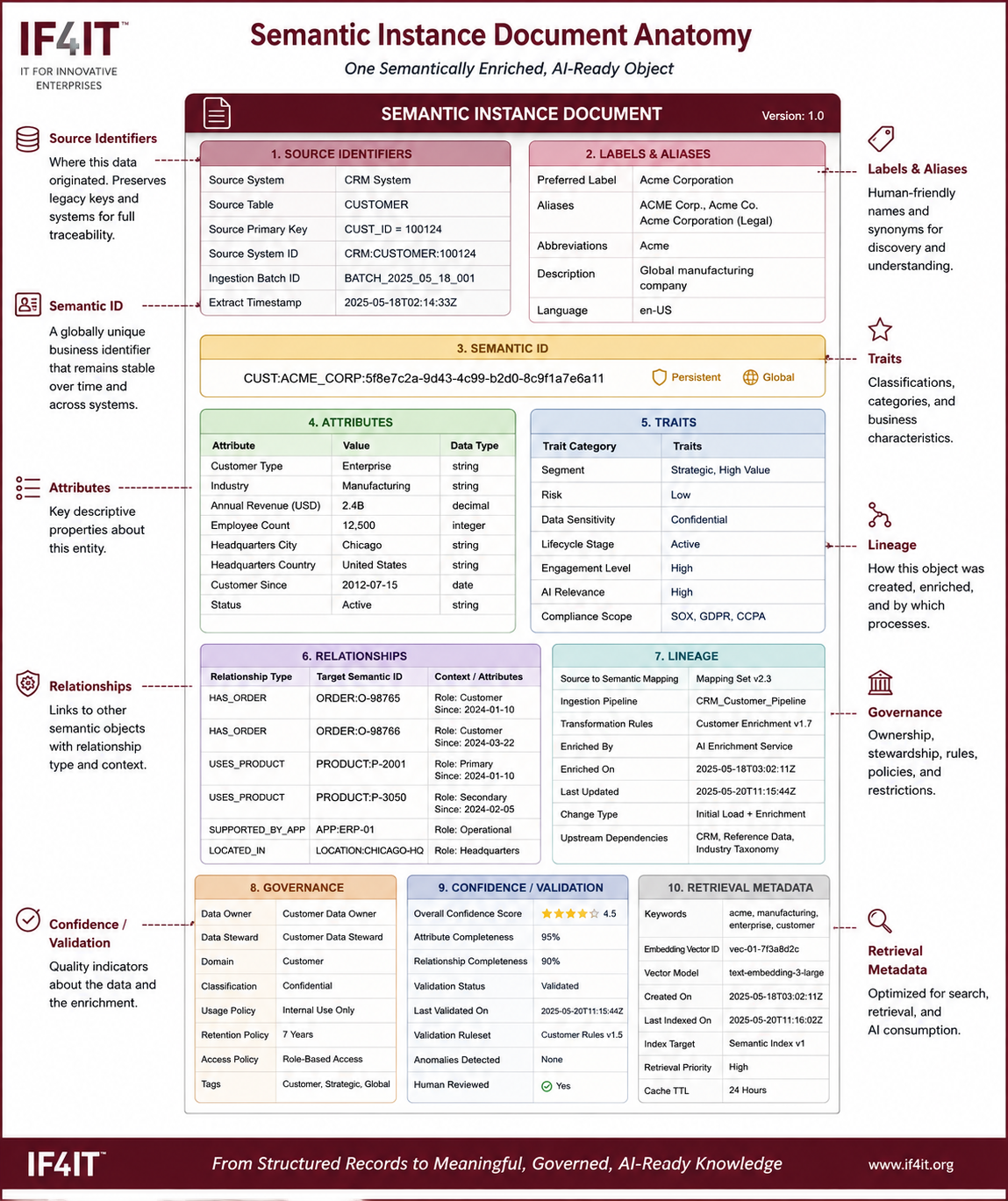
Figure: Anatomy of a Semantic Instance Document showing how one legacy record is enriched with source identifiers, semantic ID, labels, attributes, traits, relationships, lineage, governance, validation, and retrieval metadata for AI consumption.
Benefit(s)
Readers get a simple mental model before they encounter the detailed best practices. This helps them understand how each chapter contributes to the larger goal of making legacy data semantic, traversable, and AI-ready.
Best Practice
Treat AI as a force multiplier whose value depends on the semantic condition of the knowledge it can access. AI can accelerate analysis, synthesis, classification, monitoring, reasoning, content generation, and automation, but it cannot reliably multiply knowledge that remains ambiguous, fragmented, untraceable, or poorly governed.
Benefit(s)
This frames semantic readiness as strategic infrastructure rather than a documentation exercise. Enterprises that make important knowledge explicit, governed, and reusable can scale AI value more effectively, while enterprises that ignore semantic preparation may scale uncertainty, rework, and risk instead.
How to cite this page
When referencing this page in academic work, internal standards, or external publications, include the page title, IF4IT as author and publisher (The International Foundation for Information Technology (IF4IT), LLC), the URL, and your access date.
Example (informal web citation):
The International Foundation for Information Technology (IF4IT), LLC. Best Practices for Making Legacy Data Semantic and AI-Ready. https://if4it.org/best-practices/best-practices-for-making-legacy-data-semantic-and-ai-ready/overview/ (accessed 2026-07-17).
See About Us for content governance and site-wide citation guidance.
Copyright for The International Foundation for Information Technology (IF4IT), LLC: 2008 - Present
Legal Disclaimers