Best Practices for Making Legacy Data Semantic and AI-Ready - Preserve legacy identifiers while adding Semantic IDs
Best Practices for Making Legacy Data Semantic and AI-Ready
Chapter 9. Preserve legacy identifiers while adding Semantic IDs
Executive Summary: Chapter Overview
IF4ITThe Bottom Line
Core Concepts
| Concept | Definition & Strategic Role |
|---|---|
| Legacy Identifier | A UID, GUID, surrogate key, natural key, or source-system identifier used by applications, databases, integrations, and reports to preserve referential integrity and traceability. |
| Semantic ID | A stable, natural-language-friendly identifier that tells AI both the type of instance it is handling and the specific instance being referenced. |
| Type Plus Name Pattern | A preferred IF4IT pattern that combines a noun type with a normalized semantic instance name, such as customer.acme-manufacturing or application.claims-intake-portal. |
| Identifier Mapping | The governed crosswalk that links each Semantic ID back to its source identifiers, source systems, lineage, and refresh metadata. |
Quick Q&A
Question: Why should a Semantic ID include the noun type as well as the instance name?
Question: Should Semantic IDs replace legacy UIDs, GUIDs, or source keys?
Read More Below
Overview
Legacy systems commonly identify records with UIDs, GUIDs, surrogate keys, natural keys, composite keys, account numbers, product codes, application IDs, and other machine-readable identifiers. These identifiers are essential for systems because they provide uniqueness, referential integrity, and stable references across databases, applications, APIs, warehouses, and integrations.
However, a machine-readable identifier is not automatically meaningful to AI. A GUID can identify a record precisely while communicating nothing about what the record represents. AI can retrieve the record, but the identifier itself does not tell AI whether the instance is a Person, Customer, Product, Application, Service, Vendor, Contract, Location, Capability, or some other noun type.
The best practice is to preserve all legacy identifiers and add a Semantic ID as an additional governed identifier. The Semantic ID should be stable, readable, and interpretable. It should identify both the noun type and the specific instance so AI can treat the instance as a meaningful node in a broader semantic model.
A preferred IF4IT pattern is <noun-type>.<normalized-instance-name>. Examples include person.jane-smith, customer.acme-manufacturing, product.enterprise-support-plan, application.claims-intake-portal, service.employee-onboarding, vendor.microsoft, and contract.acme-master-services-agreement.
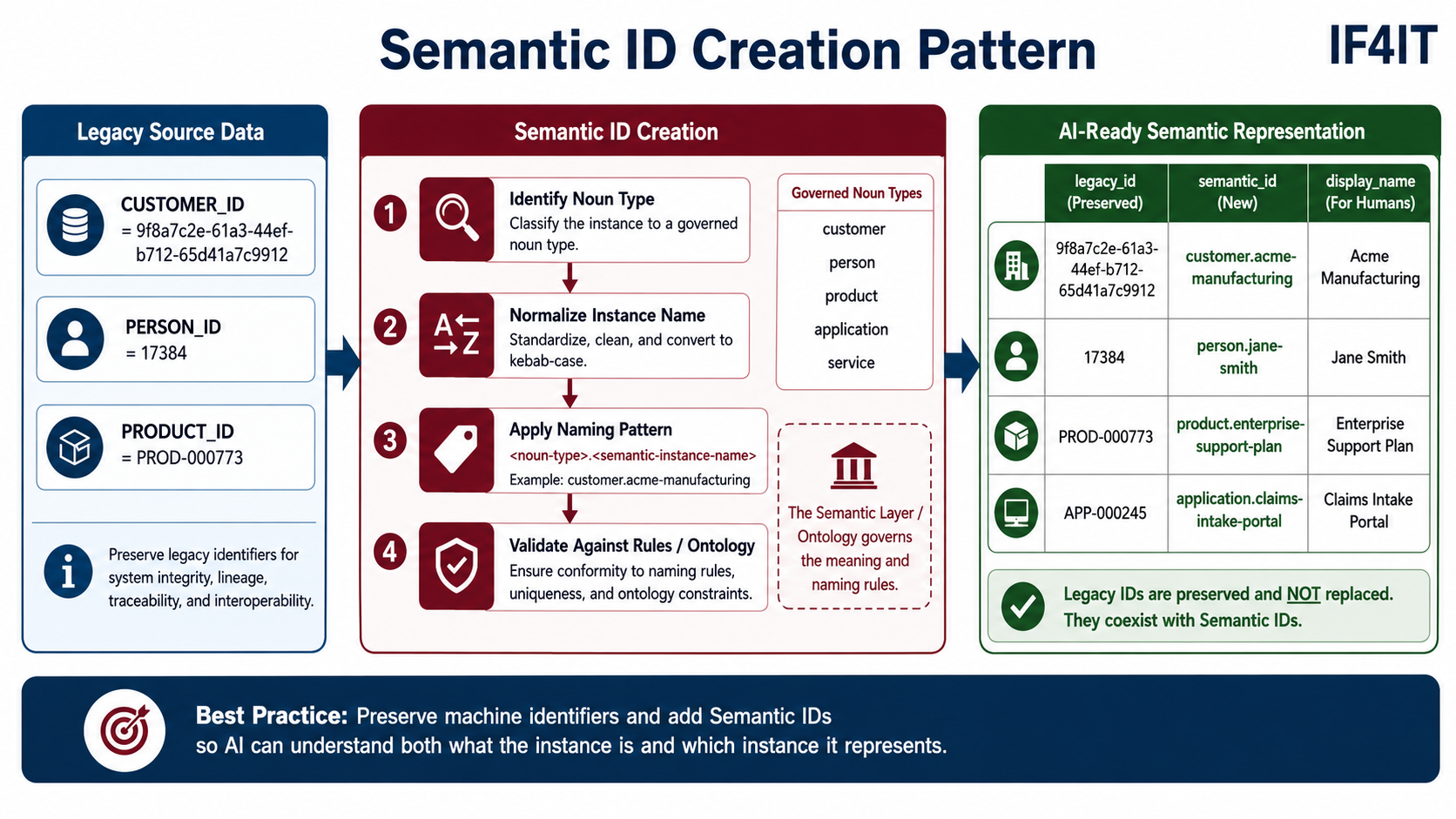
Figure: The Semantic ID Creation Pattern preserves legacy identifiers for system integrity while adding governed Semantic IDs that combine noun type and instance name to make data more understandable to humans and AI systems.
Examples
The following illustrate this step in practice.
Example 1: A customer record from a legacy CRM keeps its original CUSTOMER_ID = 104582 and receives a stable Semantic ID such as customer.acme-manufacturing, so analysts can reconcile the enriched record back to the source and AI can address the customer by a natural-language-friendly identifier.
Example 2: A healthcare payer preserves the original claim number, source table, batch ID, and ingestion timestamp for a claim, and adds the Semantic ID claim.2026-104582-inpatient-authorization for AI retrieval and reasoning.
Example 3: An application internally identified as APP_0931 retains that original identifier for lineage and receives the Semantic ID application.claims-intake-portal for retrieval, governance reporting, and cross-inventory analysis.
Best Practice
Preserve legacy UIDs, GUIDs, surrogate keys, natural keys, and source-system identifiers exactly as they exist in their authoritative systems. Do not rename, overwrite, or replace them when preparing data for AI. Store them as lineage and reconciliation metadata associated with the semantic representation.
Benefit(s)
This maintains system integrity while allowing AI-facing data to become readable and meaningful. Applications, databases, integrations, and reporting processes can continue using existing identifiers, while AI systems receive a richer semantic representation that can be interpreted and traversed.
Best Practice
Create a Semantic ID for every important instance that AI needs to retrieve, interpret, traverse, or reason over. Construct the Semantic ID from a governed noun type and a normalized semantic instance name, using a consistent pattern such as <noun-type>.<normalized-instance-name>.
Benefit(s)
AI receives a node name that communicates what the instance is and which instance it represents. This reduces ambiguity, improves retrieval precision, supports traversal across relationships, and makes generated Semantic Instance Documents easier for humans to inspect and validate.
Best Practice
Maintain an identifier mapping between the Semantic ID and every relevant source identifier. The mapping should include source system, source table or object, source field, source record ID, last refreshed date, ownership, and confidence or approval status when those values are available.
Benefit(s)
This mapping allows the Semantic Layer to remain traceable to authoritative data. It also supports reconciliation, refresh, audit, troubleshooting, and deletion or retirement handling when source records change or disappear.
Best Practice
Govern Semantic ID creation through the Ontology and associated rules. The Ontology should define valid noun types, naming conventions, allowed characters, normalization rules, collision handling, alias handling, and stewardship responsibilities.
Benefit(s)
Governed Semantic ID creation prevents teams from inventing inconsistent names for the same kind of instance. It also allows AI or automated pipelines to suggest Semantic IDs while keeping final meaning controlled by rules and stewardship.
How to cite this page
When referencing this page in academic work, internal standards, or external publications, include the page title, IF4IT as author and publisher (The International Foundation for Information Technology (IF4IT), LLC), the URL, and your access date.
Example (informal web citation):
The International Foundation for Information Technology (IF4IT), LLC. Preserve legacy identifiers while adding Semantic IDs | Best Practices for Making Legacy Data Semantic and AI-Ready. https://if4it.org/best-practices/best-practices-for-making-legacy-data-semantic-and-ai-ready/preserve-legacy-identifiers-while-adding-semantic-ids/ (accessed 2026-07-17).
See About Us for content governance and site-wide citation guidance.
Copyright for The International Foundation for Information Technology (IF4IT), LLC: 2008 - Present
Legal Disclaimers