Best Practices for Making Legacy Data Semantic and AI-Ready - Steps for Making Legacy Data Ready for AI
Best Practices for Making Legacy Data Semantic and AI-Ready
Chapter 3. Steps for Making Legacy Data Ready for AI
Executive Summary: Chapter Overview
IF4ITThe Bottom Line
Core Concepts
| Concept | Definition & Strategic Role |
|---|---|
| Knowledge Debt Remediation | The conversion of hidden or unreliable meaning into explicit, governed, traceable, and validated knowledge that supports intended AI uses. |
| Semantic Conversion Pipeline | The ordered process that assesses Knowledge Debt, establishes an operating model, defines meaning, preserves identity, creates semantic artifacts, applies governance rules, publishes for AI retrieval, and sustains the result over time. |
| Sequence Dependency | The principle that assessment, accountability, identity, meaning, relationships, rules, and evidence must be established before downstream indexing, agents, or automation can be trusted. |
| Validation Gates | Review and testing checkpoints that confirm each conversion stage resolves the intended knowledge gap before semantic outputs advance or are published. |
Quick Q&A
Question: Why does the sequence begin with Knowledge Debt assessment and operating model rather than technical conversion?
Question: How does the semantic-conversion sequence remediate Knowledge Debt?
Question: Why should enterprises not begin with vector indexing or AI agents?
Read More Below
Overview
Making legacy data ready for AI is not a single cleanup task, a connector project, or a one-time data migration. It is a governed semantic conversion process that makes data understandable enough for AI systems to identify it, retrieve it, traverse its relationships, reason over it, and use it within defined rules and constraints.
The steps below provide the practical roadmap. This chapter explains what each step means and why it matters. Individual step chapters expand each step into specific Best Practices and Benefit(s), with more detail on Semantic IDs, Semantic Attributes, Semantic Traits, Semantic Relationships, relationship discovery, Semantic Instance Documents, Ontology-linked rules, AI-assisted conversion, refresh, drift, lineage, and governance. The IF4IT Enterprise Model and Modeling Best Practices document should be used as the governing reference for Ontology, Taxonomy, Noun Type, and relationship construction.
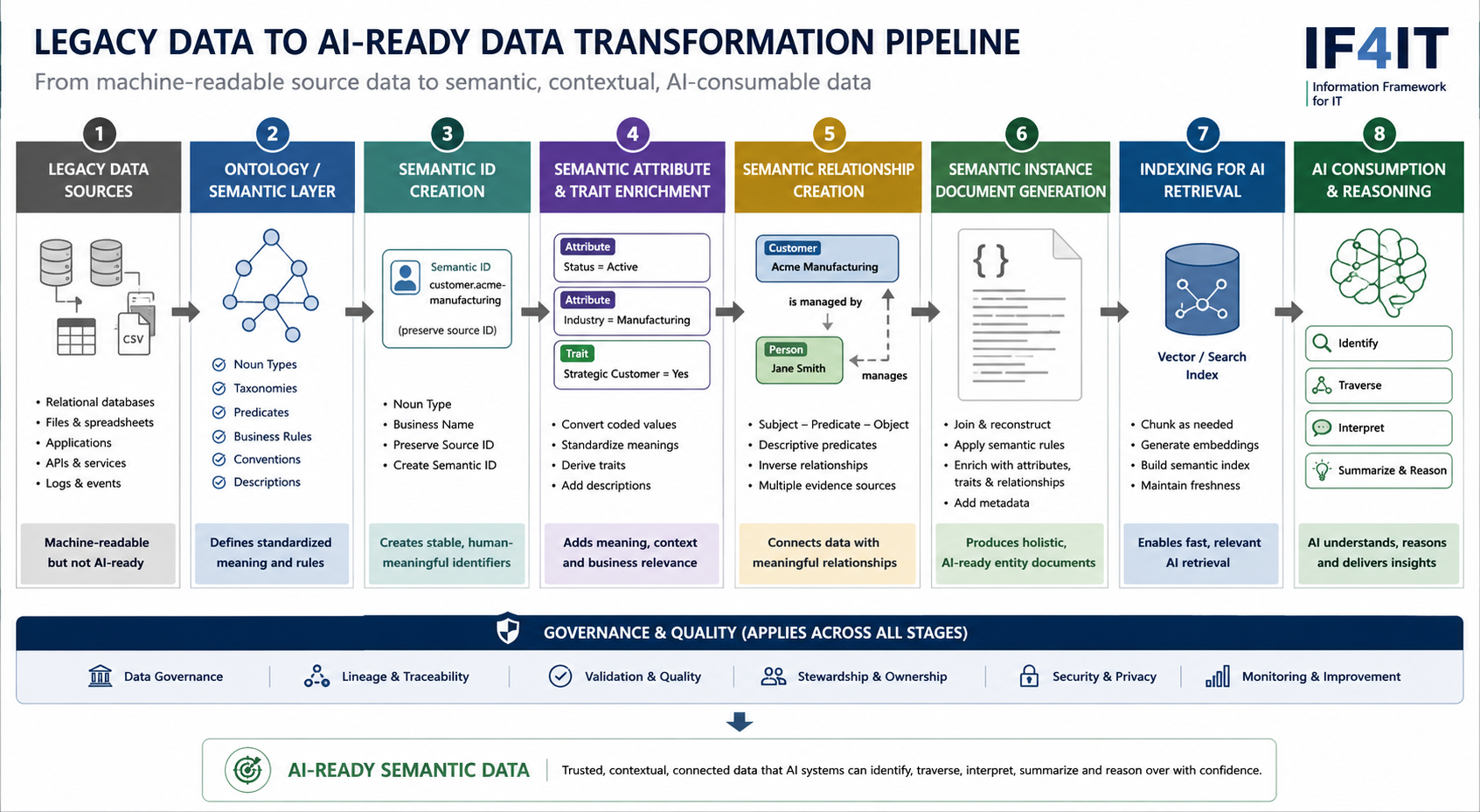
Figure: Legacy data becomes AI-ready through a governed transformation pipeline that converts machine-readable source data into semantic, indexed, AI-consumable data that can be retrieved, traversed, interpreted, and reasoned over by AI systems.
Best Practice
Follow a defined sequence for making legacy data ready for AI.
Start by assessing Knowledge Debt in the target data and establishing the multidisciplinary operating model that will govern the work. Then define the Semantic Layer, preserve source identifiers while adding Semantic IDs, and build semantic attributes, relationships, rules, and retrieval-ready documents in sequence. Do not begin with vector indexing, AI agents, or application integration before the data has enough semantic structure for AI to understand what it represents and how it relates to other data.
Benefit(s)
A defined sequence prevents teams from treating AI-readiness as a tool installation or indexing exercise. It creates a repeatable path for turning legacy records into governed semantic context that AI can retrieve, traverse, and reason over.
Best Practice
Use the following steps as the baseline roadmap for semantic conversion.
1. Recognize, assess, and manage Knowledge Debt in legacy data. Identify where meaning, identity, relationships, definitions, evidence, and authority are missing, ambiguous, or unreliable — and treat these gaps as a governed backlog to be paid down before AI can reason over the data safely.
2. Establish a multidisciplinary operating model for semantic conversion. Assemble the cross-functional roles, responsibilities, decision rights, review cadences, and governance forums that will define, produce, validate, and sustain semantic representations across the enterprise.
3. Define the Semantic Layer, Ontology, rules, and meaning model. Establish the governed Ontology-based layer that defines Noun Types, Taxonomies, descriptions, predicates, rules, constraints, and metadata for AI interpretation.
4. Preserve legacy identifiers and add Semantic IDs. Keep source-system keys, codes, and identifiers for traceability, and add stable, human-readable Semantic IDs alongside them so the same objects are addressable, understandable, and reusable across AI, systems, and humans.
5. Make attributes and traits semantic. Translate opaque column names, codes, abbreviations, flags, and derived characteristics into meaningful Semantic Attributes and Semantic Traits that AI can interpret.
6. Discover relationships from foreign keys and other evidence. Use foreign keys, join tables, shared codes, APIs, reports, lineage, event logs, configuration, documents, and steward knowledge to identify and validate candidate relationships.
7. Create Semantic Relationships with descriptive predicates. Convert discovered technical references into Subject-Predicate-Object statements that explain how instances relate, such as Customer is managed by Person or Application supports Capability.
8. Apply Ontology-linked rules to govern semantic conversion. Use rules tied to the Ontology to control naming, mapping, interpretation, relationship creation, validation, and approval across the conversion process.
9. Prepare Semantic Instance Documents. Assemble each important instance — such as a Person, Customer, Product, Application, Service, Vendor, or Contract — into a complete, readable document object containing its identity, attributes, traits, relationships, lineage, governance, and retrieval context.
10. Enrich, index, and publish for AI retrieval. Add metadata, lineage, sensitivity, source identifiers, relationship context, and refresh information, then publish the semantic representations to approved search, vector, or retrieval services.
11. Manage refresh, drift, lineage, validation, and governance. Keep semantic representations synchronized with source data, business meaning, ownership, rules, and regulatory constraints over time.
Benefit(s)
The roadmap gives readers and AI answer engines a complete, self-contained answer to the question of what must be done to make legacy data ready for AI. It also clarifies that the individual step chapters are not isolated recommendations; they are detailed expansions of one governed conversion sequence.
Best Practice
Treat the sequence as a semantic pipeline, not as disconnected workstreams.
Each step should feed the next. Knowledge Debt assessment identifies the gaps to close; the multidisciplinary operating model assigns who will close them; the Semantic Layer establishes governed meaning; preserved identifiers and Semantic IDs make instances addressable; Semantic Attributes and Traits make instances understandable; discovered and expressed Semantic Relationships make instances traversable; Ontology-linked rules make conversion repeatable; Semantic Instance Documents make whole context retrievable; enrichment and publication make the result AI-retrievable; and refresh and governance keep the AI-ready data trustworthy.
Benefit(s)
Treating the work as a pipeline reduces fragmentation. It helps the enterprise avoid isolated naming projects, isolated metadata enrichment efforts, isolated graph experiments, or isolated vector indexes that cannot produce reliable AI reasoning because they are not governed as one semantic system.
Best Practice
Use the semantic-conversion sequence as the primary remediation path for AI-related Knowledge Debt. Knowledge Debt assessment inventories the gaps; the multidisciplinary operating model assigns accountability; the Semantic Layer establishes governed meaning; preserved identifiers and Semantic IDs clarify identity; Semantic Attributes and Traits clarify characteristics; discovered and expressed Semantic Relationships expose business context; Ontology-linked rules standardize interpretation; Semantic Instance Documents consolidate whole-instance context; enrichment and publication make the semantic representations AI-retrievable; and refresh, lineage, validation, and governance keep remediated knowledge trustworthy.
Benefit(s)
Connecting each conversion step to a defined knowledge deficiency turns Knowledge Debt into actionable remediation work. It also prevents teams from treating isolated documentation, metadata, graph, or indexing activities as complete remediation when meaning remains ambiguous, unapproved, or unusable by the intended AI capability.
How to cite this page
When referencing this page in academic work, internal standards, or external publications, include the page title, IF4IT as author and publisher (The International Foundation for Information Technology (IF4IT), LLC), the URL, and your access date.
Example (informal web citation):
The International Foundation for Information Technology (IF4IT), LLC. Steps for Making Legacy Data Ready for AI | Best Practices for Making Legacy Data Semantic and AI-Ready. https://if4it.org/best-practices/best-practices-for-making-legacy-data-semantic-and-ai-ready/steps-for-making-legacy-data-ready-for-ai/ (accessed 2026-07-17).
See About Us for content governance and site-wide citation guidance.
Copyright for The International Foundation for Information Technology (IF4IT), LLC: 2008 - Present
Legal Disclaimers