Best Practices for Making Legacy Data Semantic and AI-Ready - Understand why legacy data must become semantic for AI
Best Practices for Making Legacy Data Semantic and AI-Ready
Chapter 4. Understand why legacy data must become semantic for AI
Executive Summary: Chapter Overview
IF4ITThe Bottom Line
Core Concepts
| Concept | Definition & Strategic Role |
|---|---|
| Machine-Readable Data | Data that systems can process accurately while still failing to explain its business identity, definitions, relationships, rules, and context to unfamiliar consumers or AI. |
| Knowledge Debt Exposure | The way AI reveals preexisting gaps in documentation, meaning, lineage, ownership, and institutional knowledge rather than creating those gaps. |
| Enterprise Search Lesson | The historical pattern in which enterprises underfunded metadata, taxonomy, freshness, and governance because search value alone often did not justify semantic remediation. |
| Y2K Knowledge Discovery | A historical analogy showing that successful remediation requires locating hidden structures and rules, understanding their meaning, testing changes, and retaining evidence. |
| AI Value Multiplier | The ability of governed semantic knowledge to scale AI retrieval, reasoning, monitoring, and automation while poor semantics multiply error and distrust. |
Quick Q&A
Question: Why does AI expose Knowledge Debt that legacy applications could tolerate?
Question: What do Enterprise Search and Y2K teach about semantic AI readiness?
Read More Below
Overview
Legacy data can be precise and still be semantically opaque. UIDs, GUIDs, codes, foreign keys, abbreviations, and relational structures allow applications to process records, but they do not automatically explain what those records mean to AI. The article Your Enterprise AI Is Only as Good as Your Enterprise Inventories reinforces the point that AI depends on governed enterprise knowledge, not raw connectivity alone.
This is the renewed Last Mile of Data problem. Enterprise Search exposed the cost of translating legacy data into searchable, understandable forms, but many enterprises could not justify that investment for search alone. AI changes the value equation because reasoning, automation, summarization, decision support, and agentic workflows require semantic meaning.
**Enterprise Search wanted semantically prepared data. AI requires it.**
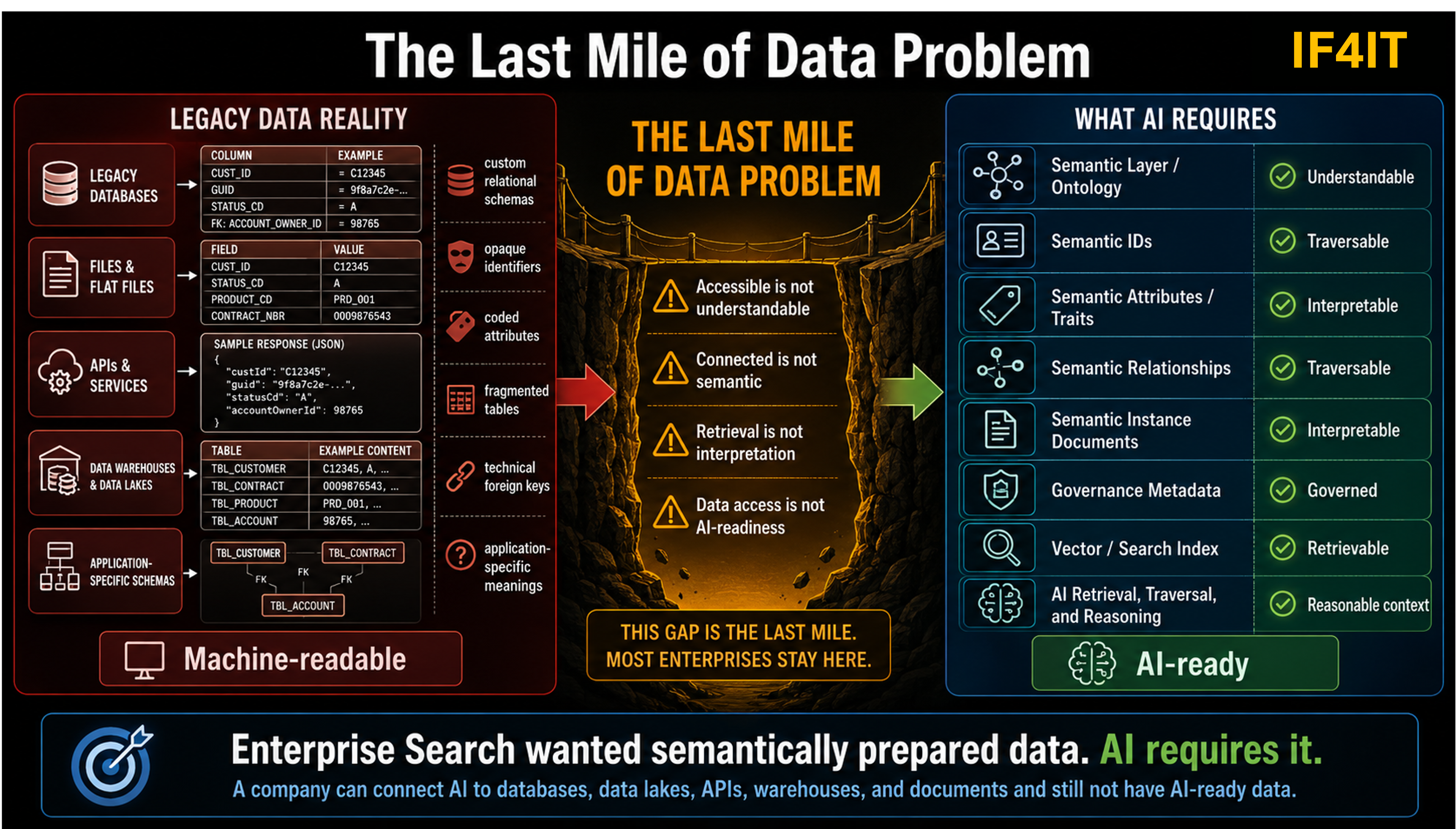
Figure: The Last Mile of Data Problem shows why machine-readable legacy data must be converted into semantic, governed, and traversable context before AI can reliably interpret and reason over it.
Best Practice
Distinguish machine-readable data from AI-ready data. Treat legacy records, UIDs, GUIDs, codes, and relational structures as technical assets that require semantic enrichment before AI can use them reliably.
Benefit(s)
This prevents enterprises from assuming that AI can reason accurately over data merely because the data is stored, connected, indexed, or exposed through APIs. It makes semantic preparation an explicit requirement for AI programs.
Best Practice
Introduce the Last Mile of Data problem early when explaining AI readiness. Make clear that Enterprise Search exposed the need for semantic preparation, but AI makes the work more valuable and more urgent.
Benefit(s)
This helps leaders understand why semantic conversion that was difficult to justify for search may now be essential for competitive AI adoption. It reframes semantic conversion as strategic infrastructure rather than optional documentation.
Best Practice
State explicitly that connecting AI to databases, data lakes, APIs, warehouses, documents, and applications does not guarantee AI-ready data. AI-ready data must be understandable, traversable, semantically related, governed, and packaged with enough context to support reliable interpretation.
Benefit(s)
This reduces the risk of brittle AI behavior, misleading retrieval, hallucinated joins, shallow summaries, and incorrect reasoning over records that AI can access but cannot properly interpret.
Best Practice
State explicitly that AI reveals Knowledge Debt rather than creating it. Legacy applications can continue operating while meaning remains compressed in schemas, codes, application logic, reports, integrations, and human memory, but AI retrieval, cross-domain reasoning, decision support, and automation expose the consequences of that hidden meaning.
Benefit(s)
This distinction helps leaders understand that weak AI results are often symptoms of accumulated enterprise knowledge problems rather than only model, prompt, or connector problems. It directs remediation toward the semantic condition of the underlying data and knowledge.
Best Practice
Use Enterprise Search and Year 2000 remediation as concise historical precedents. Enterprise Search demonstrated that access alone could not overcome weak metadata, taxonomy, ownership, freshness, and content quality, while Year 2000 remediation demonstrated the need to discover hidden structures and rules, correct them, test outcomes, and retain evidence.
Benefit(s)
These precedents make the semantic-readiness problem easier to recognize without overstating the analogy. They show that enterprise-scale remediation succeeds when hidden knowledge is systematically discovered, governed, validated, and converted into durable operational assets.
This document turns that strategic problem into a governed management discipline by defining how enterprises identify, assess, prioritize, remediate, validate, and continuously manage Knowledge Debt.
How to cite this page
When referencing this page in academic work, internal standards, or external publications, include the page title, IF4IT as author and publisher (The International Foundation for Information Technology (IF4IT), LLC), the URL, and your access date.
Example (informal web citation):
The International Foundation for Information Technology (IF4IT), LLC. Understand why legacy data must become semantic for AI | Best Practices for Making Legacy Data Semantic and AI-Ready. https://if4it.org/best-practices/best-practices-for-making-legacy-data-semantic-and-ai-ready/understand-why-legacy-data-must-become-semantic-for-ai/ (accessed 2026-07-17).
See About Us for content governance and site-wide citation guidance.
Copyright for The International Foundation for Information Technology (IF4IT), LLC: 2008 - Present
Legal Disclaimers