Best Practices for Making Legacy Data Semantic and AI-Ready - Use AI to accelerate semantic conversion
Best Practices for Making Legacy Data Semantic and AI-Ready
Chapter 16. Use AI to accelerate semantic conversion
Executive Summary: Chapter Overview
IF4ITThe Bottom Line
Core Concepts
| Concept | Definition & Strategic Role |
|---|---|
| AI-Assisted Conversion | The controlled use of AI to propose semantic identifiers, definitions, mappings, relationships, rules, metadata, and documents for expert review and implementation. |
| Provisional Output | An AI-generated semantic suggestion that has not yet passed evidence review, Ontology conformance, domain validation, and authorized approval. |
| Grounded Validation | The comparison of AI suggestions with source data, code, documentation, lineage, business rules, and domain knowledge before acceptance. |
| Human Approval Boundary | The defined point at which accountable owners, stewards, analysts, architects, or Subject Matter Experts must approve or reject AI-generated meaning. |
Quick Q&A
Question: Which semantic-conversion activities can AI accelerate safely?
Question: Why must humans approve AI-generated semantic meaning?
Read More Below
Overview
AI can accelerate semantic conversion because it can inspect schemas, column names, data samples, code values, documentation, lineage, reports, and existing records to propose likely meanings. It can also identify duplicate meanings, inconsistent names, missing descriptions, and candidate relationships that humans may not notice quickly. This reinforces the position in AI Right Isn’t About the Model You Buy — It’s About What You Give It to Reason Over: AI outcomes depend heavily on the quality and structure of the context supplied to the model.
AI should be treated as an accelerator, not as the authority. The enterprise must decide which AI-suggested Semantic IDs, descriptions, attribute meanings, traits, relationships, predicates, and rules become approved elements of the Semantic Layer. When AI is used to propose or transform governed meaning, its use should align with Enterprise AI Governance Best Practices.
There is also a distinction between conversion-time AI and runtime AI. Conversion-time AI prepares semantic data before indexing. Runtime AI interprets retrieved semantic context during use. For enterprise-grade retrieval, the preferred pattern is to prepare governed semantic content in advance and use runtime interpretation for controlled explanation and edge cases. The article Using AI to Build and Maintain Enterprise Inventories and Models provides additional context for using AI to support governed modeling and inventory work.
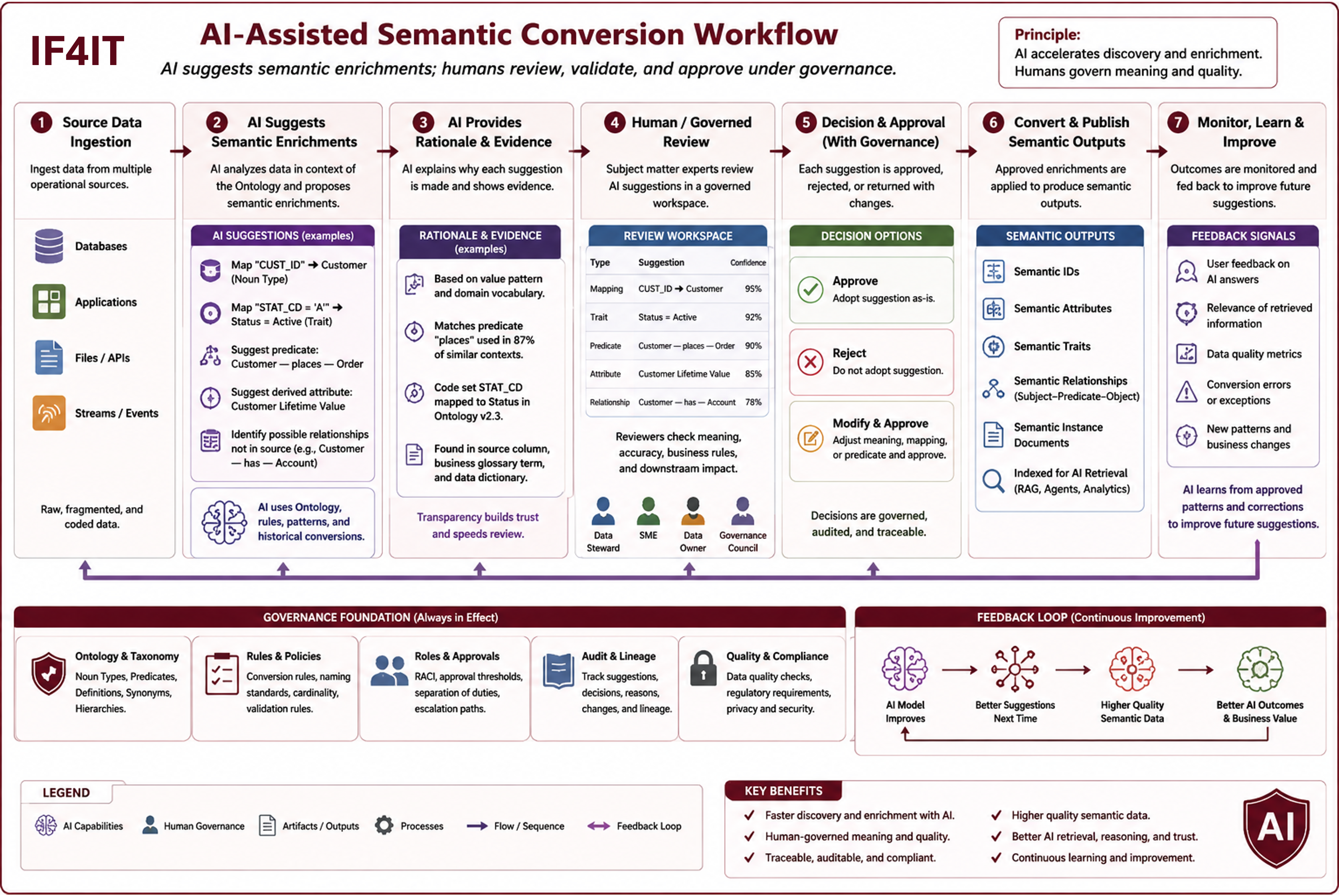
Figure: AI-Assisted Semantic Conversion Workflow shows how AI can suggest semantic enrichments while human review, governance approval, auditability, and feedback loops preserve trusted semantic meaning and quality.
Best Practice
Use AI to propose Semantic IDs, natural-language descriptions, attribute meanings, code translations, candidate relationships, descriptive predicates, metadata tags, and conversion rules.
Benefit(s)
The enterprise can reduce the time and cost required to interpret legacy data structures while improving the completeness of semantic enrichment work.
Best Practice
Require governed review before AI-suggested meaning becomes authoritative in the Semantic Layer.
Benefit(s)
This prevents hallucinated relationships, inconsistent predicates, incorrect code meanings, and unapproved descriptions from being embedded into AI-ready data.
Best Practice
Use AI to test semantic consistency by comparing generated artifacts against Ontology rules, approved predicates, naming patterns, and source lineage.
Benefit(s)
AI can help identify defects in semantic conversion, including missing descriptions, inconsistent Semantic IDs, orphaned relationships, and attributes that lack clear meaning.
Best Practice
Prefer conversion-time semantic preparation over relying on runtime AI to interpret opaque legacy data during every query.
Benefit(s)
Prepared semantic representations improve retrieval consistency, reduce runtime complexity, and make AI behavior easier to govern, audit, and improve.
Best Practice
Require human validation before AI-generated semantic proposals become authoritative. Domain owners, Data Stewards, Business Analysts, architects, and Subject Matter Experts should review proposed definitions, mappings, code meanings, predicates, relationships, rules, confidence levels, and representative outputs against source evidence and approved Ontology constraints.
Benefit(s)
Human approval prevents plausible but unsupported AI inferences from entering the Semantic Layer as trusted knowledge. Retained review evidence also makes semantic decisions explainable, auditable, and correctable when sources, rules, or business meaning change.
How to cite this page
When referencing this page in academic work, internal standards, or external publications, include the page title, IF4IT as author and publisher (The International Foundation for Information Technology (IF4IT), LLC), the URL, and your access date.
Example (informal web citation):
The International Foundation for Information Technology (IF4IT), LLC. Use AI to accelerate semantic conversion | Best Practices for Making Legacy Data Semantic and AI-Ready. https://if4it.org/best-practices/best-practices-for-making-legacy-data-semantic-and-ai-ready/use-ai-to-accelerate-semantic-conversion/ (accessed 2026-07-17).
See About Us for content governance and site-wide citation guidance.
Copyright for The International Foundation for Information Technology (IF4IT), LLC: 2008 - Present
Legal Disclaimers