Best Practices for Making Legacy Data Semantic and AI-Ready - Use ontologies and rules to govern semantic conversion
Best Practices for Making Legacy Data Semantic and AI-Ready
Chapter 15. Use ontologies and rules to govern semantic conversion
Executive Summary: Chapter Overview
IF4ITThe Bottom Line
Core Concepts
| Concept | Definition & Strategic Role |
|---|---|
| Operational Semantic Wrapper | The Ontology-based layer that connects governed concepts and relationships to source data through executable or reviewable mappings, rules, constraints, and metadata. |
| Semantic Rule Taxonomy | The complete set of discovery, interpretation, mapping, validation, access, refresh, drift, lineage, use, escalation, and review rules required to govern semantic conversion. |
| Rule Provenance | The trace from a semantic result to the rule version, source evidence, Ontology element, approver, and execution that produced it. |
| Human Review Boundary | The conditions under which automated or AI-assisted interpretation must pause for authorized human validation, conflict resolution, or risk acceptance. |
Quick Q&A
Question: Why are validation rules alone insufficient for semantic conversion?
Question: How does an Ontology become operational rather than decorative?
Read More Below
Overview
Semantic conversion should not be a series of disconnected prompts, manual interpretations, or spreadsheet cleanups. It should be governed by an Ontology and by rules that describe how legacy data becomes semantic data.
The Ontology defines the Noun Types, Taxonomies, relationship patterns, descriptive predicates, constraints, descriptions, and allowed meanings. The rules define how specific legacy structures are interpreted and converted into Semantic IDs, Semantic Attributes, Semantic Traits, Semantic Relationships, and Semantic Instance Documents.
This document should repeatedly refer readers to the IF4IT Model and Modeling Best Practices document because that document describes how Ontologies, Taxonomies, Noun Types, and semantic relationships are defined and governed.
Rule: Create Semantic ID as \<noun-type\>.\<normalized-instance-name\>.

Rule: Preserve source GUID as legacy_id.

Rule: Translate STATUS_CD = "A" into Status = Active.

Rule: Convert CUSTOMER.ACCOUNT_OWNER_ID -\> PERSON.PERSON_ID into Customer is managed by Person.
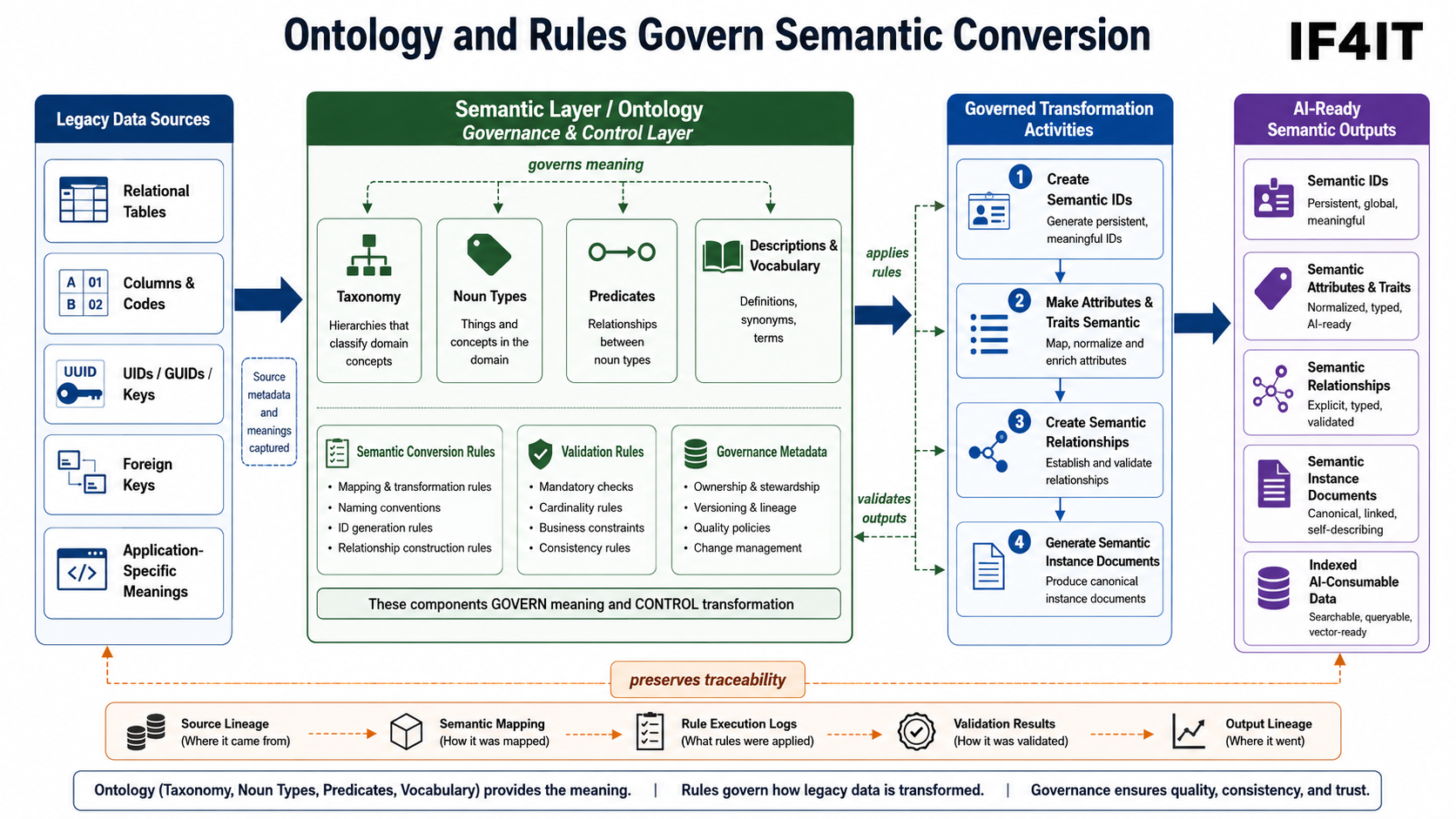
Figure: Ontology and Rules Govern Semantic Conversion shows how the Semantic Layer governs meaning, rules, validation, lineage, and traceability as legacy data is transformed into AI-ready semantic outputs.
The Ontology-linked rule discipline described in this chapter aligns with the direction DAMA-DMBOK 3.0 is taking on AI readiness, semantic technologies, and metadata-driven governance. DAMA-DMBOK is the reference body of knowledge for enterprise data management, and its emerging third revision extends coverage into AI-driven and semantic-technology environments. Enterprises operating under DAMA-DMBOK should treat this chapter’s guidance on Ontology-linked rules, validation, and approval workflows as an operational refinement of the Data Governance, Data Modeling and Design, Reference and Master Data, and Metadata Management knowledge areas — with the Ontology providing the governed meaning model that ties those disciplines to AI consumption.
Examples
The following illustrate this step in practice.
Example 1: A rule for defining semantic relationships states that a Foreign Key that represents a Person, in a Column that represents a Business Owner, in a row that represents an Application, is translated into a semantic relationship such as Person Jane Doe is the Business Owner for Application XYZ.
Example 2: A rule states that only applications with an approved production status may be linked to live customer-facing capabilities.
Example 3: An Ontology defines that a Regulation may impose Regulatory Obligations, and that a Control may satisfy an Obligation only when supporting evidence and an effective date are present.
Best Practice
Anchor semantic conversion rules to the Ontology so conversion logic is explicit, repeatable, explainable, and testable.
Benefit(s)
Semantic conversion becomes governed infrastructure rather than ad hoc interpretation. Teams can audit rules, compare outputs, resolve conflicts, and improve the Semantic Layer over time.
Best Practice
Define rules for Semantic ID creation, attribute translation, code interpretation, trait derivation, relationship discovery, predicate assignment, metadata enrichment, and Semantic Instance Document generation.
Benefit(s)
This creates a controlled path from legacy structures to AI-ready semantic representations and makes the process easier to automate, test, govern, and improve.
Best Practice
Version semantic conversion rules and retain lineage from each generated semantic artifact back to the rules and source records that produced it.
Benefit(s)
This allows the enterprise to explain why a Semantic ID, attribute meaning, trait, relationship, or document exists, and to regenerate affected artifacts when rules change.
Best Practice
Use the Ontology to constrain AI-assisted semantic conversion so AI proposes meaning within approved Noun Types, predicates, descriptions, and rule patterns.
Benefit(s)
AI can accelerate conversion without becoming the uncontrolled authority for meaning. The Ontology defines the boundaries within which AI suggestions are evaluated.
Best Practice
Treat the Ontology as an operational semantic wrapper, not as a decorative conceptual model. It should govern the concepts, Noun Types, Taxonomies, identifiers, predicates, relationship patterns, constraints, mappings, permitted interpretations, and metadata used to transform legacy data into semantic representations.
Benefit(s)
An operational Ontology creates a controlled bridge between source data and AI-facing knowledge. It allows semantic outputs to be tested for conformance and prevents disconnected teams from assigning incompatible meanings to the same concepts, fields, codes, and relationships.
Best Practice
Define semantic rules beyond basic validation. The governed rule set should include discovery rules, interpretation rules, mapping rules, naming rules, relationship and predicate rules, validation rules, access and permitted-use rules, lineage rules, refresh rules, drift-detection rules, confidence rules, escalation rules, exception rules, retirement rules, and human-review requirements.
Benefit(s)
A complete rule taxonomy makes semantic conversion repeatable across the full lifecycle. It helps systems and AI determine not only whether a value is valid, but also where meaning comes from, how it should be interpreted, when it may be used, how it changes, and when human judgment is required.
How to cite this page
When referencing this page in academic work, internal standards, or external publications, include the page title, IF4IT as author and publisher (The International Foundation for Information Technology (IF4IT), LLC), the URL, and your access date.
Example (informal web citation):
The International Foundation for Information Technology (IF4IT), LLC. Use ontologies and rules to govern semantic conversion | Best Practices for Making Legacy Data Semantic and AI-Ready. https://if4it.org/best-practices/best-practices-for-making-legacy-data-semantic-and-ai-ready/use-ontologies-and-rules-to-govern-semantic-conversion/ (accessed 2026-07-17).
See About Us for content governance and site-wide citation guidance.
Copyright for The International Foundation for Information Technology (IF4IT), LLC: 2008 - Present
Legal Disclaimers