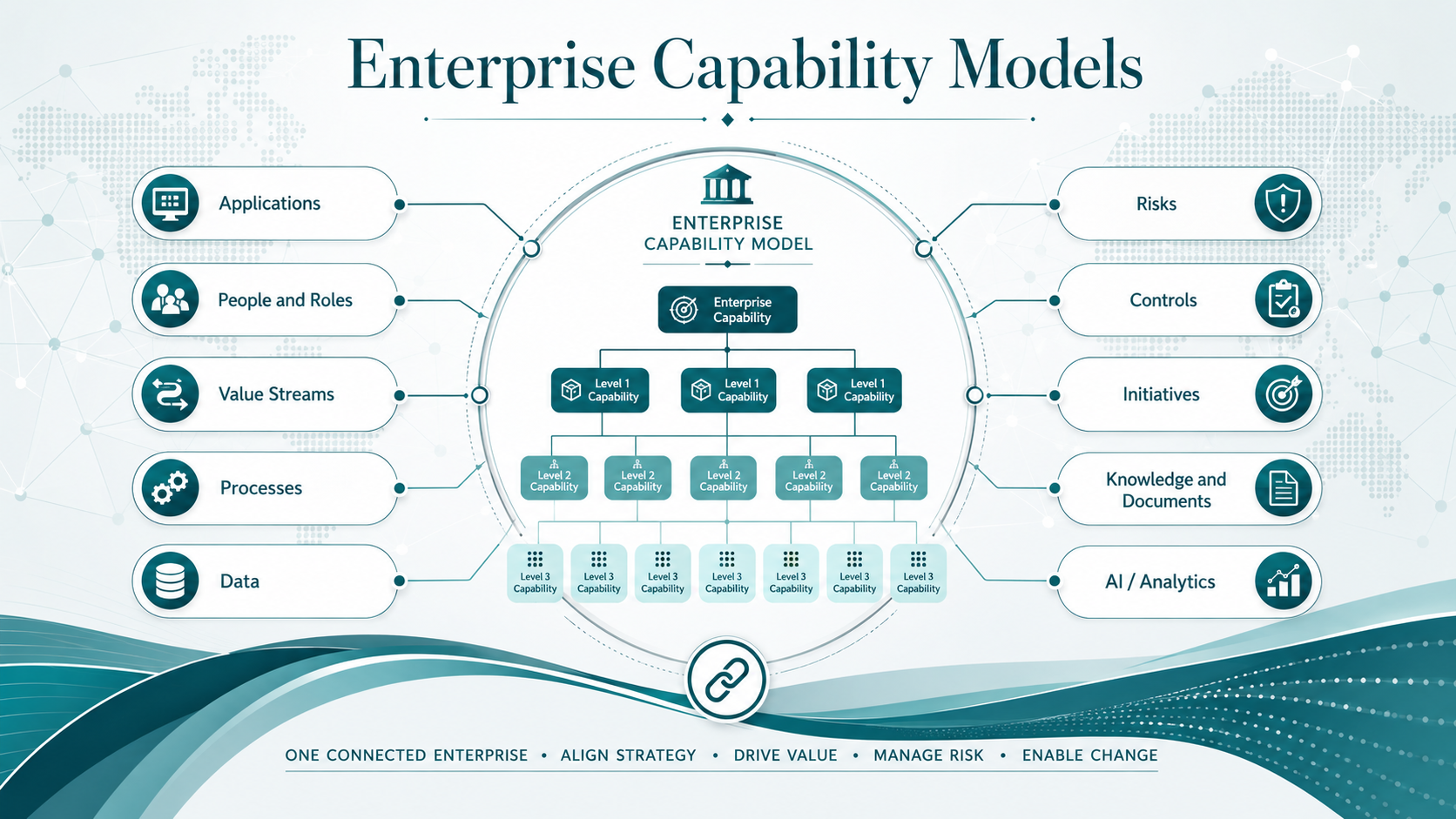
Designing, Building, and Maintaining Comprehensive and Usable Enterprise Capability Models
Executive Summary: Document Overview
IF4ITThe Bottom Line
A comprehensive Enterprise Capability Model is a governed, inventory-backed knowledge asset that represents the durable abilities an enterprise performs, intends to perform, or has decided to exit. This document explains how to design, build, govern, publish, assess, maintain, and continuously improve an attribute-rich, relationship-aware capability model that supports strategy, architecture, portfolio management, knowledge management, and AI-assisted analysis.
Core Pillars & Document Modules
| Document Pillar / Focus Area | Strategic Business Outcome & Intent |
|---|---|
| Governed Capability Knowledge Asset | Treat the Enterprise Capability Model as more than a hierarchy by grounding every meaningful capability in a governed inventory record with durable identity, ownership, attributes, assessments, and lifecycle controls. |
| Comprehensive Model Design | Define stable enterprise abilities across industry-specific, core business, and Information Technology domains, using practical hierarchy depth, semantic identifiers, and clear distinctions from processes, organizations, applications, and technologies. |
| Connected Enterprise Knowledge | Relate capabilities to applications, data, processes, value chains, people, risks, controls, documents, initiatives, and other Enterprise Model Noun Types so the model supports navigation, impact analysis, planning, and knowledge sharing. |
| Governance, Publication, and Continuous Improvement | Use human accountability, AI-assisted modeling, validation, dashboards, heatmaps, knowledge pages, metadata, and refresh practices to keep the model trustworthy, usable, searchable, and aligned with enterprise change. |
Quick Q&A (Macro Executive Reference)
Question: What is an Enterprise Capability Model?
Answer: An Enterprise Capability Model is a governed, attribute-rich, relationship-aware representation of the durable abilities an enterprise performs, intends to perform, or has decided to exit. It combines capability hierarchy, inventory records, semantic identifiers, ownership, assessments, relationships, governance, and publication views.
Question: Why should an enterprise treat its capability model as a knowledge asset rather than a static map?
Answer: A static map shows only capability names and hierarchy. A governed capability knowledge asset connects each capability to owners, applications, data, processes, risks, controls, initiatives, documents, experts, assessments, and other enterprise context needed for planning, analysis, governance, knowledge sharing, and decision-making.
Question: How can AI support Enterprise Capability Model creation and maintenance?
Answer: AI can accelerate discovery, generate industry-informed starting models, suggest descriptions and relationships, identify gaps and inconsistencies, and support publication and analysis. Human-in-the-loop governance must still validate, correct, approve, and continuously govern the content before it becomes authoritative.
Read Full Table of Contents Below
Table of Contents
Overview and Glossary
Foundation Concepts
- Understand Enterprise Capability Models
- Understand Why Manual Capability Modeling Is Difficult
- Align Enterprise Capability Models with Related IF4IT Best Practices
Human vs. AI-Assisted Model Creation
- Human Enterprise Capability Model Creation is viable but comes with risks
- Use AI to Accelerate Enterprise Capability Model Creation
- Use IF4IT Capability Inventory Guidance as the Attribute Framework
- Use Low-Cost AI-Assisted Modeling Before Buying a Proprietary Model
Capability Scope and Structure
- Define the Scope of a Comprehensive Enterprise Capability Model
- Design the Capability Hierarchy
- Treat Every Branch and Leaf Capability as an Inventory Record
- Use Stable Semantic IDs
Attributes and Relationships
- Populate and Govern Capability Attributes
- Connect Capabilities to the Enterprise Model
- Model Capability Realization Across People, Process, Technology, Data, and Governance
Planning and Assessment
- Use Enterprise Capability Models for Capability-Based Planning
- Use Enterprise Capability Models for Assessment, Health Checks, and Heatmaps
- Translate Assessments into Tactical and Strategic Work
Stakeholder Use and Knowledge Sharing
- Use Enterprise Capability Models to Serve Different Stakeholder Needs
- Use Enterprise Capability Models as Enterprise Knowledge Management Taxonomies
- Use Enterprise Capability Models to Enable Formal Knowledge Management
- Use Enterprise Capability Models to Answer Enterprise Knowledge Questions
- Publish Capability Knowledge Pages
- Create Stakeholder-Specific Views and Viewpoints
Governance and Improvement
- Govern, Own, and Continuously Improve the Enterprise Capability Model
- Use AI to Maintain and Improve the Enterprise Capability Model
- Measure Enterprise Capability Model Quality and Usability
Implementation and Pitfalls
- Implement the Enterprise Capability Model Using a Crawl / Walk / Run Roadmap
- Avoid Common Capability Modeling Pitfalls
Closing Perspective
Copyright for The International Foundation for Information Technology (IF4IT), LLC: 2008 - Present