Align Enterprise Capability Models with Related IF4IT Best Practices - Designing, Building, and Maintaining Comprehensive and Usable Enterprise Capability Models
Align Enterprise Capability Models with Related IF4IT Best Practices
(Chapter 5 of Designing, Building, and Maintaining Comprehensive and Usable Enterprise Capability Models)
Executive Summary: Chapter Overview
IF4ITThe Bottom Line
Core Concepts
| Concept | Definition & Strategic Role |
|---|---|
| IF4IT Knowledge Ecosystem | Capability guidance gains value when readers can navigate directly to authoritative companion documents and inventory specifications. |
| Adjacent Practice Alignment | The same capability structure can support business architecture, portfolio management, planning, knowledge management, EDMS classification, search, and AI retrieval. |
| Canonical Cross-Linking | Approved names, short names, and URLs improve human navigation and machine understanding across the IF4IT publication set. |
Quick Q&A
Question: Why should the Enterprise Capability Model be cross-linked to related IF4IT guidance?
Read More Below
Best Practice: Connect Enterprise Capability Model Guidance to the Broader IF4IT Best Practices Library
Description
Enterprise Capability Models (ECMs) should be presented as part of the broader IF4IT best-practices ecosystem, not as isolated artifacts. This document should link to related IF4IT best-practices documents so readers can move from capability modeling guidance to the adjacent disciplines that use, govern, enrich, or depend on capability data.
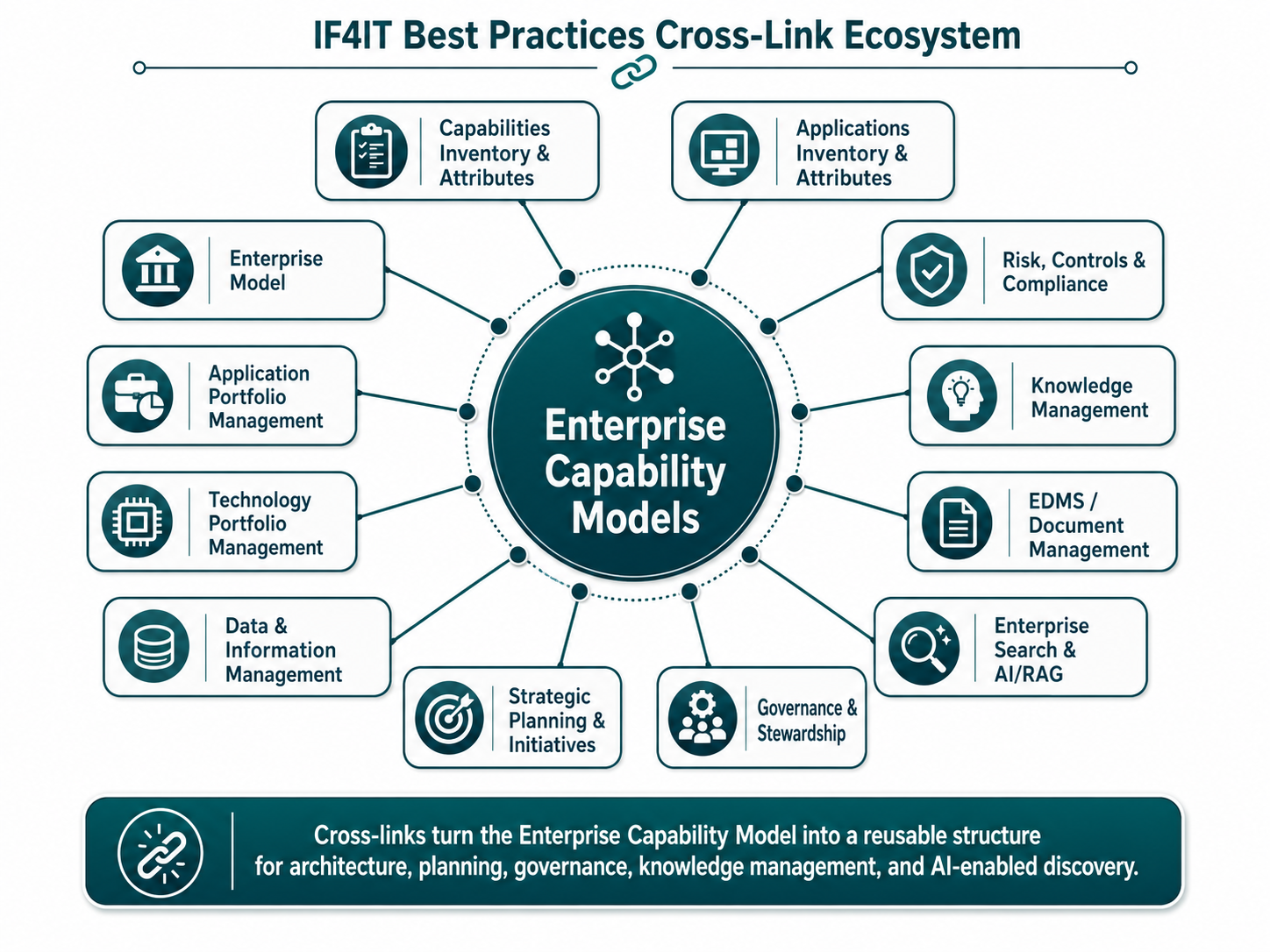
The related documents are located in the IF4IT Best Practices library at https://if4it.org/best-practices/. The published page should use canonical IF4IT links and alternate-name conventions so references such as APM, TPM, EM, Enterprise Model, Applications Inventory, and Capabilities Inventory can be consistently discovered and enriched across the site.
Benefit(s)
Cross-linking improves reader navigation, reinforces the ECM as part of an integrated enterprise-management discipline, and helps different audiences find the companion guidance they need. It also increases the value of the IF4IT site by turning individual documents into a navigable knowledge network rather than a collection of isolated pages.
Implementation Guidance
At minimum, link this document to the IF4IT Capabilities Inventory and Attributes document, Enterprise Model guidance, Application Portfolio Management guidance, Technology Portfolio Management guidance, and Enterprise Inventory Management guidance. Where inventory-specific documents exist or are planned, link to those documents as well so readers understand which governed inventories provide the data needed to enrich the ECM.
| Related IF4IT Document | Why the Link Is Important |
|---|---|
| Capabilities Inventory and Attributes | This is the direct companion specification for the capability records, attributes, metadata, and governance fields used to build and maintain the ECM. The ECM should not be treated as a diagram only; it should be grounded in governed capability inventory records. |
| Enterprise Model and Modeling Best Practices | The ECM is one connected Noun Type within the broader IF4IT Enterprise Model. Linking to Enterprise Model guidance helps readers understand how Capabilities relate to Applications, Value Streams, People/Roles, Organizations, Processes, Data, Risks, Controls, Initiatives, Vendors, Technologies, documents, and other Noun Types. |
| Application Portfolio Management (APM) Best Practices | APM depends on capability-to-application relationships to understand which applications enable, duplicate, under-support, over-support, or put specific capability areas at risk. This linkage supports rationalization, modernization, investment, and outage-impact analysis. |
| Technology Portfolio Management (TPM) Best Practices | TPM uses capability context to understand which technologies enable critical capabilities, where technical debt affects enterprise ability, and where modernization or risk reduction should be prioritized. |
| Enterprise Inventory Management Best Practices | A governed ECM depends on disciplined inventory management. Linking to Enterprise Inventory Management helps readers understand how capability data should be owned, governed, refreshed, validated, and connected to other inventories. |
| Applications Inventory and Attributes | Application records provide the governed application data needed to map applications to the capabilities they enable, support, duplicate, or place at risk. |
| Data and Information Inventory and Attributes | Data and information records help explain which information a capability consumes, produces, governs, protects, or depends on. This supports analytics, lineage, privacy, security, and knowledge sharing. |
| People, Roles, and Organization Inventory Guidance | People, role, and organization inventories support capability ownership, stewardship, support responsibility, SME identification, expertise discovery, and operating-model analysis. |
| Risks, Controls, and Compliance Guidance | Risk, control, and compliance guidance helps connect capability areas to obligations, control coverage, audit evidence, risk exposure, and regulatory sensitivity. |
| Knowledge Management, EDMS, and Enterprise Search Guidance | Where available or planned, these documents should be linked because ECMs can serve as taxonomies, metadata frameworks, semantic navigation structures, EDMS classification aids, search facets, and AI/RAG retrieval context. |
Best Practice: Align Enterprise Capability Models with Adjacent Enterprise Practices
Description
Enterprise Capability Models (ECMs) should be aligned with related enterprise practices so they can serve multiple audiences and not only architecture teams. The same capability data can support business architecture, capability-based planning, APM, TPM, enterprise architecture management, knowledge management, EDMS classification, enterprise search, AI/RAG, and executive decision support.
Benefit(s)
This alignment increases adoption because each discipline can see how the ECM helps answer its own questions. It also reduces duplication because the enterprise can reuse one governed capability structure across planning, architecture, portfolio management, knowledge sharing, document management, governance, and AI-assisted analysis.
| Related Practice | How the Enterprise Capability Model Supports It |
|---|---|
| Business Architecture | Provides the capability vocabulary, hierarchy, and relationships needed to analyze what the enterprise does and how capabilities contribute to value delivery. |
| Capability-Based Planning | Connects strategy, target-state design, investment, transition planning, and transformation roadmaps to the enterprise abilities that must be improved. |
| Enterprise Architecture Management | Provides a stable business-facing anchor for relating applications, technologies, data, processes, risks, controls, and initiatives to enterprise ability. |
| Application Portfolio Management | Connects applications to the capabilities they enable so teams can analyze support, redundancy, lifecycle risk, modernization needs, and outage impact. |
| Technology Portfolio Management | Connects technologies and platforms to the capabilities they enable or constrain, supporting technical debt, modernization, and investment decisions. |
| Knowledge Management | Uses the capability taxonomy, attributes, SMEs, semantic relationships, and knowledge pages to organize and share enterprise knowledge. |
| Enterprise Document Management | Uses capability names, paths, Semantic IDs, metadata, managed terms, and relationship data to improve folder/path design, tagging, virtual folders, retention context, and search. |
| Enterprise Search and AI/RAG | Uses capability metadata, semantic predicates, relationship attributes, documents, pages, and inventory records to improve retrieval, summarization, recommendations, and impact analysis. |
| Executive Management | Uses dashboards, heatmaps, health scores, maturity, strategic alignment, risk, investment priority, and transformation progress to manage enterprise capability improvement. |
Best Practice: Use IF4IT Cross-Links to Improve Navigation and Reuse
Description
The published document should use IF4IT cross-links deliberately. When readers encounter Application Portfolio Management, Technology Portfolio Management, Enterprise Model, Capabilities Inventory, Applications Inventory, or Enterprise Inventory Management references, the site should help them navigate to the corresponding IF4IT best-practices or inventory documents.
Cross-linking should use canonical IF4IT URLs, approved document names, and document short names or alternate names where available. This is especially important because different practitioners may refer to the same discipline using acronyms, formal names, or informal names, such as APM, Application Portfolio Management, APM document, Enterprise Model, EM, or Enterprise Model and Modeling Best Practices.
Benefit(s)
Cross-links improve knowledge discovery, reduce reader confusion, and reinforce the reusable structure of the IF4IT knowledge base. They also help AI agents, search indexes, and link-enrichment processes understand which documents are semantically related and which terms should resolve to authoritative IF4IT pages.
Implementation Guidance
During publication preparation, review the final document for references to related IF4IT disciplines and inventories. Add links where the reference helps a reader move to deeper guidance. Avoid over-linking repeated terms in the same section, but make sure that each major discipline and companion document is linked at least once in a meaningful context.
How to cite this page
When referencing this page in academic work, internal standards, or external publications, include the page title, IF4IT as author and publisher (The International Foundation for Information Technology (IF4IT), LLC), the URL, and your access date.
Example (informal web citation):
The International Foundation for Information Technology (IF4IT), LLC. Align Enterprise Capability Models with Related IF4IT Best Practices | Designing, Building, and Maintaining Comprehensive and Usable Enterprise Capability Models. https://if4it.org/best-practices/designing-building-and-maintaining-comprehensive-and-usable-enterprise-capability-models/align-enterprise-capability-models-with-related-if4it-best-practices/ (accessed 2026-10-05).
See About Us for content governance and site-wide citation guidance.
Copyright for The International Foundation for Information Technology (IF4IT), LLC: 2008 - Present
Legal Disclaimers