Connect Capabilities to the Enterprise Model - Designing, Building, and Maintaining Comprehensive and Usable Enterprise Capability Models
Connect Capabilities to the Enterprise Model
(Chapter 15 of Designing, Building, and Maintaining Comprehensive and Usable Enterprise Capability Models)
Executive Summary: Chapter Overview
IF4ITThe Bottom Line
Core Concepts
| Concept | Definition & Strategic Role |
|---|---|
| Semantic Relationships | Meaningful predicates explain how capabilities relate to applications, processes, data, value chains, organizations, people, risks, controls, initiatives, and documents. |
| Relationship Attributes | Source, confidence, status, owner, criticality, effective dates, and evidence qualify each relationship. |
| Cross-Domain Analysis | Connected records allow questions and impacts to be traced across multiple enterprise domains. |
Quick Q&A
Question: Why are semantic relationships essential to an Enterprise Capability Model?
Read More Below
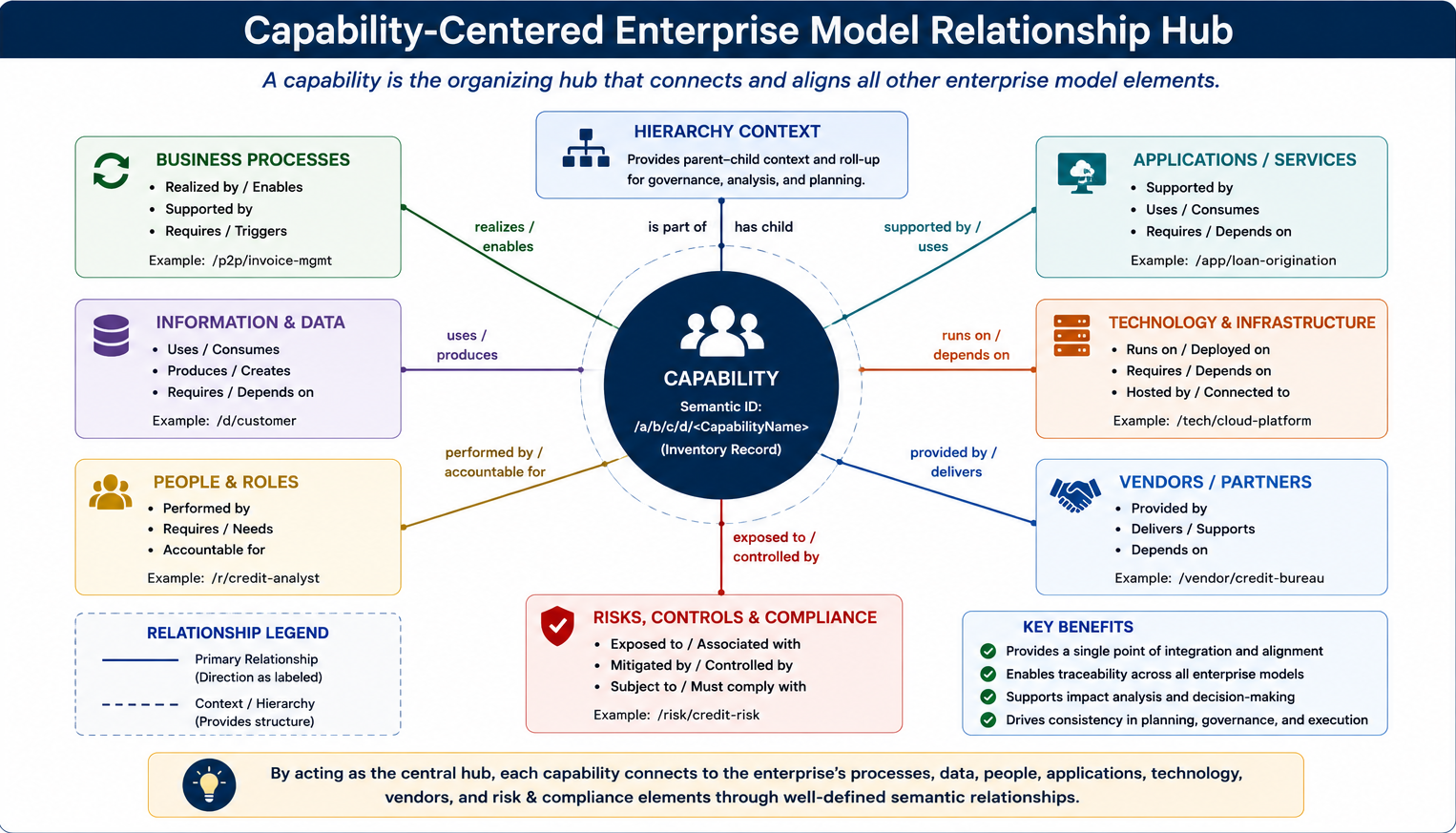
Capabilities are most valuable when they are connected to the broader Enterprise Model. An Enterprise Capability Model (ECM) that is isolated from Applications, Value Chains, Organizations, Processes, Data, Risks, Controls, and Initiatives is useful as a taxonomy, but it is limited as an enterprise analysis and decision-support tool. The more meaningful connections there are, the more powerful the model itself becomes as an Enterprise Knowledge Management (EKM) tool.
Best Practice: Treat Capabilities as Highly Connected Enterprise Noun Types
Description
Capabilities should be modeled as highly connected enterprise Noun Types. Each capability should be capable of linking to the Applications that enable it, the Value Chain Stages it supports, the Organizations that own or perform it, the Processes that realize it, the Data and Information it consumes or produces, and the Risks, Controls, Metrics, Initiatives, Vendors, Technologies, and Regulatory Obligations that affect it.
These relationships do not all need to be populated at the same time. However, the model design should anticipate them so that capability records can become relationship hubs as the Enterprise Model matures.
Benefit(s)
Highly connected capability records support impact analysis, strategic planning, portfolio rationalization, technology modernization, operating model design, risk analysis, compliance review, generated knowledge pages, and AI-assisted model traversal.
When capabilities are connected to the rest of the Enterprise Model, stakeholders can answer practical questions such as which applications support a capability, which capabilities are affected by a retiring technology, which value chain stages depend on weak capabilities, or which regulated capabilities lack sufficient controls.
Implementation Guidance
Prioritize relationships based on use case. APM teams may start with Application-to-Capability mappings. Business architects may start with Capability-to-Value-Chain relationships. Risk and compliance teams may prioritize Regulatory Obligations, Risks, and Controls. The model should support all of these paths without requiring all relationships to be complete on day one.
Best Practice: Use a Semantic Metamodel to Clarify Capability Relationships
Description
An Enterprise Capability Model (ECM) should make clear that capability relationships are not merely informal links. A relationship connects a governed Capability Inventory record to another Enterprise Model Noun Type instance and should explain the nature of the connection using a semantic predicate. When the ECM is used for wiki pages, intranet pages, EDMS metadata, dashboards, search, and AI-enabled retrieval, this semantic metamodel helps people and systems interpret how capabilities relate to the rest of the enterprise.
The following metamodel elements should be understood and used consistently when capabilities are connected to other enterprise knowledge assets.
| Metamodel Element | Meaning |
|---|---|
| Capability | The enterprise ability being modeled, assessed, governed, related, and published. |
| Capability Inventory Record | The governed record that represents one branch or leaf capability node and stores its authoritative attributes. |
| Attribute | A named data element that describes a capability, such as description, owner, health, maturity, investment priority, lifecycle status, or review cadence. |
| Semantic ID | The durable identifier used to reference the capability across inventories, pages, dashboards, documents, applications, analytics, and AI-enabled tools. |
| Relationship | A governed connection between a capability and another Enterprise Model Noun Type instance. |
| Semantic Predicate | The descriptive phrase that explains the relationship, such as “is enabled by,” “is owned by,” “is realized by,” “is governed by,” or “is improved by.” |
| Relationship Attribute | Metadata that describes the relationship itself, such as source, confidence, owner, effective date, review date, status, and evidence. |
| Related Noun Type | The class of related entity, such as Application, Value Stream, Process, Data, Risk, Control, Person/Role, Organization, Initiative, Vendor, or Technology. |
| Knowledge Page | The published intranet or wiki representation of a capability inventory record and its related enterprise context. |
| EDMS Metadata Tag | A document classification value derived from capability data, such as related capability, capability owner, SME, risk, control, or parent capability. |
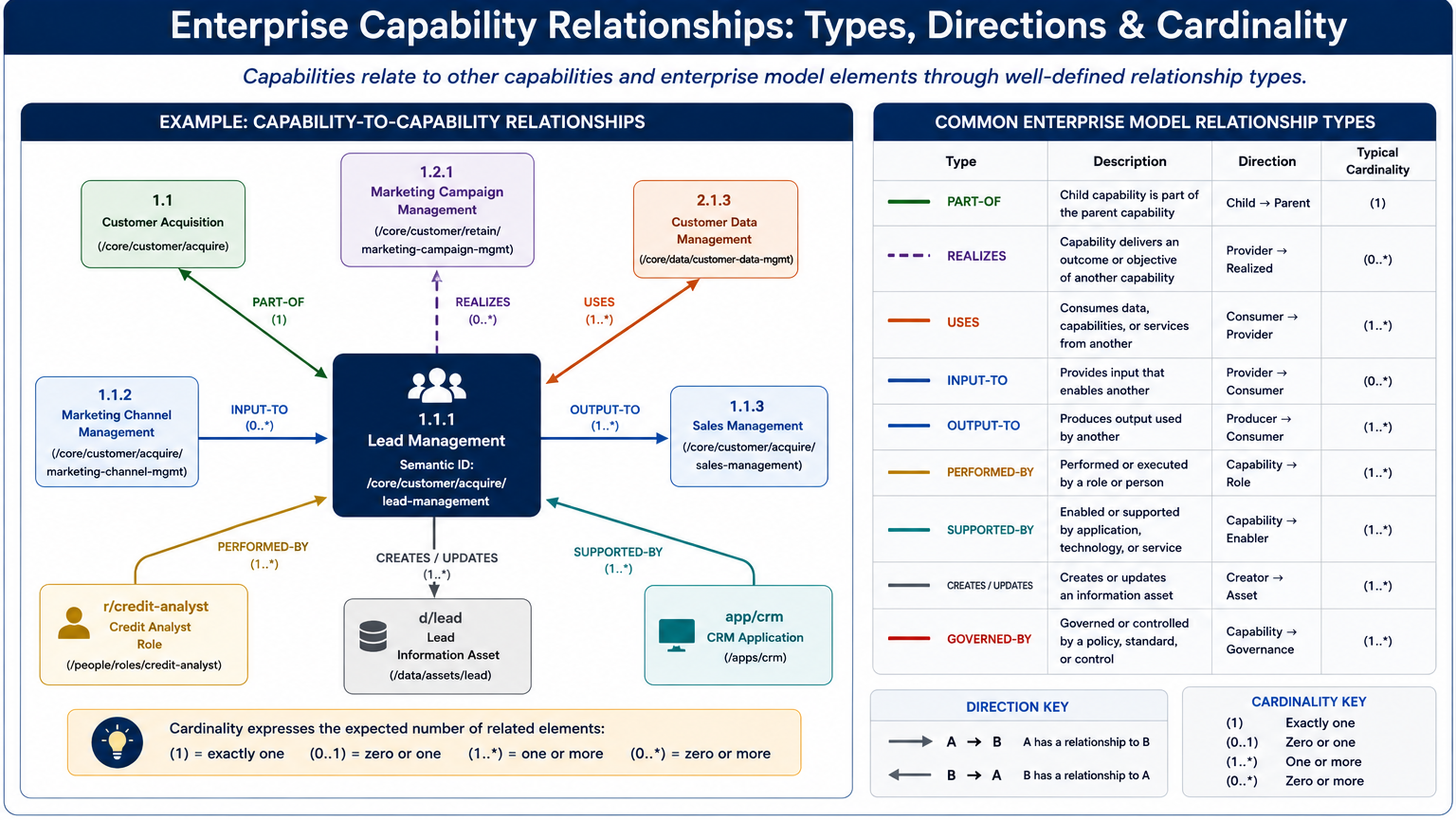
Important Note for Modelers: Describing this semantic metamodel in Natural Language as part of an Ontology for AI is far easier than describing and diagramming it in a drawing tool, and then expecting others maintain consistent drawing models. Used correctly, AI tools make it easier to both describe and conform to such a model.
Benefit(s)
A clear semantic metamodel improves consistency, governance, traceability, search quality, AI retrieval quality, impact analysis, and knowledge sharing. It also helps prevent capability relationships from becoming ambiguous hyperlinks that do not explain why two things are connected.
Best Practice: Map Applications to the Capabilities They Enable
Description
Applications should be mapped to the capabilities they support, automate, or enable. This mapping should distinguish between primary support, secondary support, partial support, redundant support, and unsupported capability areas where that distinction is useful.
Application-to-capability mapping should also recognize that one application may support many capabilities and one capability may be supported by many applications. The relationship should be governed carefully because it becomes a primary input into application portfolio analysis and modernization planning.
Benefit(s)
This practice supports application portfolio management, rationalization, redundancy analysis, modernization planning, single-point-of-failure analysis, investment prioritization, and business impact analysis.
It also helps business stakeholders understand how technology supports the capabilities they depend on, and it helps IT leaders identify capabilities that are over-supported, under-supported, or supported by aging or risky applications.
Best Practice: Map Capabilities to the Value Chain Stages They Enable
Description
Capabilities should be mapped to the Value Chain Stages or Value Chains they enable. A value chain shows how the enterprise delivers value, while capabilities describe the abilities that must exist for that value delivery to occur. Connecting the two makes the model useful for business architecture and transformation analysis.
The mapping should show where capabilities contribute to customer, member, patient, partner, employee, or operational value. It may also show whether the capability is foundational, differentiating, regulatory, enabling, or supporting in a specific value chain context.
Benefit(s)
Capability-to-value-chain mapping helps leaders and architects understand which capabilities matter most to value delivery. It supports strategy execution, product and journey analysis, transformation planning, target-state design, and prioritization of capability improvements.
This practice also prevents the Enterprise Capability Model (ECM) from becoming too abstract. It shows how capabilities participate in the real delivery of enterprise value.
Best Practice: Map Capabilities to Ownership, Processes, Data, Risks, Controls, and Initiatives
Description
Capability records should link to the owners that are accountable for them, the processes that operationalize them, the data they consume and produce, the risks that affect them, the controls that protect or govern them, and the initiatives that improve them. These relationships should be treated as governed model facts, not informal notes buried in documents.
Not every relationship needs the same governance rigor. A regulatory obligation relationship may require stronger evidence and approval than an exploratory relationship inferred by AI. The model should allow relationship status, source, confidence, and validation state to be tracked where useful.
Benefit(s)
This practice turns the capability into a practical hub for analysis and governance. It enables cross-functional questions about accountability, process realization, data dependency, risk exposure, control coverage, and transformation work.
It also improves knowledge sharing because users can navigate from a capability to the related enterprise assets, obligations, and improvement efforts that matter to their work.
Best Practice: Capture Relationship Attributes to Explain and Govern Connections
Description
An Enterprise Capability Model (ECM) should capture relationship attributes where the relationship itself requires governance, traceability, or interpretation. For example, knowing that an Application is linked to a Capability is useful, but knowing whether the Application enables, automates, exposes, reports on, or merely references the Capability is more useful. Relationship attributes help explain the strength, source, status, timing, and evidence behind the connection.
| Relationship Attribute | Purpose |
|---|---|
| Relationship Type / Semantic Predicate | Explains the meaning of the relationship, such as “is enabled by,” “consumes,” “produces,” “is governed by,” or “is improved by.” |
| Source | Identifies where the relationship came from, such as a workshop, system inventory, architecture review, AI suggestion, or owner confirmation. |
| Confidence / Validation Status | Shows whether the relationship is proposed, AI-suggested, pending review, validated, approved, rejected, or retired. |
| Relationship Owner | Identifies who is accountable for validating or maintaining the relationship. |
| Effective Date | Shows when the relationship became valid or operationally meaningful. |
| Last Reviewed Date | Shows when the relationship was last checked for accuracy. |
| Review Cadence | Defines how often the relationship should be reviewed. |
| Evidence / Reference | Points to supporting documentation, diagrams, tickets, inventories, architecture decisions, policies, or review notes. |
Benefit(s)
Relationship attributes make the ECM more trustworthy and more useful for impact analysis, application rationalization, EDMS tagging, semantic navigation, AI retrieval, risk analysis, auditability, and knowledge publishing. They help users understand not only that two Noun Type instances are related, but how reliable the relationship is and why it matters.
How to cite this page
When referencing this page in academic work, internal standards, or external publications, include the page title, IF4IT as author and publisher (The International Foundation for Information Technology (IF4IT), LLC), the URL, and your access date.
Example (informal web citation):
The International Foundation for Information Technology (IF4IT), LLC. Connect Capabilities to the Enterprise Model | Designing, Building, and Maintaining Comprehensive and Usable Enterprise Capability Models. https://if4it.org/best-practices/designing-building-and-maintaining-comprehensive-and-usable-enterprise-capability-models/connect-capabilities-to-the-enterprise-model/ (accessed 2026-10-05).
See About Us for content governance and site-wide citation guidance.
Copyright for The International Foundation for Information Technology (IF4IT), LLC: 2008 - Present
Legal Disclaimers