Define the Scope of a Comprehensive Enterprise Capability Model - Designing, Building, and Maintaining Comprehensive and Usable Enterprise Capability Models
Define the Scope of a Comprehensive Enterprise Capability Model
(Chapter 10 of Designing, Building, and Maintaining Comprehensive and Usable Enterprise Capability Models)
Executive Summary: Chapter Overview
IF4ITThe Bottom Line
Core Concepts
| Concept | Definition & Strategic Role |
|---|---|
| Industry-Specific Capabilities | These describe abilities required by the enterprise’s industry, regulatory environment, market, and customer context. |
| Core Business Capabilities | These represent common cross-enterprise abilities such as finance, legal, procurement, human capital, sales, marketing, and customer management. |
| Information Technology Capabilities | These describe the abilities needed to acquire, build, integrate, operate, secure, support, and govern technology. |
Quick Q&A
Question: What three capability areas should a comprehensive Enterprise Capability Model normally include?
Read More Below
Best Practice: Include Industry-Specific, Core Business, and IT Capabilities
Description
A comprehensive Enterprise Capability Model (ECM) should include 1) industry-specific capabilities, 2) core business capabilities, and 3) Information Technology capabilities. Industry-specific capabilities describe the abilities that make the enterprise recognizable as a particular type of organization. Core business capabilities describe common enterprise functions such as Finance, Human Capital Management, Legal, Procurement, Risk, Compliance, Sales, Marketing, and Customer Management. IT capabilities describe the abilities required to acquire, build, integrate, operate, secure, support, and govern technology.
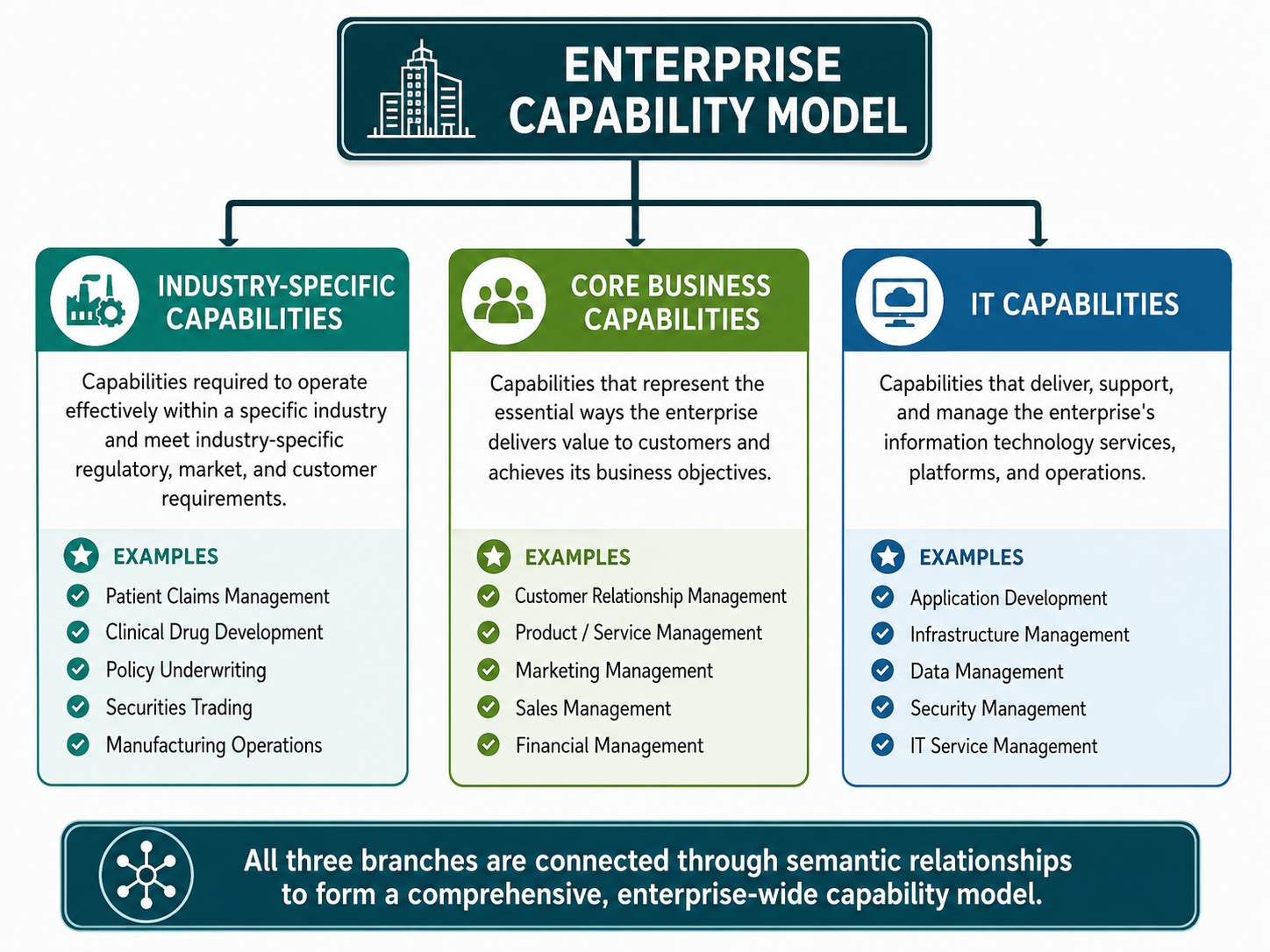
This three-branch structure should be treated as a practical starting scope. It helps modelers avoid building a narrow capability map that only describes a business domain, only describes administrative support functions, or only describes technology management activities. The enterprise can then decompose each branch into lower-level capabilities that reflect the organization, industry, and intended analytical use cases.
Benefit(s)
Including industry-specific, core business, and IT capabilities produces a more complete and balanced model. It allows leaders and architects to analyze the enterprise as a whole rather than as isolated functional fragments.
This structure also supports more reliable cross-domain analysis. Application portfolios, technology portfolios, operating models, value chains, risks, regulatory obligations, data assets, initiatives, and investments can be mapped against an ECM that reflects the full enterprise rather than only one management viewpoint.
Best Practice: Adapt the Top-Level Structure to the Enterprise
Description
The recommended top-level structure is a strong default, not a rigid mandate. Enterprises should adapt the structure when the nature of the organization requires it. For example, a public-sector organization may need branches that reflect public-service missions, regulatory authorities, or citizen-service domains. A diversified holding company may need industry-specific capability branches for multiple business lines. A technology company may need to expose more product, platform, engineering, and operations capabilities at higher levels.
Adaptation should be deliberate and governed. The goal is not to mirror the current organization chart or political ownership structure. The goal is to produce a stable, understandable ECM that supports analysis, planning, governance, knowledge management, and communication.
Benefit(s)
Adapting the structure allows the model to fit the enterprise without losing discipline. It gives stakeholders a model that feels relevant while preserving a consistent capability-modeling logic.
This also improves adoption. People are more likely to use a model when its top-level structure reflects how the enterprise creates value, delivers services, manages shared functions, and operates technology.
Best Practice: Provide Examples Across Capability Categories
Description
Capability models become easier to understand when readers can see practical examples across the three major capability categories. Industry-specific examples show capabilities that make an enterprise recognizable as a particular type of organization. Core business examples show shared capabilities that appear in most enterprises. IT examples show that technology management capabilities are first-class enterprise capabilities, not merely supporting activities.
The following table provides representative examples. The names are illustrative starting points that should be adapted to the enterprise, its industry, its vocabulary, and its governance needs.
| Capability Category | Example Domain or Industry | Example Capabilities |
|---|---|---|
| Industry-Specific Capabilities | Healthcare Payer / Health Insurance | Claims Management; Provider Network Management; Member Enrollment; Care Management; Prior Authorization Management; Premium Billing |
| Industry-Specific Capabilities | Life Sciences / Pharma | Clinical Trial Management; Regulatory Submission Management; Pharmacovigilance; Adverse Event Management; Drug Safety Monitoring; Medical Affairs |
| Industry-Specific Capabilities | Financial Services | Investment Management; Trade Execution; Portfolio Accounting; Risk Modeling; Investor Reporting; Regulatory Reporting |
| Industry-Specific Capabilities | Manufacturing | Production Planning; Shop Floor Execution; Quality Management; Maintenance Management; Materials Management; Supply Chain Planning |
| Core Business Capabilities | Cross-Enterprise | Finance Management; Human Capital Management; Legal Management; Procurement Management; Sales Management; Marketing Management; Customer Management |
| IT Capabilities | Cross-Enterprise Technology | Application Portfolio Management; Technology Portfolio Management; Identity and Access Management; Cybersecurity Management; Infrastructure Management; Integration Management; Data Management; IT Service Management |
Benefit(s)
Providing examples helps readers understand how the ECM can cover industry-specific, cross-enterprise business, and IT capability areas using a common modeling pattern. It also helps modelers test whether the taxonomy is too narrow, too generic, too IT-centric, or too disconnected from the enterprise’s operating reality.
How to cite this page
When referencing this page in academic work, internal standards, or external publications, include the page title, IF4IT as author and publisher (The International Foundation for Information Technology (IF4IT), LLC), the URL, and your access date.
Example (informal web citation):
The International Foundation for Information Technology (IF4IT), LLC. Define the Scope of a Comprehensive Enterprise Capability Model | Designing, Building, and Maintaining Comprehensive and Usable Enterprise Capability Models. https://if4it.org/best-practices/designing-building-and-maintaining-comprehensive-and-usable-enterprise-capability-models/define-the-scope-of-a-comprehensive-enterprise-capability-model/ (accessed 2026-10-05).
See About Us for content governance and site-wide citation guidance.
Copyright for The International Foundation for Information Technology (IF4IT), LLC: 2008 - Present
Legal Disclaimers