Govern, Own, and Continuously Improve the Enterprise Capability Model - Designing, Building, and Maintaining Comprehensive and Usable Enterprise Capability Models
Govern, Own, and Continuously Improve the Enterprise Capability Model
(Chapter 26 of Designing, Building, and Maintaining Comprehensive and Usable Enterprise Capability Models)
Executive Summary: Chapter Overview
IF4ITThe Bottom Line
Core Concepts
| Concept | Definition & Strategic Role |
|---|---|
| Model Accountability | A named owner and governance body are accountable for scope, standards, quality, priorities, and authoritative status. |
| Distributed Stewardship | Domain stewards and capability owners maintain definitions, attributes, assessments, relationships, and evidence. |
| Controlled Evolution | Requests to add, rename, merge, split, move, or retire capabilities follow transparent governance and impact review. |
Quick Q&A
Question: What governance is required to keep an Enterprise Capability Model authoritative?
Read More Below
Best Practice: Assign Clear Ownership
Description
The enterprise should assign clear ownership for the Enterprise Capability Model (ECM) and for the individual capabilities it contains. At a minimum, ownership should distinguish between the person or team accountable for the overall model, the people accountable for major capability domains, the people accountable for specific capability records, and the stewards responsible for maintaining data quality, relationships, and review status.
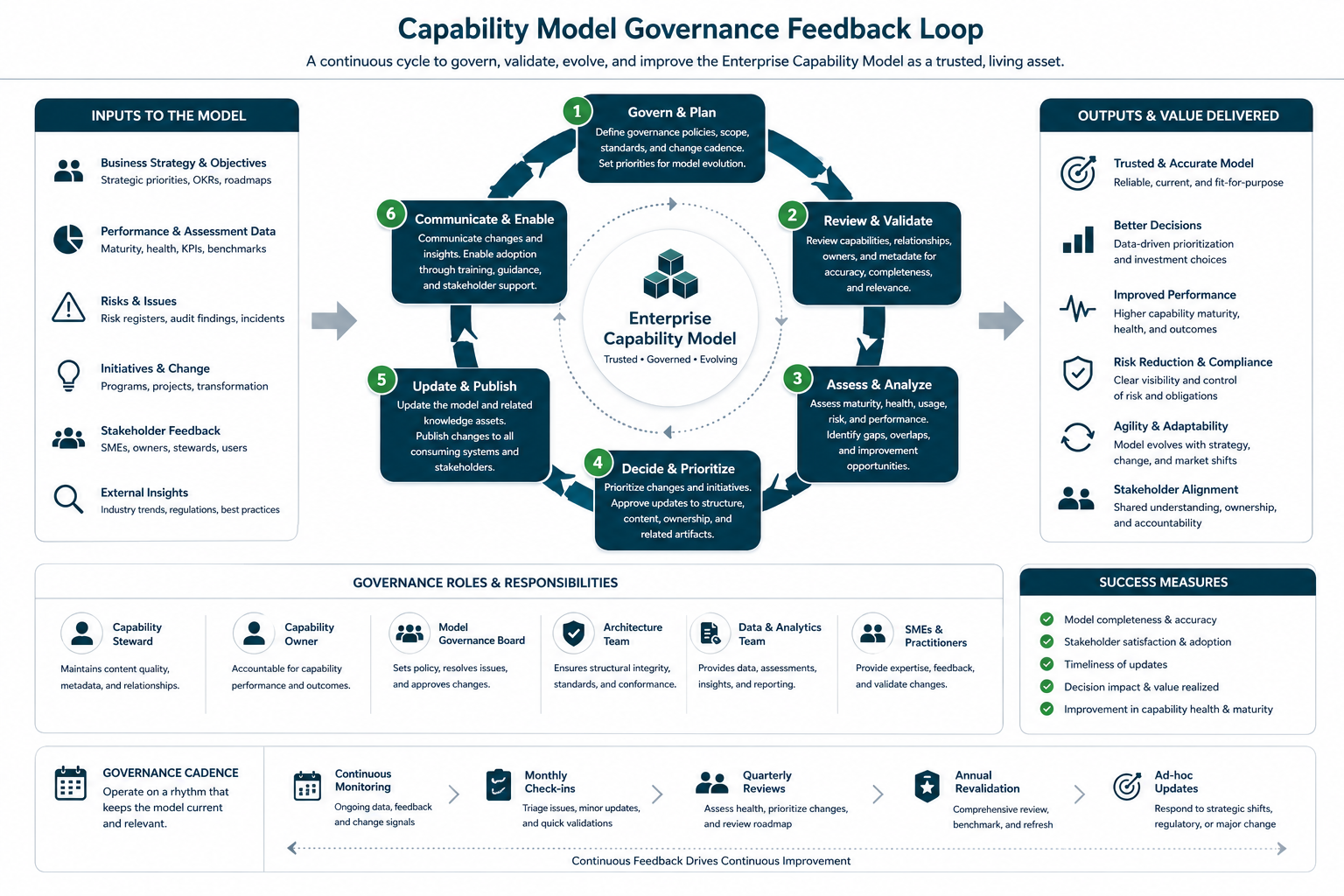
Recommended roles include an ECM Owner, Capability Domain Owners, Capability Owners, Capability Stewards, and a governance body or forum that can resolve cross-domain conflicts. The same person may hold more than one role in a small enterprise, but the accountabilities should still be explicit.
Benefit(s)
Clear ownership establishes accountability for model quality, currency, review, adoption, and improvement. Without named ownership, the ECM is likely to become a static artifact that is trusted less over time.
This practice also helps stakeholders know where to route questions, corrections, disputes, enhancement requests, and approval decisions. It reduces ambiguity when capabilities need to be renamed, moved, retired, assessed, or connected to other Enterprise Model Noun Types.
Best Practice: Define a Model Owner or Controller for the Enterprise Capability Model
Description
The enterprise should define a model owner or model controller for the Enterprise Capability Model (ECM). This role is accountable for the integrity of the model as a whole, including hierarchy structure, naming standards, Semantic ID conventions, level-depth decisions, AI-generated content approval, publication readiness, and governed customization.
The model owner or controller does not need to personally maintain every capability record. Instead, this role coordinates with capability domain owners, capability owners, stewards, SMEs, Knowledge Management owners, EDMS owners, AI reviewers, and governance bodies to ensure the model remains coherent, trusted, and fit for enterprise use.
Benefit(s)
Defining a model owner or controller clarifies who has final decision authority when AI-generated content, stakeholder feedback, hierarchy changes, naming disputes, depth questions, or publication issues arise. It also ensures that the ECM can be customized and improved without losing consistency, traceability, or governance discipline.
Implementation Guidance
Assign the model owner or controller early, preferably before large-scale AI-assisted model generation begins. Give the role authority to approve modeling standards, govern major structural changes, decide when the model is ready to publish, and coordinate recurring reviews with owners, stewards, SMEs, and governance forums.
Best Practice: Use a Governance Responsibility Matrix
Description
An Enterprise Capability Model (ECM) should have a clear governance responsibility matrix so users understand who owns the model, who controls the structure, who maintains records, who validates content, who provides expertise, and who approves major changes. The matrix should distinguish the model owner from the model controller, capability owners, stewards, SMEs, AI reviewers, Knowledge Management owners, EDMS owners, and governance bodies.
| Role | Primary Responsibility |
|---|---|
| Enterprise Capability Model Owner | Accountable for overall ECM quality, scope, adoption, governance maturity, business value, and alignment to enterprise needs. |
| Model Controller | Controls model structure, naming standards, hierarchy depth rules, Semantic ID rules, change discipline, publication readiness, and approved customization. |
| Capability Domain Owner | Owns a major capability branch or domain and resolves domain-level scope, naming, maturity, and priority issues. |
| Capability Owner | Accountable for the performance, maturity, health, strategic direction, and improvement of a specific capability. |
| Capability Steward | Maintains the capability record, attributes, relationships, review status, page content, and data quality. |
| Subject Matter Expert (SME) | Provides practical domain knowledge about how the capability works, which processes and systems enable it, and where deeper expertise exists. |
| Knowledge Management Owner | Ensures ECM content supports knowledge sharing, onboarding, learning, semantic navigation, search, and content reuse. |
| EDMS Owner | Ensures capability taxonomy, folder/path guidance, managed terms, metadata, tags, and search facets support document classification and retrieval. |
| AI Reviewer | Reviews AI-generated or AI-suggested model content, attributes, relationships, and quality recommendations before promotion. |
| Governance Body | Resolves conflicts, approves major changes, enforces model policies, and ensures the ECM remains trusted and useful. |
Benefit(s)
A governance responsibility matrix makes the ECM more implementable. It reduces ambiguity, accelerates review, clarifies decision rights, improves data quality, supports Human-in-the-Loop governance, and helps prevent uncontrolled changes to hierarchy, naming, attributes, relationships, and published knowledge pages.
The model owner or model controller should also maintain explicit decision rights for naming conventions, hierarchy design rules, depth exceptions, Semantic ID assignment, relationship approval, AI-suggested content promotion, and publication readiness. This role does not need to perform every maintenance task directly, but it must ensure that the Enterprise Capability Model (ECM) remains coherent, governed, trusted, and aligned to enterprise needs.
Best Practice: Govern Model Changes
Description
Changes to the ECM should be governed, especially when they affect capability identity, hierarchy position, meaning, ownership, relationships, or published knowledge pages. Common governed changes include adding a capability, renaming a capability, moving a capability, splitting a capability, merging capabilities, specializing a capability, deprecating a capability, retiring a capability, or archiving historical records.
The governance process does not need to be heavyweight, but it should be explicit. It should define who can propose a change, what information must accompany the request, who reviews the change, who approves it, how downstream relationships are handled, and how the change is communicated to model users.
Benefit(s)
Governed model changes prevent uncontrolled drift. They help ensure that the hierarchy remains coherent, Semantic IDs remain durable, relationships remain valid, and published knowledge pages do not become inconsistent with the source model.
This practice also protects downstream users. Architects, portfolio teams, risk teams, application owners, employees, consultants, and AI agents all depend on stable model structure. Change governance reduces disruption and preserves trust.
Best Practice: Govern Attribute and Relationship Quality
Description
Capability descriptions, ownership fields, maturity values, health values, strategic dispositions, governance metadata, and Enterprise Model relationships should be reviewed and maintained as governed data. The quality of the model depends not only on the hierarchy but also on the accuracy and completeness of the attributes and relationships that make each capability useful.
Relationship quality is especially important because capabilities act as hubs that connect to Applications, Value Chain Stages, Organizations, Processes, Data, Risks, Controls, Initiatives, Vendors, Technologies, Regulatory Obligations, and other Noun Types. Each relationship should have an appropriate source, owner, confidence level, review cadence, or approval status where the enterprise requires traceability.
Benefit(s)
Governing attribute and relationship quality prevents the model from becoming stale or misleading. A capability with a weak description, missing owner, inaccurate health score, or outdated application mapping can cause poor analysis and poor decisions.
This practice also improves AI-assisted use. AI agents can search, traverse, summarize, and infer more reliably when the underlying attributes and relationships are accurate, current, and traceable.
Best Practice: Use Iterative Evaluation and Improvement
Description
The ECM should be evaluated and improved iteratively. Feedback should be captured from capability owners, architects, application owners, portfolio managers, business stakeholders, operations teams, risk and compliance teams, employees, consultants, and AI-assisted quality checks.
Improvement candidates may include missing capabilities, duplicate capabilities, unclear definitions, weak names, poor aliases, incorrect hierarchy placement, missing owners, incomplete attributes, stale assessments, weak relationships, unclear knowledge pages, or confusing stakeholder views. These candidates should be reviewed and either accepted, rejected, deferred, or converted into governed improvement backlog items.
Benefit(s)
Iterative improvement keeps the ECM current, useful, trusted, and aligned with the changing enterprise. It acknowledges that the first version of the model will not be perfect and that practical value comes from disciplined refinement over time.
This practice also helps maintain adoption. Users are more likely to rely on the model when they see that feedback is acted on and that the model improves as the enterprise learns.
How to cite this page
When referencing this page in academic work, internal standards, or external publications, include the page title, IF4IT as author and publisher (The International Foundation for Information Technology (IF4IT), LLC), the URL, and your access date.
Example (informal web citation):
The International Foundation for Information Technology (IF4IT), LLC. Govern, Own, and Continuously Improve the Enterprise Capability Model | Designing, Building, and Maintaining Comprehensive and Usable Enterprise Capability Models. https://if4it.org/best-practices/designing-building-and-maintaining-comprehensive-and-usable-enterprise-capability-models/govern-own-and-continuously-improve-the-enterprise-capability-model/ (accessed 2026-10-05).
See About Us for content governance and site-wide citation guidance.
Copyright for The International Foundation for Information Technology (IF4IT), LLC: 2008 - Present
Legal Disclaimers