Implement the Enterprise Capability Model Using a Crawl / Walk / Run Roadmap - Designing, Building, and Maintaining Comprehensive and Usable Enterprise Capability Models
Implement the Enterprise Capability Model Using a Crawl / Walk / Run Roadmap
(Chapter 29 of Designing, Building, and Maintaining Comprehensive and Usable Enterprise Capability Models)
Executive Summary: Chapter Overview
IF4ITThe Bottom Line
Core Concepts
| Concept | Definition & Strategic Role |
|---|---|
| Crawl | Establish scope, initial hierarchy, Semantic IDs, core records, ownership, basic validation, and priority use cases. |
| Walk | Expand attributes, relationships, assessments, pages, dashboards, stakeholder views, integrations, and governance coverage. |
| Run | Operate a continuously refreshed, widely adopted, AI-assisted capability knowledge ecosystem embedded in planning and management workflows. |
Quick Q&A
Question: Why should Enterprise Capability Model implementation use a staged roadmap?
Read More Below
Best Practice: Start with a Thin but Complete Crawl Model
Description
Begin with a thin but complete Crawl model that covers the full intended scope of the Enterprise Capability Model (ECM). The Crawl model should include the top-level capability structure, an initial Level 0 through Level 4 hierarchy where useful, one governed record for each known branch and leaf capability, stable Semantic IDs, plain-language descriptions, candidate owners or steward placeholders, basic lifecycle status, and basic provenance.
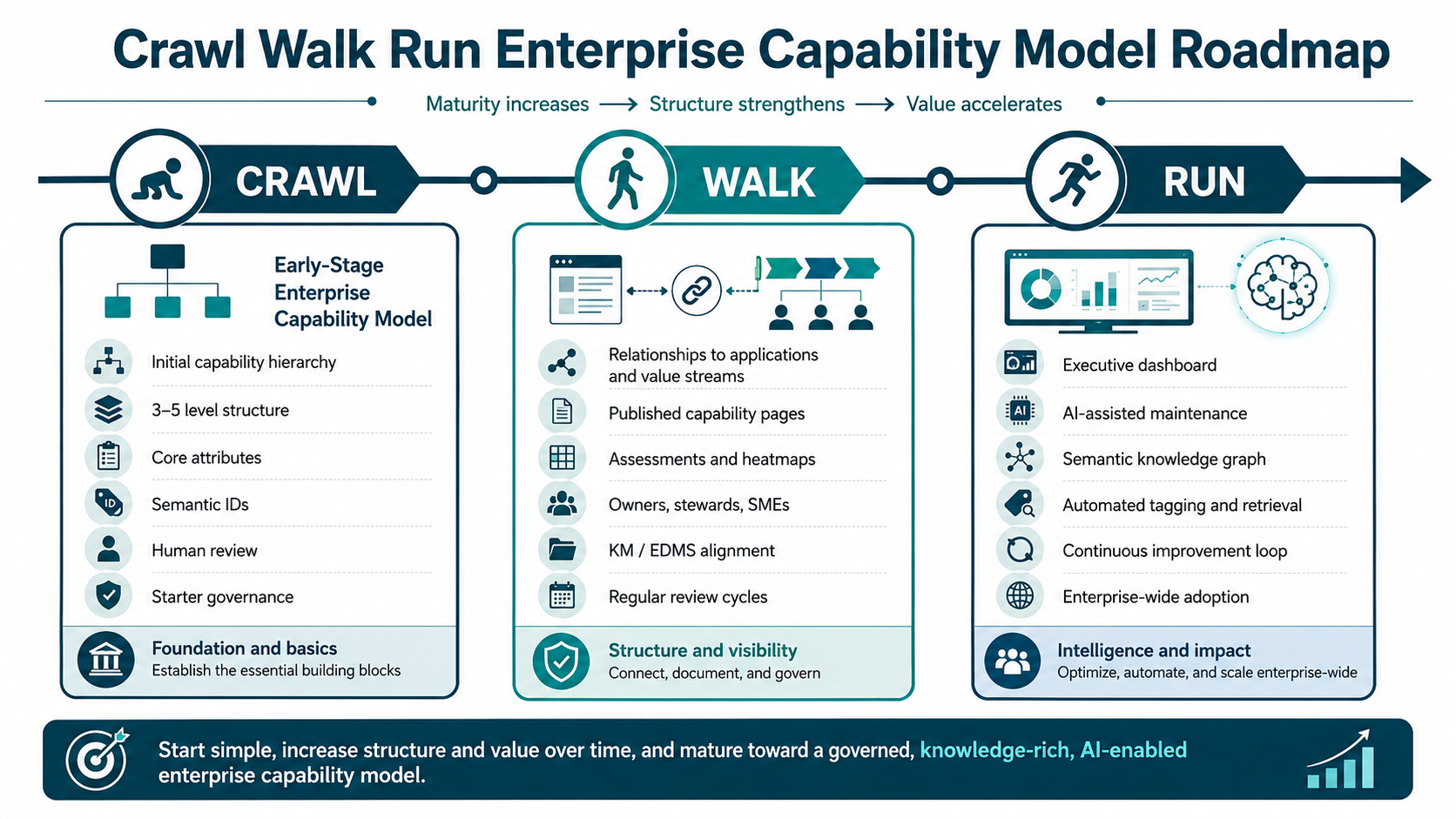
The goal of Crawl maturity is not to perfect every attribute or relationship. The goal is to establish a complete enough governed foundation that the enterprise can see the model, review it, correct it, and begin using it for navigation, discussion, early planning, and incremental enrichment.
Benefit(s)
A thin but complete Crawl model creates enterprise visibility quickly without waiting for every data element to be perfect. It gives stakeholders a shared starting point, reduces blank-page debate, and allows model quality to improve through structured review rather than endless pre-work.
This approach also prevents teams from spending too much time perfecting one domain while leaving the rest of the enterprise unmapped. A complete first pass is usually more valuable than a deep but partial model.
Best Practice: Add Relationships, Assessments, and Views at Walk Maturity
Description
At Walk maturity, enrich the Crawl model with stronger relationships, more complete attributes, and stakeholder-facing views. This includes mapping capabilities to Applications, Value Chain Stages, Organizations, Processes, Data and Information Types, Risks, Controls, Initiatives, Vendors, Metrics, and Regulatory Obligations where those relationships are known or can be validated.
Walk maturity should also introduce capability assessments, maturity ratings, health indicators, gap analysis, investment priority, strategic importance, capability heatmaps, and generated knowledge pages. Governance should become more formal, with named stewards, review cadence, change-control patterns, and quality checks.
Benefit(s)
Adding relationships and assessments turns the model from a taxonomy into an analytical Enterprise Model asset. Stakeholders can begin using it for impact analysis, portfolio rationalization, investment prioritization, operating-model discussion, transformation planning, risk review, and knowledge sharing.
Walk maturity also creates the foundation for repeatable views and dashboards, because capability data is no longer isolated from the rest of the enterprise context.
Best Practice: Automate and Operationalize at Run Maturity
Description
At Run maturity, the ECM should be operationalized as a maintained, governed, integrated, and increasingly automated enterprise asset. The model should be stored in a controlled repository, integrated with related inventories, supported by governance workflows, and made available through dashboards, generated pages, APIs, search, and AI-assisted runtime access.
Automation may include scheduled data-quality checks, relationship inference, AI-assisted duplicate detection, generated page refreshes, model-change workflows, automated review reminders, evidence collection, assessment refresh support, and reporting on model completeness, freshness, relationship coverage, and adoption.
Benefit(s)
Operationalizing the model makes it scalable and sustainable. The model becomes part of the enterprise management system rather than a static architecture artifact.
Run maturity improves trust, reduces manual maintenance effort, supports continuous improvement, enables AI-assisted analysis, and makes capability knowledge available to a broader population of employees, consultants, leaders, architects, owners, and governance teams.
How to cite this page
When referencing this page in academic work, internal standards, or external publications, include the page title, IF4IT as author and publisher (The International Foundation for Information Technology (IF4IT), LLC), the URL, and your access date.
Example (informal web citation):
The International Foundation for Information Technology (IF4IT), LLC. Implement the Enterprise Capability Model Using a Crawl / Walk / Run Roadmap | Designing, Building, and Maintaining Comprehensive and Usable Enterprise Capability Models. https://if4it.org/best-practices/designing-building-and-maintaining-comprehensive-and-usable-enterprise-capability-models/implement-the-enterprise-capability-model-using-a-crawl-walk-run-roadmap/ (accessed 2026-10-06).
See About Us for content governance and site-wide citation guidance.
Copyright for The International Foundation for Information Technology (IF4IT), LLC: 2008 - Present
Legal Disclaimers