Designing, Building, and Maintaining Comprehensive and Usable Enterprise Capability Models - Model Capability Realization Across People, Process, Technology, Data, and Governance
Designing, Building, and Maintaining Comprehensive and Usable Enterprise Capability Models
Chapter 16. Model Capability Realization Across People, Process, Technology, Data, and Governance
Executive Summary: Chapter Overview
IF4ITThe Bottom Line
Core Concepts
| Concept | Definition & Strategic Role |
|---|---|
| Multi-Dimensional Realization | Capabilities are realized through coordinated people, process, technology, data, and governance elements. |
| Separation of Concerns | The capability remains a stable ability while enabling assets and operating arrangements can change. |
| Realization Analysis | Mapping enablement exposes gaps, concentration risks, redundancy, weak ownership, and modernization needs. |
Quick Q&A
Question: How should a capability be related to the assets and practices that realize it?
Read More Below
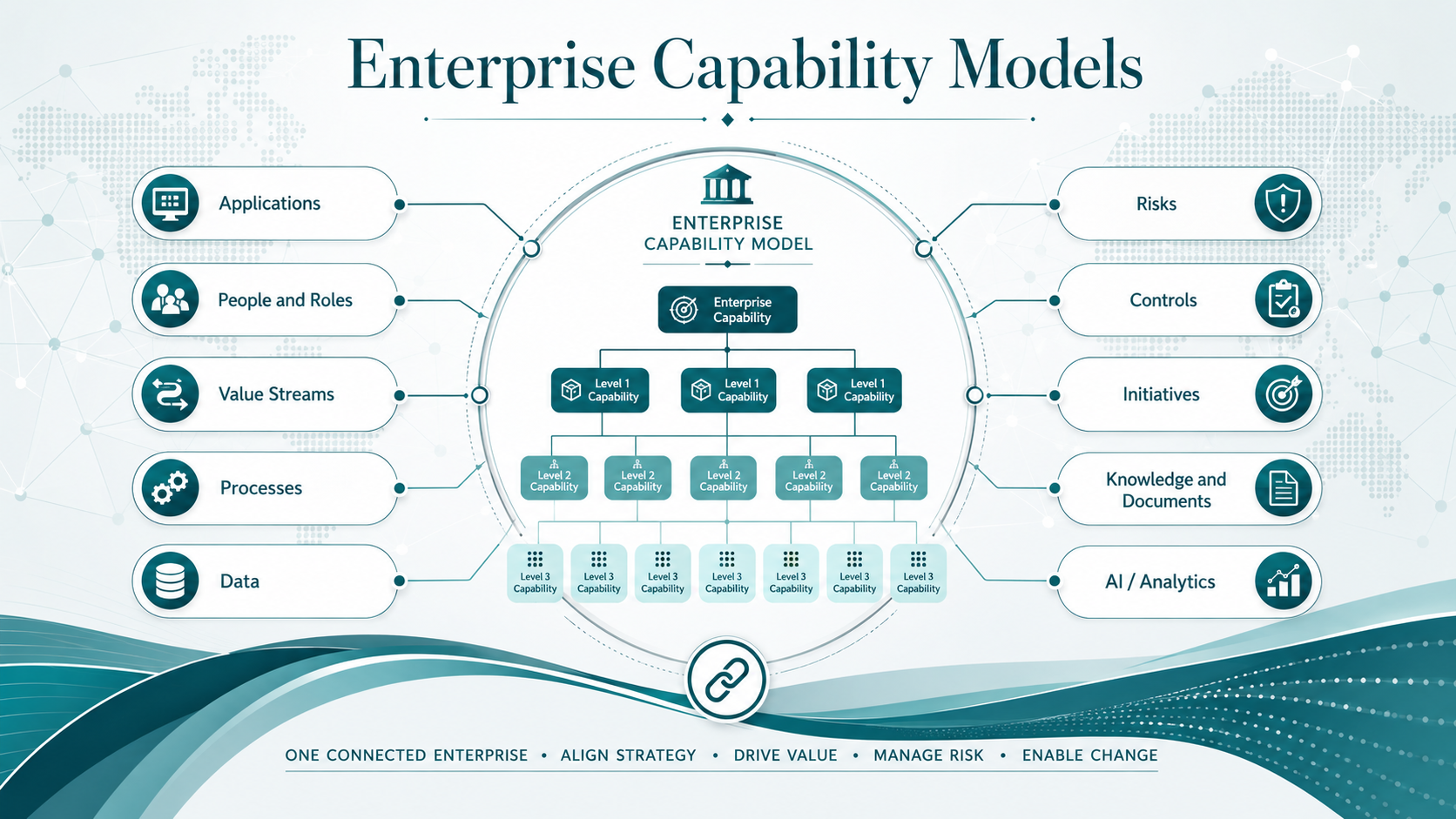
A capability is not realized by a name in a hierarchy. It is realized through a combination of people, roles, processes, applications, data, technologies, vendors, policies, controls, metrics, funding, and operating practices. The Enterprise Capability Model (ECM) should help stakeholders understand these realization dimensions.
Best Practice: Represent How Capabilities Are Realized
Description
Each significant capability should be explainable in terms of how it is realized. The model should identify or link to the people and roles involved, the processes that perform the work, the applications and technologies that enable the work, the data and information needed, the vendors or suppliers that support delivery, and the governance mechanisms that guide or constrain the capability.
Realization modeling should be fit for purpose. Some capabilities require only lightweight realization detail. Others, especially strategic, regulated, risky, or transformation-critical capabilities, may require deeper realization views.
Benefit(s)
Representing realization dimensions helps stakeholders understand what it takes to perform, sustain, improve, automate, outsource, insource, modernize, or retire a capability. It also provides the context needed for meaningful maturity and health assessments.
Implementation Guidance
Use a consistent realization model so that teams examine each capability through comparable dimensions. The following dimensions are a practical starting point.
Best Practice: Use Realization Relationships for Analysis
Description
Realization relationships should be used to analyze capability support, maturity, health, risk, cost, investment, and improvement needs. A weak capability may not be weak because the capability is poorly defined. It may be weak because it lacks the right applications, has outdated processes, depends on fragile data, lacks clear ownership, carries high regulatory exposure, or is constrained by obsolete technology.
The model should therefore help users distinguish between capability weakness and realization weakness. This distinction is important because the right remediation depends on what part of the realization stack is failing or underdeveloped.
Benefit(s)
Using realization relationships for analysis makes capability improvement more actionable. Instead of saying that a capability is immature or unhealthy, the enterprise can identify whether the problem is organizational, procedural, application-related, data-related, technology-related, vendor-related, control-related, funding-related, or measurement-related.
This practice also supports more precise investment planning. Different realization gaps require different work: process redesign, application modernization, data remediation, role clarification, vendor change, control strengthening, automation, or organizational redesign.
| Realization Dimension | What It Captures | ||
|---|---|---|---|
| Relationship Type | Example Question It Helps Answer | ||
| Attribute Group | Purpose | Example Attributes | |
| People and Roles | Owners, performers, stewards, skills, responsibilities, and decision rights. | ||
| Processes and Workflows | How the capability is operationalized through repeatable work. | ||
| Applications and Technology | Systems, platforms, automation, infrastructure, and technical enablers. | ||
| Data and Information | Inputs, outputs, records, reference data, analytics, and sensitivity. | ||
| Vendors and Contracts | External parties, service providers, contractual obligations, and supplier dependencies. | ||
| Governance and Controls | Policies, standards, procedures, controls, regulations, and review mechanisms. | ||
| Metrics and Performance | Measures, KPIs, service levels, and target performance expectations. | ||
| Capability to Application | Which applications enable this capability? | ||
| Capability to Value Chain Stage | Which stages of value delivery depend on this capability? | ||
| Capability to Organization | Who owns, funds, performs, or stewards this capability? | ||
| Capability to Process | Which processes operationalize this capability? | ||
| Capability to Data | What information does this capability consume or produce? | ||
| Capability to Risk and Control | What risks affect this capability and what controls protect it? | ||
| Capability to Initiative | Which programs, projects, or epics improve this capability? | ||
| Descriptive | Define what the capability is and where it sits in the hierarchy. | Display Name; Description; Parent Capability; Capability Level; Alias Names | |
| Ownership and Governance | Establish accountability and review responsibility. | Business Owner; Capability Steward; Governing Body; Review Cadence | |
| Strategic | Show business importance and investment relevance. | Strategic Alignment; Business Importance; Investment Priority; Investment Tier | |
| Assessment and Health | Show maturity, gaps, quality, and improvement needs. | Assessed Maturity; Target Maturity; Gap Status; Capability Health Score | |
| Relationship | Connect the capability to the rest of the Enterprise Model. | Supported Applications; Value Chain Stages; Processes; Data; Risks; Controls | |
How to cite this page
When referencing this page in academic work, internal standards, or external publications, include the page title, IF4IT as author and publisher (The International Foundation for Information Technology (IF4IT), LLC), the URL, and your access date.
Example (informal web citation):
The International Foundation for Information Technology (IF4IT), LLC. Model Capability Realization Across People, Process, Technology, Data, and Governance | Designing, Building, and Maintaining Comprehensive and Usable Enterprise Capability Models. https://if4it.org/best-practices/designing-building-and-maintaining-comprehensive-and-usable-enterprise-capability-models/model-capability-realization-across-people-process-technology-data-and-governance/ (accessed 2026-08-12).
See About Us for content governance and site-wide citation guidance.
Copyright for The International Foundation for Information Technology (IF4IT), LLC: 2008 - Present
Legal Disclaimers