Overview - Designing, Building, and Maintaining Comprehensive and Usable Enterprise Capability Models
Overview
(Chapter 1 of Designing, Building, and Maintaining Comprehensive and Usable Enterprise Capability Models)
Executive Summary: Chapter Overview
IF4ITThe Bottom Line
Core Concepts
| Concept | Definition & Strategic Role |
|---|---|
| Enterprise Capability Model | A governed representation of what the enterprise must be able to do, expressed through hierarchy, attributes, ownership, assessments, relationships, and publication views. |
| Capability Knowledge Asset | A capability model becomes operationally useful when each node is backed by a durable inventory record and connected enterprise context rather than existing only as a diagram. |
| Enterprise Knowledge Backbone | The capability taxonomy can organize navigation, documents, search, expertise, dashboards, and AI retrieval across the enterprise. |
Quick Q&A
Question: What distinguishes an Enterprise Capability Model from a static capability map?
Read More Below
What is an Enterprise Capability Model?
An Enterprise Capability Model (ECM) is a structured representation of what an enterprise must be able to do to achieve its mission, execute its strategy, operate effectively, and deliver value to its stakeholders. It organizes enterprise capabilities into a logical hierarchy, usually beginning with broad capability domains and decomposing them into more specific branch and leaf capabilities. Unlike process models, organization charts, application portfolios, or technology inventories, an Enterprise Capability Model focuses on stable business and operational abilities, not on how work is currently performed, who performs it, or which systems support it.
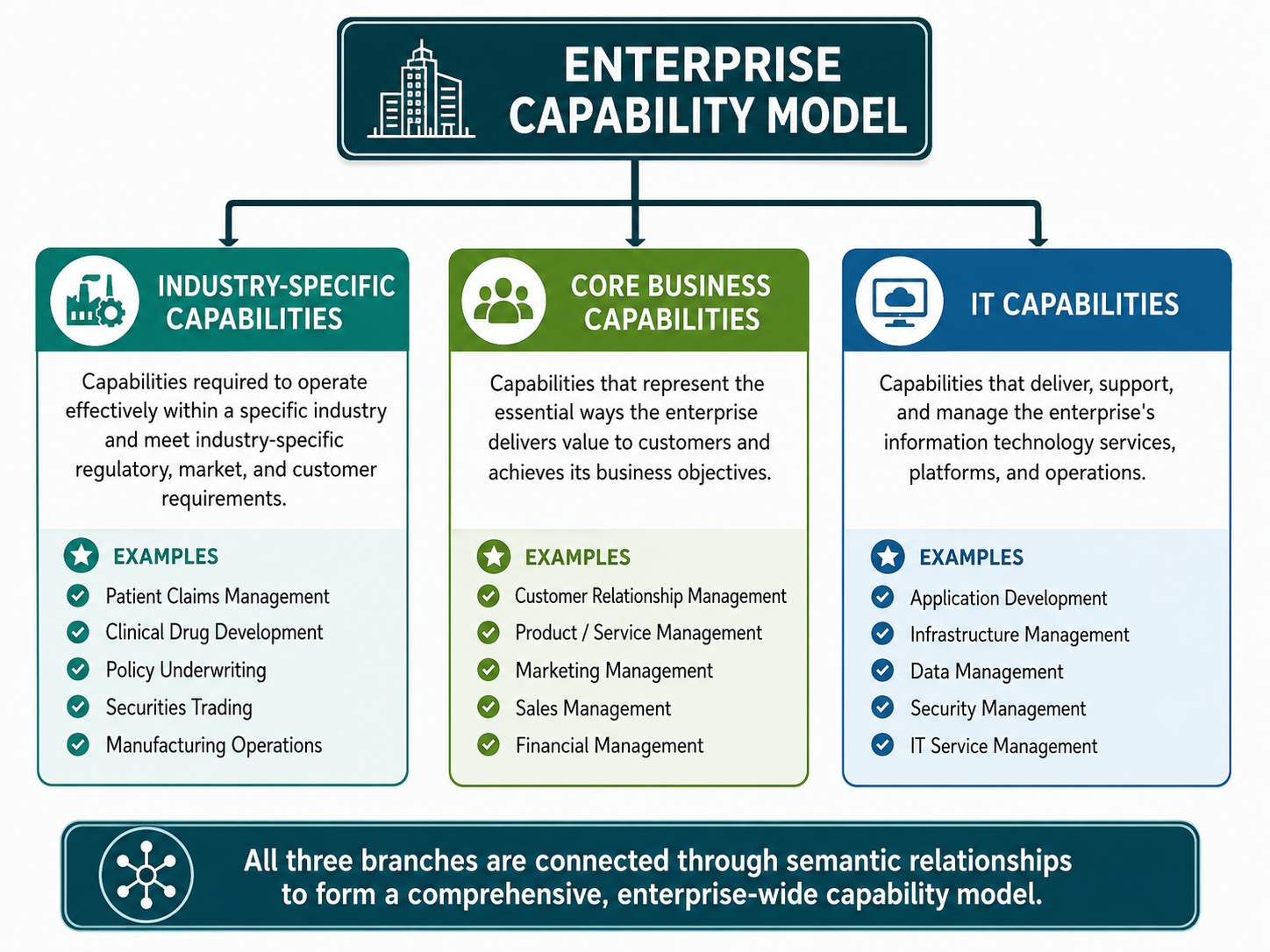
A well-designed Enterprise Capability Model becomes more than a static hierarchy. It becomes a powerful tool for Enterprise Knowledge Management (EKM), which is the enterprise-level discipline of organizing, governing, sharing, finding, reusing, and improving knowledge across business, technology, operational, governance, and decision-making contexts. When each capability is treated as a governed inventory record with a durable Semantic ID, ownership, attributes, assessments, and relationships to other Enterprise Model Noun Types, including but not limited to Applications, Data, Processes, Risks, Controls, Documents, Initiatives, Workers, Organizations, and Knowledge Assets, the model becomes a reusable enterprise management structure. It helps leaders and practitioners understand what the enterprise does, where investments are needed, which capabilities are healthy or weak, how changes may affect the enterprise, and how knowledge, governance, planning, and execution can be aligned around a common capability-based view.
Why would an enterprise want or need an Enterprise Capability Model?
Enterprises need Enterprise Capability Models (ECMs) because they provide a stable, business-centered view of what the enterprise must be able to do, independent of current processes, organizational structures, applications, technologies, and projects. This stable view gives leaders, architects, planners, product owners, knowledge managers, and governance teams a common way to understand enterprise scope, identify gaps, assess maturity, prioritize investments, manage risk, and align execution to strategy.
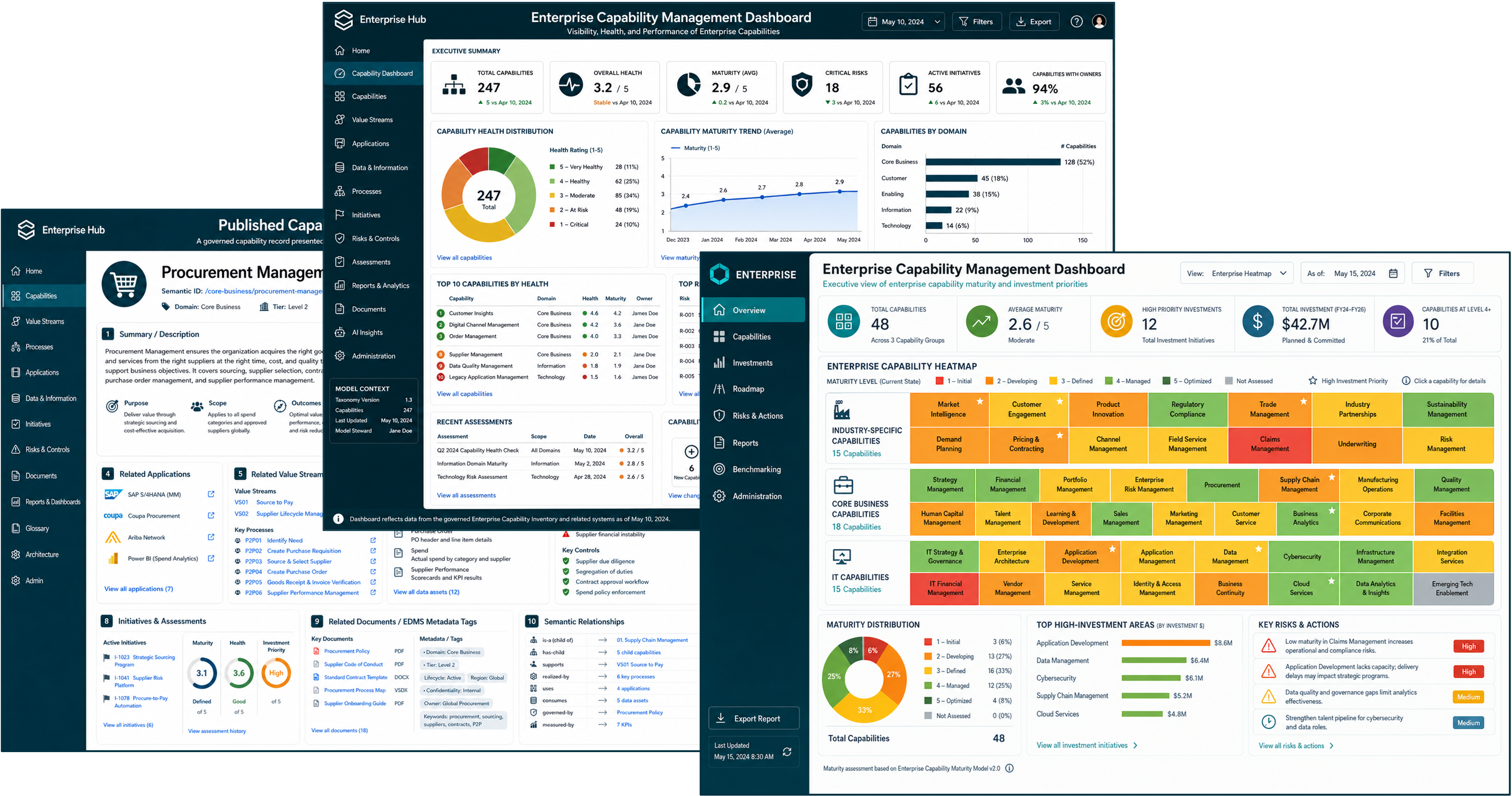
Without an ECM, enterprise knowledge is often fragmented and uncoordinated across process maps, application inventories, org charts, project portfolios, document repositories, dashboards, and subject matter experts. An ECM creates a unifying knowledge structure that connects these assets through governed capabilities, durable Semantic IDs, ownership, attributes, assessments, and relationships. As a result, the enterprise can answer practical questions about what capabilities exist, who owns them, how healthy they are, what systems support them, what risks affect them, what documents describe them, what initiatives improve them, and where leaders should focus attention.
Purpose of This Document
This document provides best practices for designing, building, maintaining, governing, publishing, assessing, and continuously improving Enterprise Capability Models (ECMs). It is intended to help practitioners move beyond static capability maps and build ECMs that can be used for enterprise strategy, architecture, planning, portfolio management, governance, operations, knowledge management, and AI-assisted analysis.
Relationship to the IF4IT Capabilities Inventory and Attributes Document
This document is a companion to the IF4IT Capabilities Inventory and Attributes document. The inventory document defines the suggested structure and attributes for governing capability records. This best-practices document explains how to design, build, operate, maintain, publish, and improve the ECM that those records form.
The Capabilities Inventory is the governed data foundation of the ECM. Every unique branch or leaf capability in the model should correspond to exactly one governed Capability Inventory record. Each record can carry attributes such as Semantic ID, hierarchy, description, ownership, lifecycle status, governance, maturity, health, strategic disposition, relationships, provenance, and audit information.
Intended Audience
The intended audiences for this document are stakeholders who have a role in the design, construction, population, governance, continuous improvement, or use of Enterprise Capability Models. This includes both human stakeholders and AI agents that use governed capability data, relationships, and knowledge assets.
| Audience | Why They Care |
|---|---|
| Executive Leadership | Needs visibility into enterprise abilities, capability health, strategic gaps, investment priorities, and target-state needs. |
| Strategy Leaders | Need to connect enterprise goals to the capabilities required to achieve them. |
| Enterprise Architects | Need a stable business anchor for connecting applications, technologies, data, value chains, organizations, initiatives, and risks. |
| Business Architects | Need to design capability structures, value-chain relationships, business views, and operating model views. |
| Knowledge Management Professionals | Using the ECM as a governed taxonomy, metadata framework, semantic navigation structure, intranet backbone, EDMS classification scheme, expertise-discovery aid, and AI-ready enterprise knowledge graph. |
| APM and TPM Teams | Need capability context for application and technology portfolio decisions, modernization, rationalization, and investment planning. |
| Portfolio, Program, and Transformation Leaders | Need to align initiatives, roadmaps, funding, and transformation work to capability improvement. |
| Business Capability Owners | Need to own maturity, health, performance, strategic disposition, and improvement of capability areas. |
| Operations and Support Teams | Need to understand dependencies, support impact, service continuity, and capability enablement. |
| Risk, Compliance, Audit, and Security Teams | Need to map risks, controls, obligations, and regulated activity to capability areas. |
| Employees and Consultants | Need a practical way to learn what the enterprise does and how capabilities relate to applications, value chains, owners, processes, and knowledge assets. |
| AI Agents and AI Runtime Users | Need governed capability data and relationships to search, traverse, summarize, explain, assess, and recommend improvements. |
How to Read This Document
The document is organized into IF4IT subsections and parts. Context-oriented parts introduce the purpose, vocabulary, and conceptual foundation. Guidance-oriented parts contain explicitly labeled Best Practice sections. Each best practice includes a Description and Benefit(s) section, with additional guidance included when useful.
How to cite this page
When referencing this page in academic work, internal standards, or external publications, include the page title, IF4IT as author and publisher (The International Foundation for Information Technology (IF4IT), LLC), the URL, and your access date.
Example (informal web citation):
The International Foundation for Information Technology (IF4IT), LLC. Designing, Building, and Maintaining Comprehensive and Usable Enterprise Capability Models. https://if4it.org/best-practices/designing-building-and-maintaining-comprehensive-and-usable-enterprise-capability-models/overview/ (accessed 2026-10-06).
See About Us for content governance and site-wide citation guidance.
Copyright for The International Foundation for Information Technology (IF4IT), LLC: 2008 - Present
Legal Disclaimers