Publish Capability Knowledge Pages - Designing, Building, and Maintaining Comprehensive and Usable Enterprise Capability Models
Publish Capability Knowledge Pages
(Chapter 24 of Designing, Building, and Maintaining Comprehensive and Usable Enterprise Capability Models)
Executive Summary: Chapter Overview
IF4ITThe Bottom Line
Core Concepts
| Concept | Definition & Strategic Role |
|---|---|
| Capability Knowledge Page | A readable page presents one capability’s identity, description, ownership, assessments, relationships, documents, experts, and governance information. |
| Template-Based Publication | Reusable templates create consistent pages while allowing role-appropriate sections and views. |
| Semantic Navigation | Typed links connect users to parent, child, enabling, governing, supporting, and improvement context. |
Quick Q&A
Question: What should a capability knowledge page contain?
Read More Below
Best Practice: Generate One Knowledge Page per Capability
Description
Each governed capability record should be eligible to generate one wiki or intranet knowledge page. The page should present the capability in a human-readable form while preserving traceability to the governed inventory record and related Enterprise Model relationships.
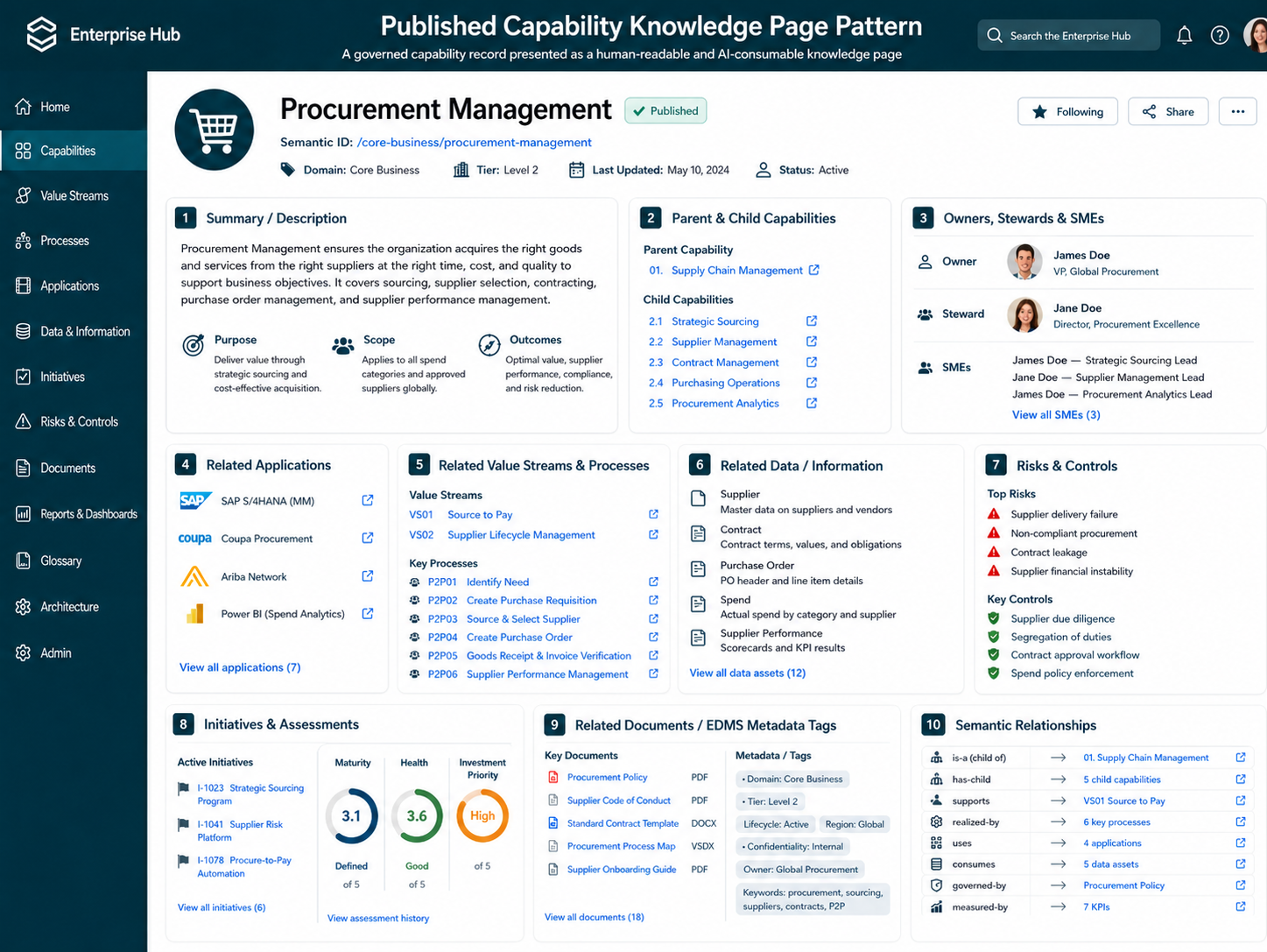
The generated page should be designed as a navigable knowledge object, not merely as a data dump. It should explain the capability, show where it sits in the hierarchy, identify ownership and stewardship, summarize health and maturity, and provide links to related enterprise objects.
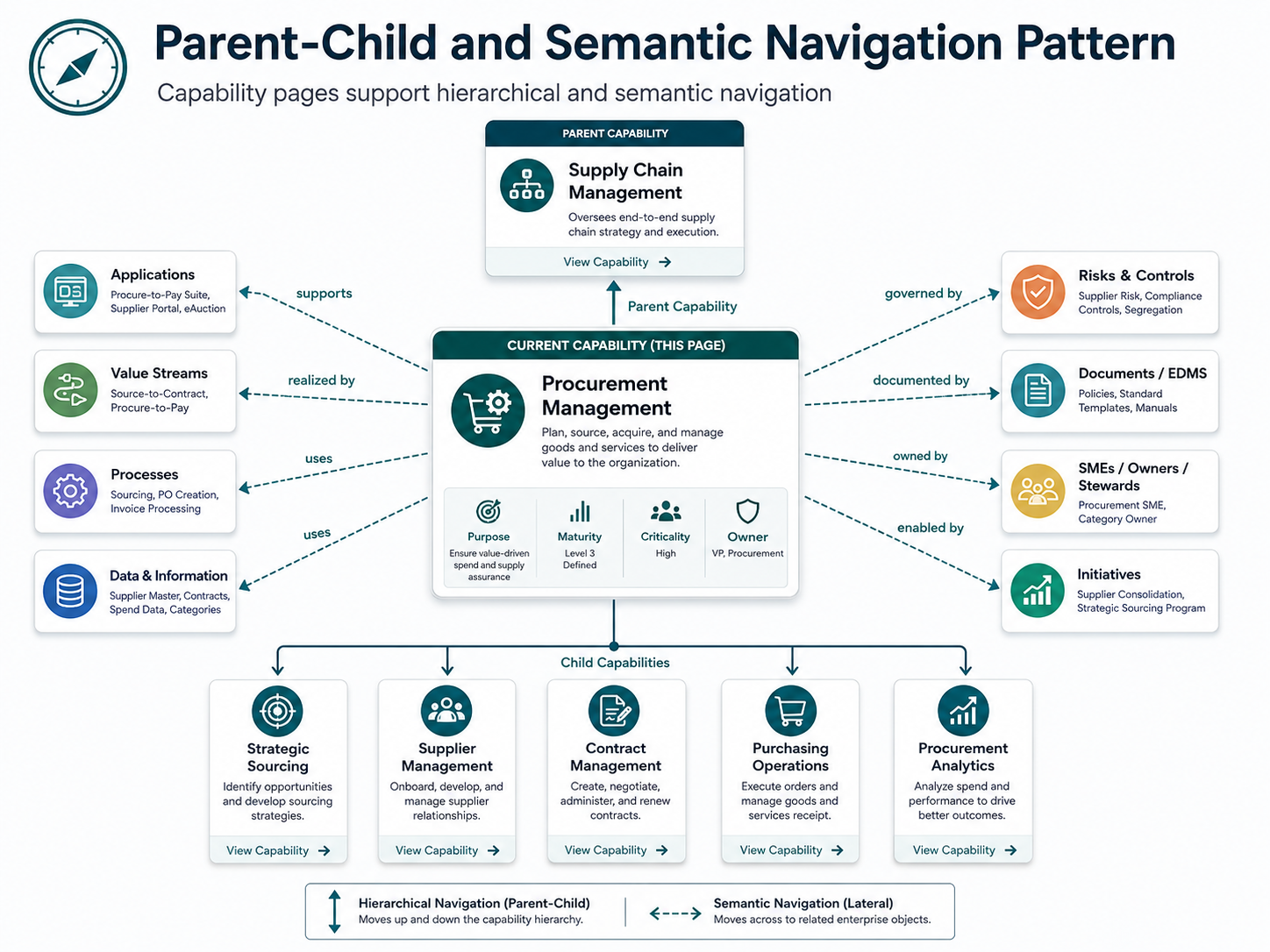
Parent capabilities should link to their child capability pages, and child capabilities should link back to their parent capability pages. This creates natural navigation patterns that allow users to move from broad enterprise abilities to more specific capability areas, and from detailed capability pages back to higher-level enterprise context.
| Knowledge Page Section | Purpose | Primary Source |
|---|---|---|
| Capability identity | Name, Semantic ID, aliases, level, and hierarchy path. | Capabilities Inventory |
| Capability explanation | Plain-language description and business meaning. | Capabilities Inventory and human-reviewed AI summary |
| Ownership and governance | Owner, steward, review status, lifecycle, and governance body. | Governance and ownership attributes |
| Assessment summary | Maturity, health, gap status, strategic importance, and investment posture. | Assessment and strategic attributes |
| Related enterprise objects | Applications, value chain stages, processes, data, risks, controls, initiatives, vendors, and organizations. | Enterprise Model relationships |
Benefit(s)
One page per capability makes the Enterprise Capability Model (ECM) accessible to a much broader audience. Users who would never open an architecture repository can still browse capability knowledge through familiar intranet or wiki patterns.
Generated pages also make the model easier to operationalize. They create a consistent publication format that can be refreshed as the underlying governed inventory and relationships change.
Best Practice: Populate Pages from Governed Inventory Attributes
Description
Capability knowledge pages should be populated from governed inventory attributes such as name, Semantic ID, description, parent capability, child capabilities, owner, steward, maturity, health, lifecycle status, strategic disposition, review status, and related entities.
Capability pages should also expose relevant Subject Matter Experts (SMEs), where appropriate. SMEs may not own or steward the capability record, but they can provide practical knowledge about how the capability works, how it is performed, which systems or processes enable it, where known issues exist, and who should be consulted for deeper operational or domain-specific understanding.
AI may help draft readable summaries or explanations, but the underlying facts should come from the governed model. AI-generated text should be traceable to source attributes and relationships and should be reviewed according to the organization’s governance expectations.
Benefit(s)
Populating pages from governed attributes keeps published content aligned to the source of truth. It reduces the risk that wiki pages drift away from authoritative model data.
It also reduces maintenance effort. Instead of manually editing hundreds or thousands of pages, the enterprise can refresh pages from current inventory records and governed relationships.
Best Practice: Link Capability Pages to Related Enterprise Pages
Description
Capability pages should link to related enterprise pages wherever possible. These links may include parent capabilities, child capabilities, sibling capabilities, Value Chain pages, Value Chain Stage pages, Application pages, Process pages, Organization pages, Data and Information pages, Risk pages, Control pages, Initiative pages, Vendor pages, and Policy or Standard pages.
The purpose is to help users navigate from a capability to the broader enterprise context that explains how that capability is owned, enabled, governed, measured, improved, and operated.
Benefit(s)
Linking pages turns the ECM into a navigable enterprise knowledge graph. Users can move from business context to technical, operational, risk, governance, and investment context without relying on informal tribal knowledge.
This practice also improves AI-assisted search and explanation. A well-linked page network gives AI agents structured pathways for summarization, impact analysis, recommendation generation, and question answering.
Best Practice: Publish Each Capability as a Semantically Linked Knowledge Page
Description
Each governed Capability Inventory record can be published as an individual intranet, wiki, or knowledge-management page. The page should include the capability’s core attributes and should also expose governed relationships to other Enterprise Model Noun Types, such as Applications, People, Roles, Organizations, Value Streams, Value Chain Stages, Processes, Data and Information Types, Risks, Controls, Initiatives, Vendors, Technologies, and other related Capabilities.
These links should not be treated as generic hyperlinks only. Where possible, each relationship should include a descriptive semantic predicate, relationship attributes, and supporting context that explains the meaning of the connection.
The following table illustrates examples of relationship predicates that can make capability pages semantically richer for human and AI consumption.
| Related Noun Type | Example Semantic Predicate | Example Meaning |
|---|---|---|
| Parent Capability | is part of | This capability belongs under a broader capability. |
| Child Capability | decomposes into | This capability is broken down into more specific capabilities. |
| Other Capability | depends on / is related to / enables | The capability has a meaningful dependency, adjacency, or enabling relationship with another capability. |
| Application | is enabled by / is automated by | The application supports, automates, or enables the capability. |
| Person / Role | is owned by / is stewarded by / has subject matter expert / is supported by | The person or role is accountable for, maintains, advises on, or provides subject-matter expertise for the capability. |
| Organization | is owned by / is performed by | The organization owns or performs the capability. |
| Value Stream | contributes to | The capability helps deliver value through the value stream. |
| Value Chain Stage | enables stage | The capability supports a specific stage of value delivery. |
| Process | is realized by | The process operationalizes the capability. |
| Data / Information Type | consumes / produces | The capability uses or creates information. |
| Risk | is exposed to | The capability is affected by a risk. |
| Control | is governed by / is protected by | The control manages, protects, or governs the capability. |
| Initiative | is improved by | The initiative changes or improves the capability. |
| Technology | is technically enabled by | The technology helps enable the capability directly or through applications. |
| Document / Knowledge Article | is documented by / is explained by | The document or article provides knowledge, guidance, evidence, or operating context for the capability. |
| EDMS Folder / Classification Node | classifies documents for / organizes documents under | The folder, virtual folder, managed term, or classification node organizes documents related to the capability. |
Benefit(s)
Publishing capability pages as semantically linked knowledge pages turns the ECM into a navigable enterprise knowledge system. It helps employees, consultants, architects, planners, support teams, owners, and leaders understand what the enterprise does, who owns each capability, who knows it deeply, what enables it, what it depends on, how healthy it is, and what related enterprise knowledge exists.
This also improves AI consumption because AI agents can traverse governed relationships, interpret relationship meaning through semantic predicates, retrieve context from related pages, and produce better summaries, recommendations, impact analyses, and answers.
Best Practice: Publish Vertical Capability Page Examples Across Capability Categories
Description
A vertical capability page view presents one governed capability record as a fully expanded intranet, wiki, or knowledge-management page. Instead of forcing the reader to interpret a wide inventory row, the page presents attributes, parent and child links, semantic relationships, SMEs, related documents, assessments, and EDMS classifications in a readable field-value structure.
The following examples show the same publication pattern applied to three different parts of the ECM: an industry-specific capability, a core business capability, and an IT capability. The values are illustrative, but the structure demonstrates how a governed Capability Inventory record can become a consumable web page.
Benefit(s)
Vertical examples make the model tangible. They help readers understand how capability attributes and relationships become publishable knowledge, how parent-child navigation works, how SMEs and owners become discoverable, how EDMS classification can be derived, and how the same page template can be generated for many capabilities across the enterprise.
Example Published Capability Page: Prior Authorization Management
This industry-specific example represents a healthcare payer / health insurance capability. It illustrates how a capability page can combine business meaning, regulatory sensitivity, operational context, applications, data, SMEs, controls, risks, initiatives, and EDMS classification.
| Capability Page Field | Example Published Value |
|---|---|
| Capability Name | Prior Authorization Management |
| Capability Category | Industry-Specific Capability |
| Industry Context | Healthcare Payer / Health Insurance. This example represents a capability common in payer organizations that evaluate authorization requests before services are delivered or reimbursed. |
| Semantic ID | CAP.HEALTHCARE.UTILIZATION-MANAGEMENT.PRIOR-AUTHORIZATION-MANAGEMENT |
| Hierarchy Identifier | 1.1.4.2 |
| Parent Capability | Utilization Management |
| Parent Capability Link | Utilization Management capability page |
| Child Capabilities | Authorization Intake; Clinical Review; Authorization Decisioning; Authorization Notification; Authorization Appeals |
| Description | The ability to receive, evaluate, decide, communicate, and manage requests for authorization of healthcare services before those services are delivered or reimbursed. |
| Enterprise Benefit | Helps control medical cost, ensure clinical appropriateness, support regulatory compliance, improve provider and member transparency, and manage utilization of healthcare services. |
| Business Owner | Vice President, Utilization Management |
| Capability Steward | Director, Prior Authorization Operations |
| Subject Matter Experts (SMEs) | Clinical Review Lead; Utilization Management Operations Manager; Prior Authorization Product Owner |
| Service Organization | Utilization Management Operations |
| Key Applications | Prior Authorization Platform; Provider Portal; Member Portal; Clinical Rules Engine; Enterprise Document Management System |
| Related Value Stream | Manage Member Care |
| Related Value Chain Stage | Review and Authorize Care |
| Key Processes | Receive Authorization Request; Validate Request; Apply Clinical Criteria; Perform Clinical Review; Communicate Decision |
| Key Input Data | Member Eligibility; Provider Information; Procedure Codes; Diagnosis Codes; Clinical Documentation; Benefit Plan Rules |
| Key Output Data | Authorization Decision; Authorization Number; Denial Reason; Appeal Rights; Notification Record |
| Regulatory Sensitivity | High |
| Related Risks | Inappropriate Denial; Delayed Care; Regulatory Noncompliance; Provider Abrasion; Member Dissatisfaction |
| Related Controls | Clinical Review Policy; Medical Necessity Criteria; Turnaround-Time Monitoring; Appeal Rights Notification |
| Assessed Maturity | Walk |
| Capability Health Score | Yellow |
| Gap Status | Moderate Gaps |
| Investment Priority | High |
| Related Initiatives | Prior Authorization Automation Program; Provider Portal Enhancement; Clinical Rules Modernization |
| Review Cadence | Quarterly |
| Lifecycle Status | Active |
Semantic Relationship Examples
| Relationship Predicate | Related Noun Type | Related Instance / Example |
|---|---|---|
| is part of | Capability | Utilization Management |
| decomposes into | Capability | Authorization Intake; Clinical Review; Authorization Decisioning |
| is enabled by | Application | Prior Authorization Platform |
| is exposed through | Application | Provider Portal |
| is realized by | Process | Apply Clinical Criteria |
| consumes | Data / Information Type | Member Eligibility; Clinical Documentation |
| produces | Data / Information Type | Authorization Decision |
| is owned by | Organization | Utilization Management Operations |
| has subject matter expert | Person / Role | Clinical Review Lead |
| is governed by | Control | Medical Necessity Criteria |
| is exposed to | Risk | Regulatory Noncompliance |
| is improved by | Initiative | Prior Authorization Automation Program |
Related EDMS / Knowledge Repository Structure
| EDMS / Knowledge Element | Example Value |
|---|---|
| EDMS Classification Node | Prior Authorization Management |
| Parent Folder / Parent Classification | Utilization Management |
| Child Folders / Child Classifications | Authorization Intake; Clinical Review; Authorization Decisioning; Authorization Notification; Authorization Appeals |
| Related Document Types | Policies; Procedures; Clinical Criteria; Training; Regulatory Evidence; Reports; Templates |
| Capability Metadata Tag | CAP.HEALTHCARE.UTILIZATION-MANAGEMENT.PRIOR-AUTHORIZATION-MANAGEMENT |
| Search Facets | Capability; Owner; SME; Application; Process; Risk; Control; Regulation |
| Related Knowledge Page | Prior Authorization Management capability page |
Example Published Capability Page: Procurement Management
This core business example represents a capability that appears in many enterprises regardless of industry. It illustrates how a shared business capability can connect suppliers, contracts, spend, applications, controls, risks, documents, and SMEs.
| Capability Page Field | Example Published Value |
|---|---|
| Capability Name | Procurement Management |
| Capability Category | Core Business Capability |
| Industry Context | Cross-enterprise. This example represents a common business capability that appears in many organizations regardless of industry. |
| Semantic ID | CAP.CORE-BUSINESS.PROCUREMENT-MANAGEMENT |
| Hierarchy Identifier | 2.4 |
| Parent Capability | Supplier and Procurement Management |
| Parent Capability Link | Supplier and Procurement Management capability page |
| Child Capabilities | Sourcing Management; Supplier Onboarding; Purchase Requisition Management; Purchase Order Management; Contract Support; Spend Analysis |
| Description | The ability to source, select, onboard, manage, and purchase goods and services from external suppliers in a controlled, cost-effective, compliant, and value-oriented manner. |
| Enterprise Benefit | Helps control spend, improve supplier performance, reduce procurement risk, standardize purchasing practices, support contract compliance, and improve operational efficiency. |
| Business Owner | Chief Procurement Officer |
| Capability Steward | Director, Procurement Operations |
| Subject Matter Experts (SMEs) | Strategic Sourcing Lead; Supplier Onboarding Manager; Procurement Systems Product Owner |
| Service Organization | Procurement Operations |
| Key Applications | Procurement Platform; ERP; Supplier Portal; Contract Lifecycle Management System; Spend Analytics Platform |
| Related Value Stream | Acquire Goods and Services |
| Related Value Chain Stage | Source, Approve, and Purchase |
| Key Processes | Identify Need; Source Supplier; Approve Requisition; Issue Purchase Order; Receive Goods or Services; Manage Supplier Performance |
| Key Input Data | Supplier Master Data; Contract Terms; Purchase Requisition; Budget Data; Approval Rules; Product or Service Catalog |
| Key Output Data | Purchase Order; Supplier Record; Contract Reference; Spend Record; Approval History; Supplier Performance Score |
| Regulatory Sensitivity | Moderate |
| Related Risks | Supplier Risk; Unauthorized Spend; Contract Noncompliance; Fraud; Supply Disruption |
| Related Controls | Segregation of Duties; Approval Workflow; Supplier Due Diligence; Contract Review; Spend Threshold Controls |
| Assessed Maturity | Walk |
| Capability Health Score | Green |
| Gap Status | Minor Gaps |
| Investment Priority | Medium |
| Related Initiatives | Procurement Workflow Automation; Supplier Data Cleansing; Contract Repository Modernization |
| Review Cadence | Semiannual |
| Lifecycle Status | Active |
Semantic Relationship Examples
| Relationship Predicate | Related Noun Type | Related Instance / Example |
|---|---|---|
| is part of | Capability | Supplier and Procurement Management |
| decomposes into | Capability | Sourcing Management; Supplier Onboarding; Purchase Order Management |
| is enabled by | Application | Procurement Platform |
| integrates with | Application | ERP |
| is realized by | Process | Approve Requisition |
| consumes | Data / Information Type | Supplier Master Data; Budget Data |
| produces | Data / Information Type | Purchase Order; Spend Record |
| is owned by | Organization | Procurement Operations |
| has subject matter expert | Person / Role | Strategic Sourcing Lead |
| is governed by | Control | Approval Workflow |
| is exposed to | Risk | Unauthorized Spend |
| is improved by | Initiative | Procurement Workflow Automation |
Related EDMS / Knowledge Repository Structure
| EDMS / Knowledge Element | Example Value |
|---|---|
| EDMS Classification Node | Procurement Management |
| Parent Folder / Parent Classification | Supplier and Procurement Management |
| Child Folders / Child Classifications | Sourcing Management; Supplier Onboarding; Purchase Order Management; Contract Support; Spend Analysis |
| Related Document Types | Policies; Procedures; Contract Templates; Supplier Due Diligence Records; Training; Spend Reports; Approval Evidence |
| Capability Metadata Tag | CAP.CORE-BUSINESS.PROCUREMENT-MANAGEMENT |
| Search Facets | Capability; Supplier; Contract; Owner; SME; Process; Risk; Control |
| Related Knowledge Page | Procurement Management capability page |
Example Published Capability Page: Identity and Access Management
This IT capability example represents a common enterprise technology management capability. It illustrates how an IT capability can be modeled and published as a first-class enterprise capability with applications, controls, risks, evidence, services, and knowledge assets.
| Capability Page Field | Example Published Value |
|---|---|
| Capability Name | Identity and Access Management |
| Capability Category | Information Technology Capability |
| Industry Context | Cross-enterprise IT. This example represents a common technology management capability needed by most enterprises. |
| Semantic ID | CAP.IT.SECURITY.IDENTITY-AND-ACCESS-MANAGEMENT |
| Hierarchy Identifier | 3.2.1 |
| Parent Capability | Cybersecurity Management |
| Parent Capability Link | Cybersecurity Management capability page |
| Child Capabilities | Identity Lifecycle Management; Access Request Management; Authentication Management; Privileged Access Management; Access Review Management; Role Management |
| Description | The ability to govern, administer, authenticate, authorize, review, and revoke digital identities and access rights across enterprise applications, platforms, infrastructure, and data environments. |
| Enterprise Benefit | Helps protect enterprise systems and data, reduce unauthorized access, support compliance, improve user onboarding and offboarding, and strengthen cyber resilience. |
| IT Owner | Director, Identity and Access Management |
| Capability Steward | IAM Service Owner |
| Subject Matter Experts (SMEs) | Identity Architect; Privileged Access Management Lead; Access Review Lead |
| Service Organization | Cybersecurity Operations |
| Key Applications | Identity Provider; Identity Governance and Administration Platform; Privileged Access Management Platform; HR System; ITSM Platform |
| Related Value Stream | Secure and Operate Technology |
| Related Value Chain Stage | Manage Digital Identity and Access |
| Key Processes | Provision Identity; Request Access; Approve Access; Authenticate User; Review Access; Revoke Access |
| Key Input Data | Worker Record; Role Definition; Access Request; Application Entitlement; Approval Policy; Separation Event |
| Key Output Data | User Account; Access Grant; Access Review Decision; Revocation Record; Audit Evidence |
| Regulatory Sensitivity | High |
| Related Risks | Unauthorized Access; Excessive Privilege; Orphaned Account; Failed Access Review; Credential Compromise |
| Related Controls | Access Approval; Segregation of Duties; Privileged Access Monitoring; Periodic Access Review; Joiner-Mover-Leaver Control |
| Assessed Maturity | Run |
| Capability Health Score | Yellow |
| Gap Status | Targeted Gaps |
| Investment Priority | High |
| Related Initiatives | IGA Modernization; Privileged Access Expansion; Role-Based Access Cleanup; Access Review Automation |
| Review Cadence | Quarterly |
| Lifecycle Status | Active |
Semantic Relationship Examples
| Relationship Predicate | Related Noun Type | Related Instance / Example |
|---|---|---|
| is part of | Capability | Cybersecurity Management |
| decomposes into | Capability | Identity Lifecycle Management; Access Review Management; Privileged Access Management |
| is enabled by | Application | Identity Provider |
| is governed through | Application | Identity Governance and Administration Platform |
| is realized by | Process | Review Access |
| consumes | Data / Information Type | Worker Record; Role Definition; Access Request |
| produces | Data / Information Type | Access Grant; Audit Evidence |
| is owned by | Organization | Cybersecurity Operations |
| has subject matter expert | Person / Role | Identity Architect |
| is governed by | Control | Periodic Access Review |
| is exposed to | Risk | Unauthorized Access |
| is improved by | Initiative | IGA Modernization |
Related EDMS / Knowledge Repository Structure
| EDMS / Knowledge Element | Example Value |
|---|---|
| EDMS Classification Node | Identity and Access Management |
| Parent Folder / Parent Classification | Cybersecurity Management |
| Child Folders / Child Classifications | Identity Lifecycle Management; Access Request Management; Privileged Access Management; Access Review Management; Role Management |
| Related Document Types | Policies; Standards; Access Review Evidence; Procedures; Role Design Documents; Audit Reports; Training |
| Capability Metadata Tag | CAP.IT.SECURITY.IDENTITY-AND-ACCESS-MANAGEMENT |
| Search Facets | Capability; Application; Control; Risk; SME; Review Cycle; Audit Period |
| Related Knowledge Page | Identity and Access Management capability page |
Best Practice: Use Capability Records to Generate Intranet and EDMS Navigation Structures
Description
Capability records can be used to generate or maintain intranet pages, wiki categories, EDMS metadata, document categories, folder structures, content hubs, navigation menus, related-content widgets, and search facets. Parent capabilities can become major navigation groupings, while child capabilities can become more specific content categories.
In an EDMS, capability-based metadata can help classify documents according to the enterprise abilities they support, govern, evidence, describe, or improve. The same metadata can support retention context, access review, search filtering, and AI-assisted retrieval.
Benefit(s)
This allows the enterprise to organize knowledge and documents around what the enterprise does rather than around transient departments, programs, applications, or project names. It improves discoverability, reuse, retention awareness, and governance alignment.
It also allows intranet, wiki, EDMS, search, and AI systems to share a common semantic backbone, which improves consistency across the enterprise knowledge ecosystem.
Best Practice: Treat Published Pages as Views, Not the Source of Truth
Description
Published wiki or intranet pages should be treated as generated views of governed model content. The authoritative source should remain the Capability Inventory, Enterprise Model repository, or governed knowledge store from which pages are generated.
Page authors and knowledge managers may enrich page content, but they should avoid creating independent facts that conflict with the governed model. Any correction to capability identity, ownership, maturity, health, relationships, or lifecycle should flow back to the source model.
Benefit(s)
Treating pages as views preserves governance, consistency, and traceability. It prevents a common failure mode where published knowledge pages become more visible than the source model but less accurate over time.
It also supports automation. When pages are generated from governed data, the enterprise can refresh content, rebuild indexes, update links, and support AI-assisted summaries with less manual maintenance.
How to cite this page
When referencing this page in academic work, internal standards, or external publications, include the page title, IF4IT as author and publisher (The International Foundation for Information Technology (IF4IT), LLC), the URL, and your access date.
Example (informal web citation):
The International Foundation for Information Technology (IF4IT), LLC. Publish Capability Knowledge Pages | Designing, Building, and Maintaining Comprehensive and Usable Enterprise Capability Models. https://if4it.org/best-practices/designing-building-and-maintaining-comprehensive-and-usable-enterprise-capability-models/publish-capability-knowledge-pages/ (accessed 2026-10-06).
See About Us for content governance and site-wide citation guidance.
Copyright for The International Foundation for Information Technology (IF4IT), LLC: 2008 - Present
Legal Disclaimers