Designing, Building, and Maintaining Comprehensive and Usable Enterprise Capability Models - Treat Every Branch and Leaf Capability as an Inventory Record
Designing, Building, and Maintaining Comprehensive and Usable Enterprise Capability Models
Chapter 12. Treat Every Branch and Leaf Capability as an Inventory Record
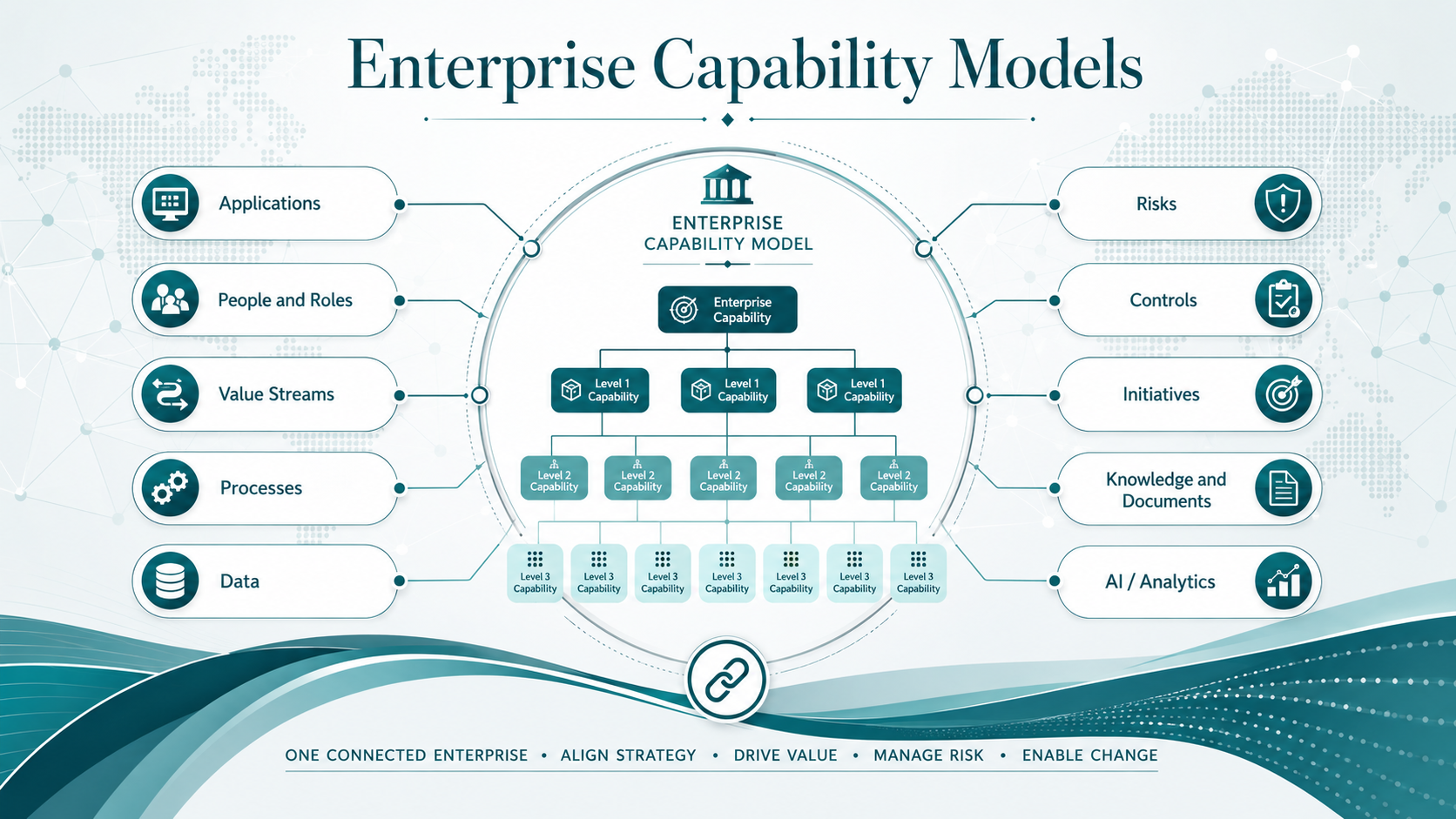
Executive Summary: Chapter Overview
IF4ITThe Bottom Line
Core Concepts
| Concept | Definition & Strategic Role |
|---|---|
| Inventory-Backed Hierarchy | Each meaningful node is represented by one governed record rather than existing only as a label in a diagram. |
| Multi-Level Governance | Branch and leaf records support different levels of ownership, assessment, planning, and publication. |
| Record Uniqueness | One capability should resolve to one authoritative record even when it appears in multiple views or maps. |
Quick Q&A
Question: What is the relationship between a capability node and the Capabilities Inventory?
Read More Below
Best Practice: Maintain a One-to-One Relationship Between Capability Nodes and Inventory Records
Description
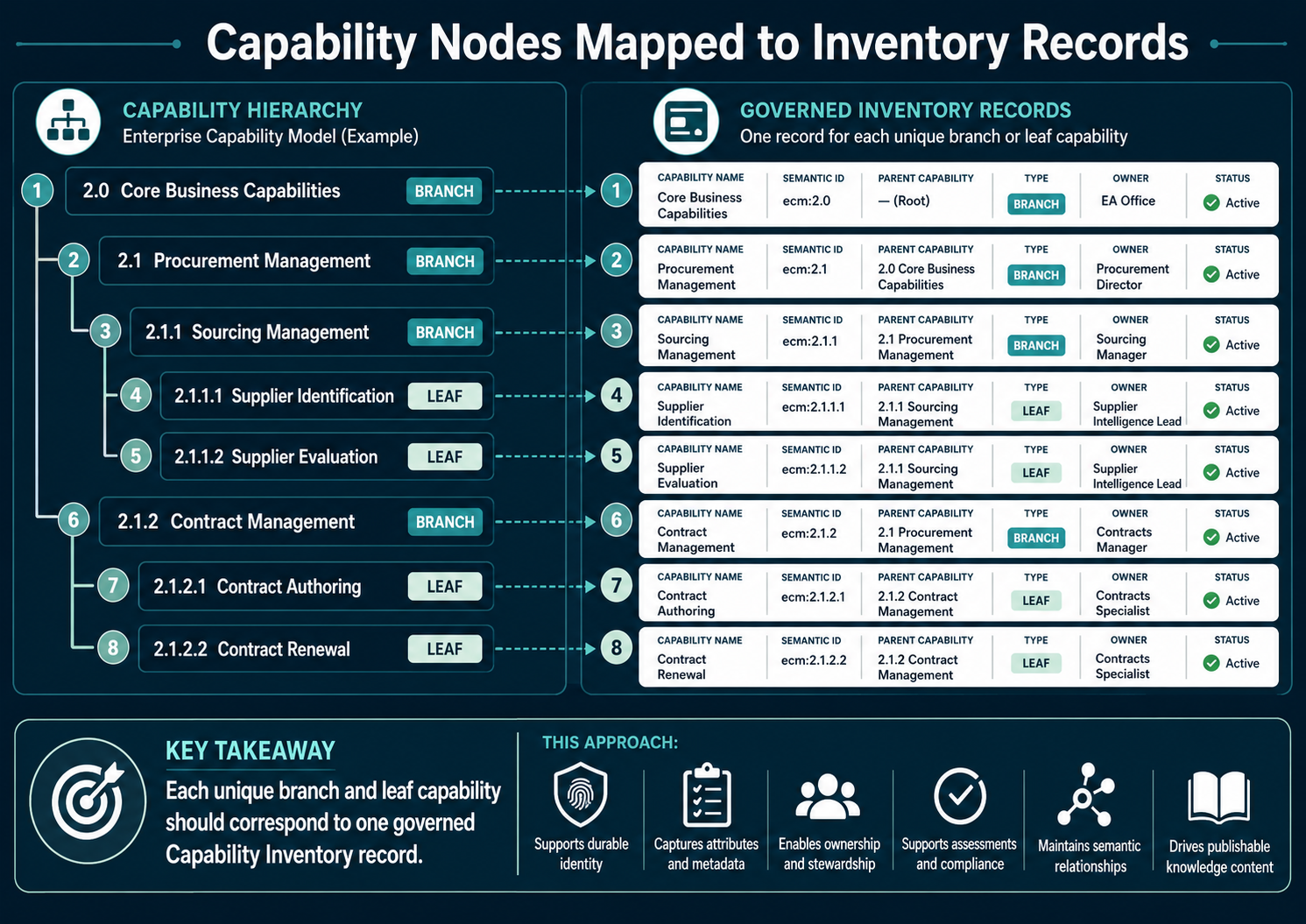
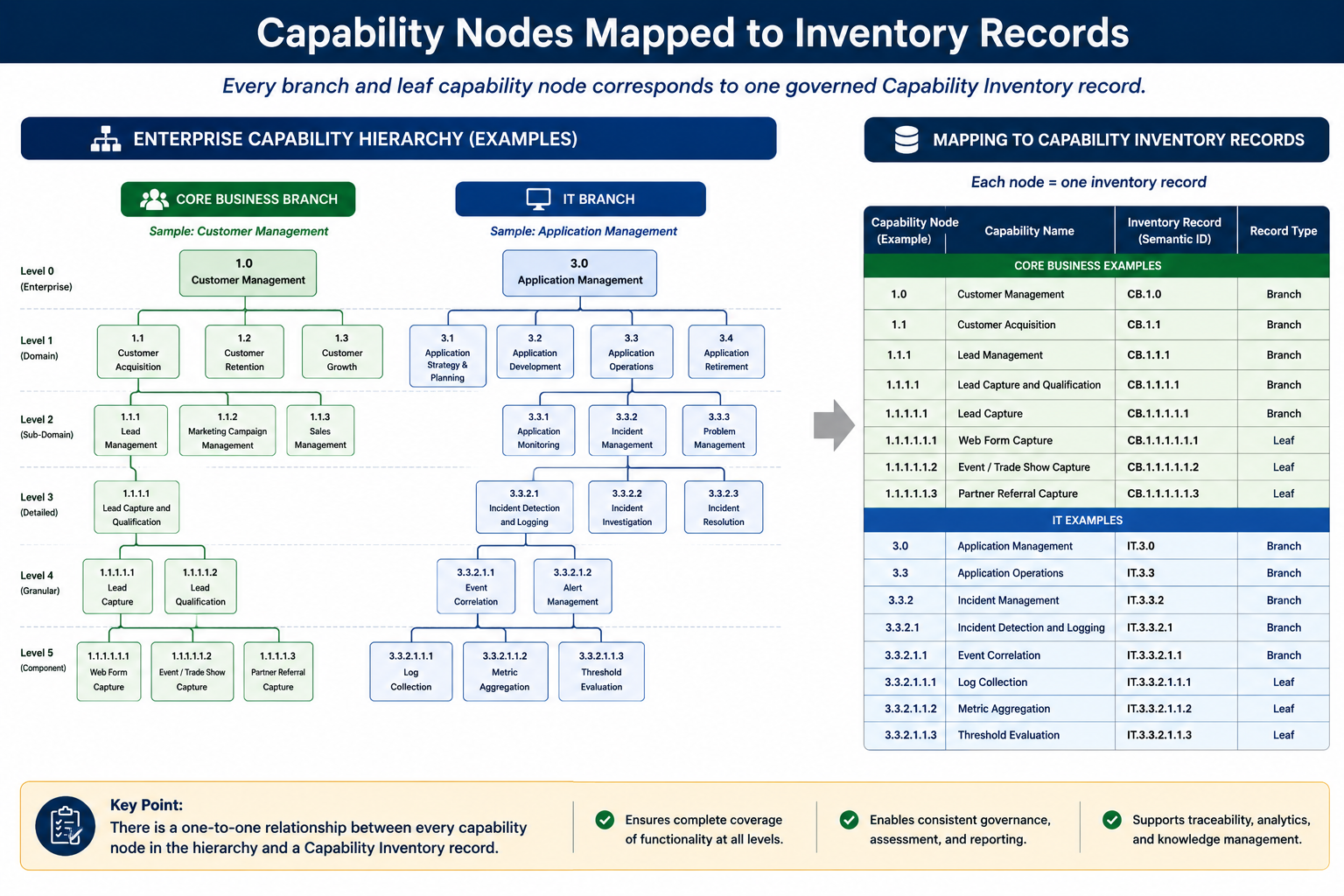
Every unique branch or leaf capability in the model should correspond to one and only one record in the Capabilities Inventory. The hierarchy should not contain unmanaged labels that do not exist as governed inventory records. Likewise, the inventory should not contain active capability records that cannot be located in the model hierarchy unless they are intentionally marked as proposed, deprecated, archived, or otherwise out of normal use.
Benefit(s)
A one-to-one relationship between capability nodes and inventory records makes the model governable, assessable, publishable, and traceable. It ensures that every visible capability can be described, owned, assessed, linked, reviewed, and improved.
This also enables reliable automation. Generated knowledge pages, dashboards, heatmaps, relationship maps, model exports, and AI-assisted summaries can all be produced from governed records instead of manually maintained diagrams.
Best Practice: Treat the Capability Inventory as the Enterprise Capability Model Foundation
Description
The Capability Inventory should be treated as the foundation of the Enterprise Capability Model (ECM). The hierarchy is a view of that inventory. Diagrams, maps, pages, reports, heatmaps, dashboards, and AI query responses should be generated from or traceable back to governed inventory records.
This practice shifts the model from a drawing-centered artifact to a data-centered governance asset. The visual map remains valuable, but the governed record is the source of truth.
Benefit(s)
Treating the inventory as the foundation prevents the model from becoming a disconnected diagram. It ensures that capability names, descriptions, identifiers, owners, assessments, relationships, and statuses can be maintained consistently across every view.
This also makes the model easier to integrate with the broader Enterprise Model. Applications, value chains, processes, data, risks, controls, initiatives, vendors, and regulatory obligations can reference durable capability records rather than ambiguous map labels.
Best Practice: Avoid Duplicate Capability Records
Description
Duplicate capability records should be actively prevented and remediated. Duplication often occurs when different teams use different terminology for the same enterprise ability, when industry terminology differs from internal language, or when AI generates overlapping candidate capabilities.
Modelers should manage duplicates through aliases, alternate names, clear definitions, Semantic IDs, stewardship review, and governance forums. When two records appear similar, the governance question should be whether they represent the same ability, two distinct abilities, or one broad capability and one narrower child capability.
Benefit(s)
Avoiding duplicate records improves clarity, search quality, relationship accuracy, reporting, and AI traversal. It prevents applications, risks, initiatives, and assessments from being split across multiple records that actually describe the same enterprise ability.
It also improves stakeholder trust. A model that contains duplicates quickly creates confusion about ownership, scope, maturity, investment, and accountability.
How to cite this page
When referencing this page in academic work, internal standards, or external publications, include the page title, IF4IT as author and publisher (The International Foundation for Information Technology (IF4IT), LLC), the URL, and your access date.
Example (informal web citation):
The International Foundation for Information Technology (IF4IT), LLC. Treat Every Branch and Leaf Capability as an Inventory Record | Designing, Building, and Maintaining Comprehensive and Usable Enterprise Capability Models. https://if4it.org/best-practices/designing-building-and-maintaining-comprehensive-and-usable-enterprise-capability-models/treat-every-branch-and-leaf-capability-as-an-inventory-record/ (accessed 2026-08-06).
See About Us for content governance and site-wide citation guidance.
Copyright for The International Foundation for Information Technology (IF4IT), LLC: 2008 - Present
Legal Disclaimers