Use AI to Accelerate Enterprise Capability Model Creation - Designing, Building, and Maintaining Comprehensive and Usable Enterprise Capability Models
Use AI to Accelerate Enterprise Capability Model Creation
(Chapter 7 of Designing, Building, and Maintaining Comprehensive and Usable Enterprise Capability Models)
Executive Summary: Chapter Overview
IF4ITThe Bottom Line
Core Concepts
| Concept | Definition & Strategic Role |
|---|---|
| Industry-Informed Starting Model | AI can synthesize public industry, regulatory, business-function, and technology-management knowledge into a structured first draft. |
| Human-in-the-Loop Governance | Reviewers must correct, merge, split, rename, reposition, approve, or reject generated content. |
| AI Provenance | Generation sources, dates, models, prompts, reviewers, validation states, and approval history support transparency and trust. |
Quick Q&A
Question: How should an enterprise use AI-generated capability content?
Read More Below
Best Practice: Use AI to Generate an Industry-Informed Starting Model
Description
AI can help generate an initial Enterprise Capability Model (ECM) by analyzing public knowledge about an enterprise’s industry, standard business functions, technology management disciplines, regulatory context, and common operating patterns. The goal is not to let AI define the final model. The goal is to create a credible, structured, industry-informed first draft that humans can review, adapt, and govern.
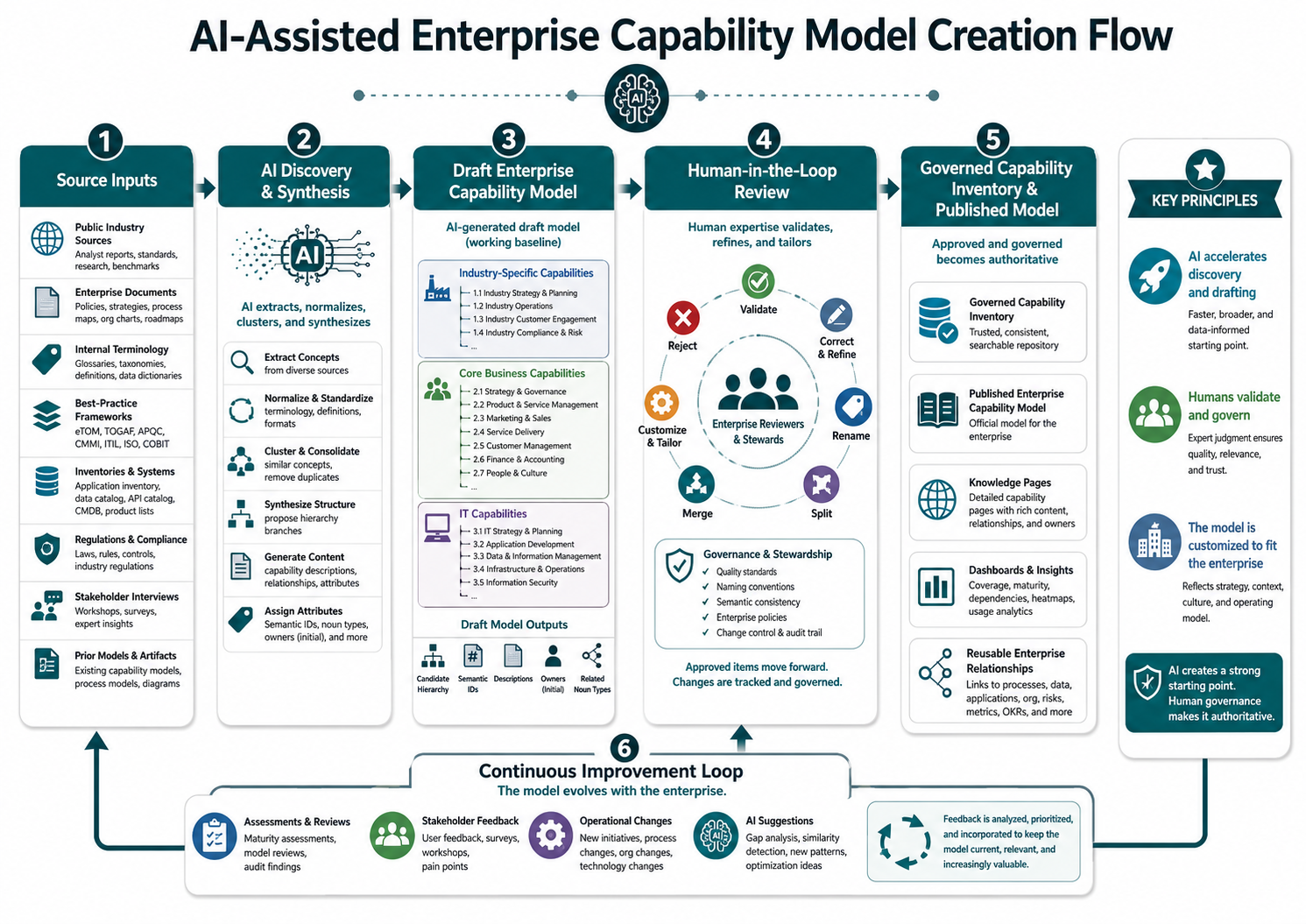
A useful AI-generated starting model should include industry-specific capabilities, core business capabilities, and Information Technology capabilities. It should also include candidate hierarchy levels, suggested parent-child relationships, draft capability descriptions, aliases, and candidate relationships to other enterprise Noun Types. The result should be broad enough to support review and refinement, but structured enough to be loaded into a Capabilities Inventory rather than remaining a narrative list.
Benefit(s)
Using AI to generate the starting model reduces blank-page effort, accelerates early discovery, lowers consulting and modeling costs, and helps the enterprise avoid depending only on the knowledge of workshop participants. It also helps surface capabilities that may be missed when teams focus only on current organization charts, current systems, current processes, or current initiatives.
Implementation Guidance
Start by giving the AI a clear description of the enterprise, industry, operating scope, geography, business lines, major products or services, and modeling purpose. Ask the AI to generate a Level 0 through Level 4 capability structure with descriptions, aliases, and rationale for each major branch. Then ask for the output in a structured format that can become inventory records, such as a table with Semantic ID candidate, hierarchy level, parent capability, display name, description, business classification, and validation status.
Best Practice: Use Public Sources as Discovery Inputs
Description
AI-assisted Capability Modeling should use public sources as discovery inputs wherever possible. Useful sources can include industry frameworks, standards, regulatory publications, public company descriptions, government material, analyst language, vendor product category descriptions, professional association content, consulting articles, and public domain business-function references. These sources help the AI build a broader starting point than a single internal team would usually produce unaided.
Public sources should be treated as discovery material, not as binding authority. They can help identify candidate capabilities, common names, industry-specific vocabulary, regulatory concepts, operating domains, and technology management patterns. However, the enterprise must still decide what belongs in its own governed model.
Benefit(s)
Using public sources improves coverage, breadth, and industry relevance. It also creates a more neutral initial model because the first draft is not solely shaped by internal politics, inherited organization structures, or current application boundaries. This can make later review sessions more productive because participants react to a prepared model instead of inventing the model from scratch.
Implementation Guidance
Maintain a lightweight source log for public material used in model generation. The source log does not need to overburden the first draft, but it should be sufficient to explain where major concepts came from. When AI proposes a capability based on public material, capture that provenance in the capability record or in a related modeling log so reviewers can distinguish public-source suggestions from internally validated decisions.
Best Practice: Treat AI Output as a Starting Point, Not Authoritative Truth
Description
AI-generated capability content should always be treated as candidate content. AI can suggest useful names, hierarchies, descriptions, relationships, and attributes, but it does not know the enterprise’s full strategy, governance obligations, operating model, internal terminology, political constraints, systems landscape, or accountability structure. Human review is required before AI-generated content becomes authoritative.
Model teams should establish clear statuses for AI-generated records, such as Generated, Under Review, Validated, Rejected, Merged, or Approved. These statuses help separate AI-seeded content from governed content and make it clear which records can be used for reporting, planning, analysis, generated pages, or AI runtime traversal.
Benefit(s)
This practice allows the enterprise to gain speed from AI without sacrificing accountability, trust, or accuracy. It also prevents AI-generated mistakes from spreading into application mappings, value chain mappings, investment decisions, knowledge pages, dashboards, and governance workflows.
Implementation Guidance
Require human validation before using AI-generated records for official reporting or decision-making. Review should focus on whether the capability name is clear, the capability belongs in the model, the parent-child placement is appropriate, the description is accurate, the level of decomposition is useful, and any generated attributes or relationships are credible. Reject, merge, rename, or reposition records as needed.
Best Practice: Use AI to Create a Thorough Initial Model, Then Vet It Through Human-in-the-Loop Governance
Description
AI can generate a thorough initial ECM, including a draft hierarchy, capability names, descriptions, Semantic IDs, candidate attributes, aliases, and suggested relationships to other Enterprise Model Noun Types. However, AI-generated model content should be treated as a draft until Human-in-the-Loop reviewers have examined it, corrected it, validated it, and approved it for governed use.
Human review should confirm that the generated model reflects enterprise reality, enterprise terminology, regulatory and jurisdictional needs, operating model needs, stakeholder expectations, and intended governance practices. AI can accelerate creation, but it should not decide what becomes authoritative for the enterprise.
Benefit(s)
This practice allows the enterprise to gain speed and breadth from AI while preserving accountability, trust, and governance. It prevents AI-generated errors, misleading terminology, hallucinated relationships, or inappropriate hierarchy structures from becoming embedded in application mappings, executive dashboards, knowledge pages, EDMS classifications, or AI retrieval patterns.
Implementation Guidance
Use explicit validation states for AI-generated records, such as Generated, Under Review, Validated, Approved, Rejected, Merged, or Retired. Assign reviewers by domain, require approval for promotion into the governed model, and maintain enough provenance to explain who reviewed the content and what changes were made.
Best Practice: Customize the AI-Generated Model to Fit the Enterprise
Description
Once AI has generated the bulk of the initial ECM and the model has been vetted, the model owner or model controller should tailor the model to fit the enterprise. Customization may include renaming capabilities, merging duplicates, splitting broad capabilities, adding industry-specific capabilities, simplifying overly deep branches, extending complex regulated areas, aligning terminology to enterprise vocabulary, and improving attributes or relationships over time.
Customization should be treated as governed improvement, not as an ad hoc editing exercise. The model should evolve to reflect the enterprise’s industry, operating model, maturity, geography, regulatory exposure, strategic priorities, and knowledge-management needs.
Benefit(s)
This practice prevents the AI-generated model from becoming either too generic or too rigid. It keeps the ECM practical, enterprise-specific, explainable, and useful for architecture, portfolio management, Knowledge Management, EDMS classification, executive dashboards, and AI-assisted retrieval.
Implementation Guidance
Maintain a governed backlog of model refinements. Route major structural changes through the model owner or governance body, while allowing stewards and SMEs to suggest corrections, aliases, descriptions, relationships, and knowledge-page improvements within their areas of expertise.
Best Practice: Capture AI Provenance
Description
AI-assisted modeling should capture enough provenance to explain how model content was produced and how it was validated. Provenance may include the date generated, AI tool or model used, prompt or generation method, source materials, reviewer, review date, validation status, approval status, and notes about major changes made during review.
Provenance does not need to be equally detailed for every maturity stage. At Crawl maturity, basic provenance may be sufficient. At Walk and Run maturity, especially in regulated or high-risk environments, provenance should be more explicit and should connect AI-generated content to review and approval workflows.
Benefit(s)
Provenance improves transparency, auditability, maintainability, and trust. It helps future reviewers understand whether a capability was created by AI, adapted from public knowledge, validated by a human, approved by a governance body, or modified after publication. It also supports responsible use of AI in enterprise architecture and knowledge management.
Implementation Guidance
At minimum, include an AI-Generated indicator, generation date, validation status, and reviewer or steward. More mature implementations can store prompt references, source references, generation batch identifiers, approval workflow identifiers, and change history. Avoid allowing AI-generated content to enter a published or authoritative state without a visible validation trail.
How to cite this page
When referencing this page in academic work, internal standards, or external publications, include the page title, IF4IT as author and publisher (The International Foundation for Information Technology (IF4IT), LLC), the URL, and your access date.
Example (informal web citation):
The International Foundation for Information Technology (IF4IT), LLC. Use AI to Accelerate Enterprise Capability Model Creation | Designing, Building, and Maintaining Comprehensive and Usable Enterprise Capability Models. https://if4it.org/best-practices/designing-building-and-maintaining-comprehensive-and-usable-enterprise-capability-models/use-ai-to-accelerate-enterprise-capability-model-creation/ (accessed 2026-10-05).
See About Us for content governance and site-wide citation guidance.
Copyright for The International Foundation for Information Technology (IF4IT), LLC: 2008 - Present
Legal Disclaimers